

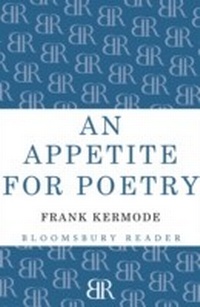
An Appetite for Poetry
1st Edition
Published on 23. May 2013
227 pages
978-1-4482-1129-6 (ISBN)
Description

Frank Kermode is one of the pre-eminent practitioners of the art of criticism in the English speaking world. It has been his distinction to make a virtue - as all the best critics have done - of the necessarily occasional nature of his profession. That virtue is evident on every page of this collection of essays.
In one group of essays he asks the reader to share his pleasure in a number of major writers - Milton, T.S. Eliot, Wallace Stevens. In another, he discusses ideas about problems in biblical criticism and their implications for the study of narrative in particular and the interpretation of secular literary texts in general. In them he gives clear accounts of questions relating to interpretation and the debate about canons.
A key essay looks at the career of William Empson, a career lived between literature and criticism, between the pleasure of the text and the delight in conceptual issues which is characteristic of so much of the contemporary taste for theory. It is Empson's career, perhaps, which is the foundation for the polemical prologue to the book, where Kermode challenges those who doubt the possibility (and the necessity) of the cross-over between literature and criticism, and who argue that criticism is mere appreciation, mere connoisseurship, that theory has displaced criticism and has left literature in the dust, that theory is the avant-garde of critical thought. This piece defines the author's position in the debate about literature and value.
In one group of essays he asks the reader to share his pleasure in a number of major writers - Milton, T.S. Eliot, Wallace Stevens. In another, he discusses ideas about problems in biblical criticism and their implications for the study of narrative in particular and the interpretation of secular literary texts in general. In them he gives clear accounts of questions relating to interpretation and the debate about canons.
A key essay looks at the career of William Empson, a career lived between literature and criticism, between the pleasure of the text and the delight in conceptual issues which is characteristic of so much of the contemporary taste for theory. It is Empson's career, perhaps, which is the foundation for the polemical prologue to the book, where Kermode challenges those who doubt the possibility (and the necessity) of the cross-over between literature and criticism, and who argue that criticism is mere appreciation, mere connoisseurship, that theory has displaced criticism and has left literature in the dust, that theory is the avant-garde of critical thought. This piece defines the author's position in the debate about literature and value.
More details
Edition
1. Auflage
Language
English
Place of publication
London
United Kingdom
Publishing group
Bloomsbury Publishing PLC (Digital)
ISBN-13
978-1-4482-1129-6 (9781448211296)
Copyright in bibliographic data and cover images is held by Nielsen Book Services Limited or by the publishers or by their respective licensors: all rights reserved.
Schweitzer Classification
Person
Sir John Frank Kermode was born in November 1919. He was a British literary critic best known for his work The Sense of an Ending: Studies in the Theory of Fiction, published in 1967 and for his extensive book-reviewing and editing.
Kermode was born on the Isle of Man, and was educated at Douglas High School and Liverpool University. He served in the Royal Navy during World War II, for six years in total, much of it in Iceland.
He began his academic career as a lecturer at Durham University in 1947. He later taught at Reading University, then the University of Bristol. He was named Lord Northcliffe Professor of Modern English Literature at University College London from 1967 to 1974.
In 1974, Kermode took the position of King Edward VII Professor of English Literature at Cambridge University, resigning in 1982. He then moved to Columbia University, where he was Julian Clarence Levi Professor Emeritus in the Humanities. In 1975-76 he held the Norton Lectureship at Harvard University. He was knighted in 1991.
Kermode died in Cambridge on 17 August 2010.
Kermode was born on the Isle of Man, and was educated at Douglas High School and Liverpool University. He served in the Royal Navy during World War II, for six years in total, much of it in Iceland.
He began his academic career as a lecturer at Durham University in 1947. He later taught at Reading University, then the University of Bristol. He was named Lord Northcliffe Professor of Modern English Literature at University College London from 1967 to 1974.
In 1974, Kermode took the position of King Edward VII Professor of English Literature at Cambridge University, resigning in 1982. He then moved to Columbia University, where he was Julian Clarence Levi Professor Emeritus in the Humanities. In 1975-76 he held the Norton Lectureship at Harvard University. He was knighted in 1991.
Kermode died in Cambridge on 17 August 2010.
Content
- Cover
- Title Page
- Contents
- Prologue
- 1 The Common Reader
- 2 Milton in Old Age
- 3 Wallace Stevens: Dwelling Poetically in Connecticut
- 4 T. S. Eliot: The Last Classic
- 5 William Empson: The Critic as Genius
- 6 Freud and Interpretation
- 7 Divination
- 8 The Plain Sense of Things
- 9 The Argument about Canons
- 10 The Bible: Story and Plot
- Notes
- Imprint
