

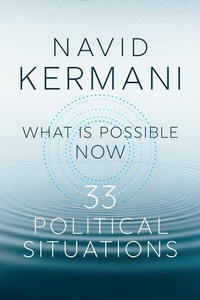
What is Possible Now
Description

Navid Kermani is one of the outstanding public intellectuals of his generation. Not one for drawing hard and fast conclusions, his style of thought is probing, observant, often straying from well-trodden paths and always peering beyond the present moment to trace connections and grasp the bigger picture.
Well known for his prize-winning novels and major works of non-fiction, Kermani has also gained widespread acclaim as a journalist, displaying a rare political sensitivity which manages to illuminate what politicians fail to see and to seek out solutions where all appears hopeless. This volume brings together his brilliantly perceptive writing from the last thirty years, on topics ranging from terror in the Middle East to Russia's invasion of Ukraine. As a record of Kermani's uniquely compassionate curiosity, this absorbing book is a welcome antidote to the confusion and despair that stalks global politics today.
More details
Other editions
Additional editions
Persons
Content
1. Islam versus Islam
The Judgement against the Egyptian Quran Scholar Nasr Hamid Abu Zayd
2. The Thousand Voices of Silence
The Situation of Artists and Intellectuals in Iran
3. Sympathy for the Satan
After the Attacks of 11 September
4. The Soft Words of Violence
After the Beginning of the War in Afghanistan
5. What Alternative?
Before the War in Iraq
6. Right Again, Sadly
The Attack on the Synagogue in Istanbul
7. Strategy of Escalation
On the Hostages in Beslan
8. Good Thing You're Educating Me...
Confusion in the Integration Debate
9. Desperation and Enthusiasm
After the French Referendum on the European Constitution
10. Hate Pictures and Hysteria
The Dispute over the Muhammad Cartoons
11. Relying Only on Strength Makes Israel Weaker
On the War in Lebanon
12. We are Murat Kurnaz
Before Foreign Minister Steinmeier's Testimony to the Bundestag Investigative Committee
13. The Message of Cologne
The Discussion on Building a Grand Mosque
14. Death on Wednesday?
The Trial of Ayatollah Boroujerdi in Tehran
15. Rejection of Europe
The Swiss Referendum on the Prohibition of Minarets
16. State Without a People
The Recent Mass Protests in Iran
17. Allianz Lecture on Europe
18. Triumph of Vulgar Rationalism
The Outcry over Martin Mosebach and the Ban on Circumcision
19. Too Late for Good Conscience
The Civil War in Syria
20. Farewell to the Middle East
The 'Islamic State's' March on Baghdad
21. Stop the 'Islamic State'!
The Threat of Genocide against Christians, Yazidis and other Ethnic Groups in Iraq
22. The European Ideal is Sinking
The Mediterranean Sea as a Mass Grave
23. At Our Children's Cost
Europe after Brexit
24. What We Can Do in This Situation
After the Attacks in Ansbach, Würzburg and Munich
25. The Weight of Two Sacks
In Search of the Last Blind Spots of Progress in China
26. The Laughter of Nasrin Sotoudeh
Iran on International Human Rights Day
27. For Three Dollars a Day
After the West's Withdrawal from Afghanistan
28. No Programme but Politics
The Chancellorship of Angela Merkel
29. Afghanistan? Already a Non-Issue
German Apathy Towards the World
30. The Price of Justice
The Disappearance of the Generic Masculine in German
31. War as a Means of Politics
After Vladimir Putin's Announcement of a Russian Troop Deployment to Donbas
32. Through the Night
Ukraine at War
33. Woman Life Freedom
The Uprising in Iran, July - December 2022
PREFACE
Newspapers are ephemeral. The oldest of the essays I had planned to include in this book, the article on Nasr Hamid Abu Zayd which appeared in the Frankfurter Rundschau in 1993, was nowhere to be found at home, not even as a file on my computer. My editor wrote to the newspaper assuming they would have the article in their electronic archives - but in vain. All right, then they must have a basement where they archive the issues of years past, the editor supposed, and they could pull up the issue with the article for a suitable moderate fee. No, they didn't, the newspaper replied. Frankfurter Rundschau, until a few years ago one of the four, five national newspapers in the German-speaking countries with an outstanding cultural section and foreign reporting that, in sheer volume, seems almost unbelievable today - doesn't even have archives any longer. Finally, an assistant at the publishers' made the trip to the state library in Munich and found on a shelf the big, dust-covered binder with every issue of Frankfurter Rundschau from 1993. On opening it to 4 September, she had the presence of mind to take photos not only of the article we were looking for but of the frontpage headlines too: 'Ukraine Relinquishes Nuclear Weapons - Accord Reached with Russia on Black Sea Fleet'. Thirty years later, in March of 2022, Ukraine was at war.
I started working for the Siegen local desk of the Westfälische Rundschau at the age of fifteen. From town council meetings to plays and rock concerts to demonstrations against the planned ring autobahn and the obligatory archery society fairs, there was nothing I would not cover. Since then I have continued to write for newspapers, more frequently in the beginning; more sporadically after my first books were published. What have I learned from the political situations that I described or analysed? If I had to pick out just one lesson, it would be this: I have learned, or, more precisely, I have experienced, seen with my own eyes, how single events that seem to be confined to one region can set off massive eruptions years later and far away. In politics, just as in nature, everything seems to be connected with everything else by chains of cause and effect whose complexity is impossible to foresee but often visible after the fact.
I remember how Afghan acquaintances told me in 1989 that it was actually Afghans who brought down the Berlin Wall. I was a student then, and their logic seemed a bit strained to me, but, when I studied the events in more detail, I soon realized that Mikhail Gorbachev's reform policies, the more immediate cause of the German unification, were causally connected with the Mujahidin's successful resistance against the Soviet Army - and hence with the Kremlin's 1979 decision to intervene militarily in Afghanistan. Another example: if the Democratic candidate Adlai Stevenson had been elected president of the United States in 1952, then the CIA would not have toppled the democratic Mosaddegh government in Tehran a year later, and there would have been no Islamic revolution in 1979 and no occupation of the American embassy - nor any of the further consequences in relations between the West and the Islamic world. And yet, during the election campaign, even Dwight D. Eisenhower probably hadn't thought much about Iran. And so on and so forth, down to the invasion of Ukraine: in 1993, that country relinquished its nuclear weapons only out of trust in the Russian promise to respect its sovereignty and its existing borders. As the report on the front page of the Frankfurter Rundschau of 4 September 1993 indicates, Ukraine also demanded guarantees of its security from the West. I don't think anyone besides specialists in international relations still remembers that demand - I at least hadn't remembered it. Maybe it wasn't even taken seriously in the Western capitals at the time. But now, thirty years later, the whole world knows how reasonable the demand was. Fulfilling it then might well have prevented the present war, which is not only catastrophic for Ukraine, for Russia, for the whole of Europe, but will also result in terrible famines far away in East Africa. In the worst case, the refusal to guarantee Ukraine's security in 1993 may result in a third world war.
As I was compiling articles for the present book, the thought often crossed my mind that political decisions, which we may register as dubious although we cannot foresee their consequences, can have dramatic effects a long time later and in completely different places. Sometimes, however, the effects can also occur much more promptly - and then, strangely, everyone is just as surprised. Without the West's hasty withdrawal from Afghanistan, Russia would probably not have been tempted to attack Ukraine on the assumption that the West was divided, weary, anxious, busy with internal problems, and thus incapable of a resolute response. It was easy enough to guess that the images from Kabul airport, where Afghans clung in vain to the outsides of American aircraft, would be followed by further calamities, and not just for Afghanistan. I was not the only one to write that the Taliban's rule would make itself felt in the West as well - in the form of new migrations, cheaper drugs, retreats for terrorists, or further growth in China's power. But a war raging in the middle of Europe just a few months later? No, no one reckoned with that, except perhaps inside the Kremlin. And yet, in hindsight, a connection can be seen reaching from the Soviet Army's invasion of Afghanistan in 1979 to the rise of Islamic fundamentalism and the 9/11 attacks, to America's wars in the Middle East, the passiveness of the West in Syria and the refugee crisis of 2015, and finally to Brexit, Trump and the West's weakness, resulting in the increasingly confident actions of China and Russia. Similar threads run through every area of our social lives; but we don't realize it when we open today's newspapers, and much less if we only follow TV news or click on the top headlines online. Just think of climate change, which is mainly caused by us in the North and results in severe droughts in the South, and consequently in wars breaking out and whole populations losing their livelihoods - if not the physical ground under their feet, as in Bangladesh or in the Maldives. What an illusion it is to think that we could be shielded from the developments all around us on this ever-shrinking planet - and how sobering to see that the illusion is cultivated afresh every four years in electoral campaigns that centre on nothing but Germany, Germany, Germany.
The present book is not a representative or authoritative survey of the major political developments of the past three decades, and that is not only because the issues I am able to comment on are inevitably limited. Furthermore, as I have already hinted, I wrote for newspapers more often in some years and then rarely in others because books, and sometimes life, monopolized my time. And up until the pandemic, a large part of my journalistic work consisted of travel writing. As talk shows and the internet have advanced the inflation of everybody's opinions on everything, my urge to report from abroad has grown steadily stronger. But although many of my travel texts first appeared in newspapers, almost all of them have also been collected and published as complete books. I have also left aside the cultural commentary, critical reviews and literary impressions I have published in newspapers over the years: this book is limited to my political statements. Of those, I have selected the thirty-three that seem most significant to me from the vantage point of the present, whether because they evoked the strongest reactions immediately upon publication, or because they are still relevant today, or subsequent developments have made them relevant again. I have also included certain articles that were collected in earlier books in German: in the anthology Strategie der Eskalation: Der Nabe Osten und die Politik des Westens [Strategy of escalation: the Middle East and Western policy], in the essay Wer ist Wir? Deutschland und seine Muslime [Who is 'we'? Germany and its Muslims], and in modified versions in the novel Dein Name.
Not all of my predictions have turned out to be correct, and the present book does not hide the miscalculations I have made. The present-day reader looking back on the situations I wrote about will rest his or her own judgement on a foundation that is more solid for the time that has passed. On reviewing the texts, however, I was dismayed to see that my hopes were seldom borne out but my fears often were, or else exceeded. And so one of the lessons that I have learned, as a political commentator and still more as a reporter, is, sadly, this: violence works. Those who mercilessly persecute their political opponents, deploying firearms against peaceful demonstrators from the moment protests begin or dropping bombs on an insurgent population, have a good chance of holding on to power. It is not glasnost that set an example in the watershed year of 1989, but Tiananmen. In a way, the same can be said of our Western democracies, whether in the United States, Europe or Israel: violating international law, taking a hard line in combating terror, abandoning the rule of law, inciting hostility against migrants, or redefining democracy as a dictatorship of the majority are all too often the way to win the next election.
Violence works. But for how long? If in...
