

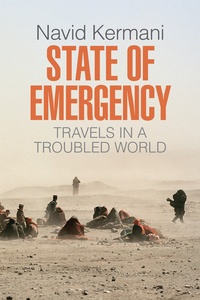
State of Emergency
Description

More details
Other editions
Additional editions
Persons
Content
Cairo, December 2006
Paradise in a State of Emergency
Kashmir, October 2007
Houseboat 1
In the City
Houseboat 2
Politicians 1-4
Night
Houseboat 3
The Shrine
Houseboat 4
In the Countryside
Houseboat 5
The Mother
Houseboat 6
Ahad Baba
In Kashmir, Far Away from Kashmir
Landless
Between Agra and Delhi, September 2007
Lumpenproletariat in Formation
Why Complain?
They Want Land
Expulsion as Industrial Development Policy
The Sky and the Ground
Ram Paydiri Doesn't Understand
The Laboratory
Gujarat, October 2007
An Idol
On the Rubbish Tip
Into the Centre
Social Praxis
India's Future
Where Even the Atheists Pray
The Pit
A Visit to the Sufis
Pakistan, February 2012
Rhythm of God
War Against Themselves
The Lovers' Tomb
O Papa, Protect Me
In the Mansion District
The Poor People's Peace
Quiet, Cleanliness and Order
The Feast
The Cosmic Order
Bleak Normality
Afghanistan I, December 2006
People Don't Change Much
Really Crazy
Two British Commanders
Humanitarian Mission
In Kabul
Where Is the Progress?
Master Tamim
The New Motorway
American Headquarters
Visit to the Passport Office
Cola in the Dark
The Limits of Reporting
Afghanistan II, September 11, 2011
Cemetery 1
Walls in Front of Walls
Northward
Mazar-e Sharif
The Best Place in Town
In the Countryside
In the Panjshir Valley
In the South
Peace Conference
Tribal Leaders 1
Kandahar
Tribal Leaders 2
The Limits of Reporting
Cemetery 2
The Uprising
Tehran, June 2009
Chance Companions
Arrival
Wednesday
Thursday
Friday
Back to Saturday
Sunday
Early Monday
When You See the Black Flags
Iraq, September 2014
I. Najaf: In the Heart of the Shia
Ubiquity of Death
A Dangerous Topic
A Different Shia
With Swordlike Index Finger
Grand Ayatollah Sistani's Message
II. Baghdad: The Future Is Past
A Thirty Years' War and More
A Hookah with Goethe and Hölderlin
Fog of Melancholy
Right Out of Ali Baba
The Last Christian
A Warrior
III. Kurdistan: The War for Our World Too
Literally Overnight
What For?
To the Front
The General
The Entrance to Hell
Syria, September 2012
The Centre and the Margins
Artists of the Revolution
Two Views
Outsourcing Terror
The Feast of St Elian
At the Tomb of Ibn Arabi
Thinking without Gradations
The Intensive Care Unit
Those Who Can Read, Let Them Read
We Too Love Life
Palestine, April 2005
In Search of Palestine
Without Hope
The Wall Against Empathy
My Capitulation
They Are Human Beings
Life as What It Is
Lampedusa, September 2008
Sunday Outing
Ghosts
Midnight
The Previous Mayor
The Camp
The New Mayor
Night Again
With or Without Approval
Cairo, October 2012
LANDLESS
BETWEEN AGRA AND DELHI , SEPTEMBER 2007
LUMPENPROLETARIAT IN FORMATION
A picture that might have been projected in a play by Brecht: Lumpenproletariat forming and rising up. Twentyfive thousand people marching in three files, most of them in rubber sandals, many barefoot, women in colourful saris in the middle, the men on the outside in cream-coloured shirts and matching dhotis, the rectangular cloth wrapped around the legs. The men carry their plastic-covered bundles on their shoulders; the women balance theirs on their heads. Everyone has a long stick in one hand with the green-and-white flag of Ekta Parishad, the Indian land rights movement. Between the files there is space for the marshals, musicians and singers, jeeps or other vehicles if necessary. Every block of a thousand marchers is led by a tractor pulling a water tank and followed by a bicycle rickshaw with two big metal loudspeakers, one aimed forwards, the other backwards. It is as loud as almost everywhere in India.
The expressions and colours of the faces are different in every block, as are the patterns of the saris, the jewellery, the women's reticence or confidence, and the language, because the marchers are from all parts of India. Many of the landless are old, some of them ancient, leaving the younger ones in their villages to work, although I will later discover that the outcastes and the members of the lower castes and the tribal peoples look as old at fifty as Europeans do at eighty. For twelve days they have been marching; they have come a hundred and fifty kilometres and have another two hundred kilometres ahead of them before they reach the parliament in Delhi if the authorities continue to clear their path, which is not idyllic, but motorway, the main road from Bombay to Delhi. Beyond the crash barrier the traffic backs up. Not all the motorists look delighted.
WHY COMPLAIN?
India is booming. Over 9 per cent economic growth annually, globally competitive in information technology, pharmacy, biotechnology, aerospace engineering, nuclear energy and, of course, the services sector, which is now siphoning off not only business from the West but also labour: the pay is not higher, but life is much cheaper, a German business magazine raves, pointing to 'the sensational leisure value' - Himalayas over Alps, Goa over the Costa Brava. As a proportion of its gross domestic product, the Indian state invests more money in research and development than Germany does. In the cities, where perhaps 200, perhaps 250 million people are at least indirectly involved, the signs of growing prosperity are unmistakable: mobile phones, high-rise buildings and shopping malls. The new private airlines offer better service and more modern aircraft than most European airlines. Naturally people book online and fly with e-tickets. Those who once belonged to the lower middle class now drive small cars and send their children to private schools. Those who earn more withdraw into one of the gated communities that are popping up everywhere. And for the wealthy there are no limits in India. The country is no longer a supplicant but a future superpower, as the international press explains forwards and backwards.
I climb over the crash barrier and thread my way between the cars. The traffic would probably be flowing in spite of the blocked carriageway if the drivers didn't insist on passing between the two remaining lanes, and always in both directions at the same time. As it is, the cars are wedged together every hundred yards like rugby scrums. Some of the drivers have got out and are staring in disbelief at the other carriageway. Japanese travellers take photographs from coach windows. For people on unemployment and social welfare benefits to block the motorway from Frankfurt to Cologne even for one day would be unthinkable. In India, no government, in the states or in the capital, is interested in a confrontation because the landless represent the lowest stratum of society, and hence the majority of the voters. The minister of agriculture was expected yesterday. He cancelled at short notice, pleading a cabinet meeting. Disappointment mingled with the marchers' fatigue, which was heightened by the cold of the nights they spend on the asphalt or in fields. Prosperous Indians have donated blankets, a euro or two apiece, but there are far too few of them, only five thousand so far. Along the entire route, housewives distribute baked goods, schoolchildren sing songs, and local politicians greet the marchers with speeches. Occasionally an intellectual or an actor drives up from Delhi or Bombay to march along for an afternoon. A long-bearded, white-robed holy man who joined the column has collected four thousand shoes so far, smiling constantly. He himself walks barefoot.
There is a magazine lying on the asphalt. It seems to have been dropped by a woman talking on the phone in the back seat of a tiny Suzuki Tata. The wages in India are so low that even compact cars have chauffeurs. As I walk on, I read an interview with a television hostess who spent her holiday with friends. I imagine a scene like a TV commercial, young attractive people under palm trees, only not white, but brown, light brown like almost all Indians who can afford the Maldives. They had a bungalow with a view of the sea, left and right and centre; the sea on three sides of the pool too, which was set higher for a better view; a pool bar of course, it's so nice to sleep late, no appointments, drinks, and the best thing: no cars. 'Stuff in my shopping bag: Nothing! I took a holiday not only from work but from shopping as well. But, yes, I couldn't resist buying a bikini, a pair of sunglasses, a sarong, a photo frame and a bright pink trolley bag.' There is a more expensive category for politicians and celebrities, of which she is not one apparently, for about $900 a night. 'But why complain when I had a Jacuzzi in my bathroom?'
THEY WANT LAND
Two hundred and fifty million consumers are a giant market for global players but a comparatively small figure for India. Seven hundred and fifty million Indians have little or no share in economic growth. India therefore ranks 126th on the United Nations Human Development Index, behind its neighbour Sri Lanka and only slightly ahead of Bangladesh. A large proportion of the rural population still have no access to educational institutions or health care, and many have no electricity or running water. Almost half of all children are underweight, a higher proportion than in Ethiopia. Indian agriculture, which employs two-thirds of the working population, has seen only minimal growth for years. Food production is also stagnating, so that the average caloric intake is actually declining, according to government statistics. Declining prices, declining subsidies for seed, fertilizer and pesticides, and the reduction of tariffs on imports from China, Pakistan and the United States have ruined many farmers. Many of them cannot cope with the industrialization of agriculture, advocated by agribusiness and accelerated by price pressure. When they are unable to repay the loans they have taken out for new machines or expensive, genetically modified seed, they lose their land. The current suicide rate is about 12,000 farmers annually, not counting unreported cases.
No one in India would dispute that unspeakable misery persists, least of all the Congress Party, governing in a coalition with left-wing partners who campaigned on promises of social justice. The parliament recently passed a law that guarantees every family a minimum of one hundred days of work a year. Another new law, the 'Right to Information Act', allows every citizen to address inquiries to government agencies for the equivalent of twenty cents: the authorities must answer within thirty days. The problems in the enforcement of these laws do not disprove the government's good intentions. The critical point is that the country's economic policy, and a large part of public opinion, assumes that the increasing wealth will trickle down. Thus the poorest are supposed to benefit indirectly from the free market through higher tax revenues, an expanding infrastructure, and new jobs - poorly paid ones, but better than unemployment. But will they really benefit? And, most of all, will the rural population? The state of Gujarat, where the economy is growing faster than in any other state in India, also has one of the highest rates of suicide among farmers.
Ordinarily, these spindly-legged men are only rarely visible, perhaps from the windows of the trains leaving the city, standing along the tracks or in the fields with bales of straw or brushwood on their backs. Their furrowed faces, the few wrinkle-free patches of skin tanned a dark brown, look dull like worn leather, teeth sticking out, teeth missing, teeth rotted, teeth all gone. And then the elegant gait of even the oldest women, especially in comparison with the two hundred supporters from Western countries who march along, each of them for a few days. Twenty-five thousand people under the sun make a seemingly endless procession, especially when you pass them walking quickly between two of the three files. Once when I had almost arrived at the front of the column, I rested at a petrol station. Until the time the jeep arrived that would bring me to the front again, I watched with the attendant, who offered me water and a chair, as the stream of people flowed past. 'Poor people,' says the attendant, whose parents worked in the fields.
He himself...
