

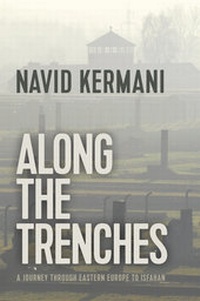
Along the Trenches
Description

More details
Other editions
Additional editions
Persons
Content
Cologne
Every day I walk through my neighbourhood behind the railway station. I hear some Arabic here, some Polish there, something Balkan-sounding to the left; Turkish, obviously; occasionally Persian, which makes me prick up my ears; I hear French spoken by Africans; Asian languages; also German, spoken in every accent and every quality, by blonds as well as by Asians, Blacks and Orientals. It is not always an unalloyed pleasure - the tramps, the many black imitation-leather jackets (or maybe they're real leather; what do I know?), my God, the gold front teeth of the black-haired women with their long, colourful skirts and their babies carried in slings, a second child led by the hand and a third running ahead, the young people hanging around, the drug addicts and the deranged who live in a home in Unter Krahnenbäumen - a street name referring to some long forgotten 'crane booms'; to round it off a few Muslims with suspiciously long beards. This is a reality that extends well beyond the area behind Cologne's railway station. In every city in Western Europe you can probably find the same mixture of Turkish greengrocers, Chinese supermarkets, Iranian specialities sold by a shopkeeper who used to be a director for Iranian state television before the revolution, traditional and self-service bakeries, rows of phone shops and Internet cafés - Iran, 19 cents a minute; Turkey, 9; Bangladesh, 24; the cheap hotels, sex shops, bridal shops, dives; tearooms and coffeehouses for Turks, Albanians, Africans; Turkish places that do or don't sell alcohol, chic restaurants and shabby ones, Thai massage studios, bookmakers that do or don't sell alcohol, import-export businesses, and here and there an antediluvian shop offering housewares or rubber stamps; on the main road the refugee shelter where the Roma have taken out the windowpanes to put satellite dishes in the open windows, and in the middle of it all, every winter, a shock troop of elderly gentlemen in blue or red uniforms with tricorn hats and rapiers, a band of Indians or a horde of half-naked Huns - the carnival societies, devotedly practising for their Pancake Day festivities from Epiphany on. What do merchants live on who all offer the same twenty batteries for one euro fifty in their oversized shops? Certainly not on the batteries, considering one after another of the old, well-respected specialist retailers can no longer afford the rising rents. International understanding takes place, with oom-pah and tata-ra-ta, at the beginning and at the end of the neighbourhood, where Cologne's most experienced whores stand at four long bars singing with fat Germans and with drunken Turks, always with the windows open. These are the new inner cities, and the one behind the Cologne railway station is far less aggressive than others - no, it's idyllic beyond these or any other words. They are pure, nothing less. They have nothing to do with the history of the cities where they develop, although they cannot efface that history either - certainly not the 2,000-year history of Cologne. As if they wanted to restore Cologne to its name's etymological meaning, they are like colonies of foreigners, but of many different foreigners who are also foreign to one another as they sit between the blinds of their carrels in the Internet cafés or stand in groups in front of the call shops. I often wonder if they scrambled down an embankment into a boat one night near Tangier, a boat that neither sank nor got intercepted - walking success stories all of them, even if they're still sharing a room with four other people and afraid of the police? Iran, 19 cents a minute; Turkey, 9; Bangladesh, 24. These are not the margins of society. They surge out from the centre of town. It is the margins that still have the look of homogeneity. There the city is divided by income; in the centre, everything is jumbled together. I walk through the neighbourhood; I hear some Arabic here, some Polish there, something Balkan-sounding to the left; Turkish, obviously; occasionally Persian, which makes me prick up my ears; also French spoken by Africans, Asian languages, and German, spoken in every accent and every quality. I don't understand half of it, and I mean half. And of the half I do understand, I usually understand only half again, because it's already slipped away behind the window or into a shop, it's poorly enunciated or too far away, I walked by too fast or the speakers were walking past me. I finish the sentences in my head, or I guess how they began; I imagine stories set, not across the Rhine in Deutz or during the Second World War, but in provincial Chinese cities, at Nigerian universities, in boats, freight containers and departure lounges where hearts race.
From the novel Dein Name
First Day: Schwerin
'Are there really no problems at all?' I ask the woman who directs the Sunday school for Syrian children in the concrete high-rise housing estate.
'No,' the woman answers, 'nothing serious.' Once in a while an unfriendly word about her headscarf, she says, but nothing worth mentioning compared to what her family went through in Syria, in the war. The child she is carrying in her womb will be born in peace.
Ghadia Ranah is forty years old and was already a teacher before she left Syria. Now she is responsible for 136 Syrian children who practise their Arabic every weekend in Dreesch, Schwerin's largest housing estate, to stay connected with their home country. The children I question on the playground of the community centre during the break have no intention of going back, however. I can hardly believe how well they already master German; they've been here just eight, nine months and they already inflect their verbs in the subjunctive, as required for hypothetical clauses, to explain what their day-to-day life would look like if they still lived in Syria: no school, no playing outdoors, the fear of bombs, tanks, fighters. Here in Germany, everyone is nice to them.
In September 2016, my trip barely begun, my expectations are already being challenged: my idea was to talk to the refugees themselves before hearing in the afternoon how Germany's new anti-immigration party, the AfD, talks about them. Naturally I assumed I would find them in God knows what horrible circumstances; as a West German, after all, I had pictured the formerly communist East as punishment in itself for any refugee: xenophobic neighbours, overstrained bureaucracies, isolation, possibly assaults. What I actually encounter are cheerful helpers, industrious refugees, playing children - as if the 'welcome society' were showing me its image video in the middle of the high-rise housing estate.
Word has got around among the Syrians, one of the volunteer Arabic teachers explains, that conditions in Schwerin are particularly advantageous for refugees. Come again? Yes, here you get your papers after two, three months, and you can work, maybe not in the profession you've learned, not as a chemist or an engineer, but as an interpreter for a social-welfare organization perhaps, or on a building site. Besides, the teacher explains, with so many flats vacant in the estate, the refugees aren't housed in shelters, the language courses aren't overcrowded, and there are no queues at the government offices. Soon the association the Syrians have founded will be offering free Arabic classes to interested neighbours; they've also been helping in the allotment gardens to show their gratitude.
It's not as easy as all that with the neighbours, says Claus Oellerking, who was a school head himself earlier in life, and is a co-founder of the refugees' aid association in Dreesch. The Syrians are very unusual, he says: middle class, highly motivated, good education, so they adapt much faster than the problem cases, of which there are some too of course among the refugees, especially if the influx is completely uncontrolled because there are no official ways to flee. On the one hand, most of the original residents of the estate once left their homes themselves, whether on expulsion from Germany's eastern territories after the war or as ethnic Germans 'returning' from the former Soviet Union, or as workers who moved to Schwerin when the factories were built in the 1970s. Accordingly, the willingness to help is widespread, especially among the older residents - in the beginning, the refugees hardly knew what to do with all the gifts they received. At the same time, Oellerking continues, many Germans here have the feeling they've been left behind: the sudden unemployment when the heavy industries shut down after unification, a meagre pension or benefit, the disproportionately high numbers of single households and people over forty, not enough children; add to that the welfare-state mentality left over from East Germany - and now hundreds of Syrians are moving into the estate, young men and, most of all, young families who, after having been lucky enough to escape with their lives, are determined to make something of them, and who are perhaps a bit more hot-blooded, have different customs, speak a different language, and also wear headscarves. Obviously that produces rejection, although mostly in private. There is hardly any violence in Dreesch, according to Oellerking, whatever the newspapers may say about a so-called flash point; not even graffiti or playground vandalism. But whether anyone will come to Arabic classes, or even just to an international barbecue -...
