

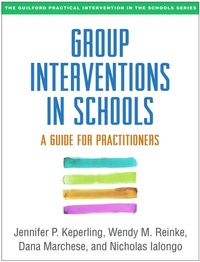
Group Interventions in Schools
A Guide for Practitioners
Published on 21. February 2017
196 pages
978-1-4625-2947-6 (ISBN)
Description

School psychologists and counselors working with children ages 5-13 (grades K-8); school social workers; other school-based mental health clinicians; behavior specialists; special educators. May serve as a supplemental text in graduate-level courses.
More details
Other editions
Additional editions
Jennifer P. Keperling | Wendy M. Reinke | Dana Marchese
Group Interventions in Schools
A Guide for Practitioners
Book
04/2017
1st Edition
Guilford Press
€42.00
Shipment within 15-20 days
Persons
Jennifer P. Keperling, MA, LCPC, is a Faculty Member and Research Associate in the Department of Mental Health at the Johns Hopkins Bloomberg School of Public Health. She has extensive experience implementing evidence-based group interventions in school settings with students and families and coaching teachers in implementing evidence-based techniques in classrooms. She also coordinates schoolwide initiatives aimed at reducing risks for mental health disorders in Baltimore City Public Schools.
Wendy M. Reinke, PhD, is Associate Professor in School Psychology at the University of Missouri and Co-Director of the Missouri Prevention Center. She developed the Classroom Check-Up, an assessment-based, classwide teacher consultation model. Her research focuses on preventing disruptive behavior problems in children and increasing school-based implementation of evidence-based practices. She is Associate Editor of School Psychology Quarterly and serves on the editorial boards of several other scholarly journals. Dr. Reinke presents nationally, has published numerous peer-reviewed articles, and has coauthored five books on teacher consultation and effective practices in schools.
Dana Marchese, PhD, is a Research Associate in the Department of Mental Health at the Johns Hopkins Bloomberg School of Public Health. Dr. Marchese coordinates and implements evidence-based interventions with children and families in Baltimore City Public Schools. She has extensive experience coaching and consulting with teachers to increase implementation of evidence-based practices in the classroom.
Nicholas Ialongo, PhD, is Professor in the Department of Mental Health at the Johns Hopkins Bloomberg School of Public Health, where he is also Director of the Center for Prevention and Early Intervention. Dr. Ialongo has a particular interest in adolescent mental health promotion and is the author of numerous publications in this area.
Wendy M. Reinke, PhD, is Associate Professor in School Psychology at the University of Missouri and Co-Director of the Missouri Prevention Center. She developed the Classroom Check-Up, an assessment-based, classwide teacher consultation model. Her research focuses on preventing disruptive behavior problems in children and increasing school-based implementation of evidence-based practices. She is Associate Editor of School Psychology Quarterly and serves on the editorial boards of several other scholarly journals. Dr. Reinke presents nationally, has published numerous peer-reviewed articles, and has coauthored five books on teacher consultation and effective practices in schools.
Dana Marchese, PhD, is a Research Associate in the Department of Mental Health at the Johns Hopkins Bloomberg School of Public Health. Dr. Marchese coordinates and implements evidence-based interventions with children and families in Baltimore City Public Schools. She has extensive experience coaching and consulting with teachers to increase implementation of evidence-based practices in the classroom.
Nicholas Ialongo, PhD, is Professor in the Department of Mental Health at the Johns Hopkins Bloomberg School of Public Health, where he is also Director of the Center for Prevention and Early Intervention. Dr. Ialongo has a particular interest in adolescent mental health promotion and is the author of numerous publications in this area.
Content
1. Facilitating Successful Child and Parent Groups
2. Locating Evidence-Based Group Interventions
3. Recruiting for Child and Parent Groups
4. Planning, Organizing, and Establishing the Group
5. Managing Behaviors in Child Groups
6. Managing Behaviors in Parent Groups
7. Engaging Group Members
8. Abuse, Neglect, Crisis Situations, and Suicidal Ideation
9. Data-Based Decision Making and Planning for Termination
Appendices
Reproducible Forms
References
Index
2. Locating Evidence-Based Group Interventions
3. Recruiting for Child and Parent Groups
4. Planning, Organizing, and Establishing the Group
5. Managing Behaviors in Child Groups
6. Managing Behaviors in Parent Groups
7. Engaging Group Members
8. Abuse, Neglect, Crisis Situations, and Suicidal Ideation
9. Data-Based Decision Making and Planning for Termination
Appendices
Reproducible Forms
References
Index
