

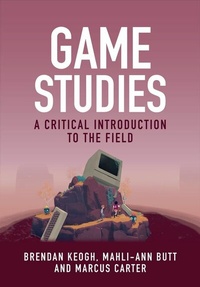
Game Studies
Description

From Among Us to Minecraft, Catan to Dungeons and Dragons, games and play are fundamentally transforming how we understand storytelling, education, identity, politics, and creativity. Game Studies provides the first ever critical and comprehensive introduction for navigating this complex, interdisciplinary, and rapidly growing research field. Each chapter introduces a timely area of debate in games research, and addresses critical questions about the social, cultural, and economic aspects of games and the people who play and make them. Combining key theoretical frameworks with case studies of influential games, the book equips readers with the tools needed to engage critically with games and their growing cultural significance. Full of concrete examples and pedagogical features, Game Studies offers a highly accessible and urgently needed guide to this rapidly expanding, hotly contested, and culturally significant field. It is essential reading for students of both media studies and game design, and an important resource for scholars, developers, and players.
More details
Other editions
Additional editions
Persons
Mahli-Ann Butt is Lecturer in Cultural Studies at the University of Melbourne.
Marcus Carter is Professor in Human-Computer Interaction at the University of Sydney.
Content
List of figures
Acknowledgements
1. Welcome to game studies
2. How games mean
3. How games persuade
4. Playing with games
5. Breaking the rules
6. Beyond gamer culture
7. Playing together
8. Decentering the player
9. Playing globally
10. Making games
11. The games industry
Notes
References
Index
1
Welcome to game studies
This chapter provides an initial overview of the field of game studies, describing its historical formation and main areas of inquiry. In this context, it details the key arguments of the book and the structure of the following chapters.
KEYWORDS:
academic disciplines, critical theory, game studies, ludology, narratology, play.
1.1 Introduction
In 2015 in Washington USA, a small group of independent videogame developers started working together under the studio name Innersloth. They released a few different small videogames to little fanfare including, in 2018, a small game called Among Us. Based heavily on the existing party game Mafia (also known as Werewolf), Among Us asks players to work together to control a spaceship while trying to deduce who among them is the treacherous monster trying to sabotage the mission and destroy them all (see Figure 1.1). At first, just like Innersloth's previous games, Among Us wasn't particularly popular. That was until two years later, in the midst of COVID-19 lockdowns when it became a viral sensation and commercial hit. First, popular game livestreamers and YouTubers began playing it for their spectating audiences before millions around the world picked it up, looking for alternative ways to socialise online while trapped indoors. By November 2020, Among Us had an estimated half a billion active users across mobile, desktop, and console platforms (Carpenter 2024). In the years since, Among Us has become a cultural juggernaut. Its simple little cartoon astronauts can now be found on meme templates across the internet, bootleg t-shirts in your local mall, and even on their own TV show.
How do we begin to understand Among Us as a cultural and social phenomenon? First, it is, obviously, a videogame. It has particular rules, mechanics, and goals that are presented through a cartoony science fiction/horror aesthetic. These aspects encourage particular behaviours that in turn lead players to have certain kinds of experiences - in this case, highly social and amusing experiences of suspicion and betrayal. But these experiences don't make sense without considering those who are playing Among Us: their past relationships with each other, how familiar they are with Among Us, Mafia, videogames, or lying. But then, central to the game's popularity is the fact it is distributed globally and freely available via the app stores of different mobile phones, allowing the game to access huge demographics of people who might not typically play a videogame that would require you to own a dedicated console or high-powered personal computer (PC). And then what about the game's developers, working part-time, who have since used their massive financial return to start investing in other game development studios? Or the livestreamers recording themselves in bedrooms around the world who are responsible for the game becoming so popular years after its release? Simply put: Among Us is no one thing, and there's many different perspectives from which one could look at and try to understand Among Us.
Figure 1.1 Among Us by Innersloth.
We start with this story of Among Us to make a simple point that underpins the very reason we have written this book: games and play exist at the intersection of a vast range of established and emerging areas of research. They are a part of culture and history. They are a major global entertainment industry and a form of artistic expression. They are fundamental to education, personal development, and how we understand our place in society. They are a crucial site of technological innovation, youth and pop culture, and design. They both reinforce and challenge hegemonic ideologies and norms. Blockbuster movies and TV shows are now produced from videogame franchises such as The Last of Us (Naughty Dog) and Super Mario Bros. (Nintendo); chart-topping music gets launched at virtual concerts inside the worlds of Fortnite (Epic Games) and Roblox (Roblox Corporation). Militaries use videogames to recruit young gamers who then use game controllers to pilot unmanned drones on real battlefields. Interactive design methods produced by game developers are used across classrooms, hospitals, and casinos. Games and play are everywhere, and one can't hope to fully comprehend modern society without understanding the influence of games and play.
Yet, this ubiquity of games also makes studying games a daunting proposition. As Among Us shows, games are complex cultural and social phenomena that sit at the nexus of all sorts of practices, audiences, and technologies, and they're difficult to pin down with concrete definitions. A game can consist of high-tech hardware and software, physical pieces, or simply a set of agreed upon rules for how to behave. Researchers from different academic disciplines approach games and play in very different ways to answer very different questions.
For an anthropologist interested in questions about human behaviour and culture, Among Us is perhaps best studied for the way social groups gravitated around it during the unprecedented solitude of the COVID-19 lockdowns. For the education researcher, Among Us might suggest new ways to engage students in the classroom, or to teach key social and communication skills. For the psychologist, Among Us might provide a place to observe how different social groups form and break trust dynamics. For the computer scientists, the technological infrastructure that allowed Among Us to connect players across vastly different devices (phones, consoles, computers) might be worth investigating. And for the media studies researcher, Among Us might be a valuable text to 'read' alongside similar science-horror works like Alien or 2001: A Space Odyssey, or a place to think about the complex evolutions and entanglement of media industries where part-time game developers, amateur livestreamers, and professional tech companies all end up working together. Certainly, many research questions and approaches overlap and reappear across disciplines. Nevertheless, the field a researcher is situated in will inevitably shape how they approach the study of games, and the boundaries of what they even understand games to be.
Spread across - and drawing from - all these different disciplines is a loosely connected field of research called game studies. With this book, we hope to provide you with an introduction to this rapidly expanding field. We will be approaching game studies from the broader disciplinary perspective of media and cultural studies. However, rather than tell you the one way to study games, or give you the one history of games scholarship, we picture this book more as a map that will help you locate yourself and your own questions about games and play within this complex, sprawling, and interdisciplinary field. We don't want to tell you how you should study games. We want to show you what is out there, the contours and outlines of the histories and debates that have defined the field so far, so that you can orient yourself and plot your own path through the wilderness.
The rest of this introductory chapter will provide an overview of what this field of game studies is, where it came from, and what key questions and debates have motivated it. Towards the end of the chapter we will provide an overview of the topics waiting in future chapters and return to our intent with how we have structured this book and how to best navigate through it.
1.2 What is game studies?
Game studies is an academic discipline that studies games as artefacts, play as a practice, and players as subjects.1 It's concerned with who plays games, how they play them, and what they play. It's also concerned with what games tell us about society, and how games influence cultural, social, and economic practices. It's concerned as well with who makes games, how they make them, what technologies and design philosophies they implement. It's concerned with how games connect to other aspects of society, what they might tell us about the changing nature of media industries, schools, public health responses, youth culture, or even war. Sometimes game studies can look like art criticism, with a researcher looking deeply at the themes and symbolism of a single game as a 'text' (see 2.1.2). Other times, it can look like anthropology, as a researcher attends an eSports tournament or hangs out in an online virtual world to observe how humans are interacting (see 7.3.1). At other times still, it can look like computer science, as a researcher tests different approaches to rendering a first-person camera, or different approaches to determining who goes first in a board game, on a control group of test subjects. This breadth and diversity of possible approaches and questions makes game studies particularly difficult to pin down and define. Perhaps the best place to start answering the question 'what is game studies' is to ask 'what is a game?'
1.2.1 Defining 'games' and 'play'
Unfortunately, part of the challenge is that games and play themselves are near impossible to pin down and define (Stenros 2017). Seemingly simple questions like 'what is a game?' or 'what is play?' are incredibly difficult to...
