

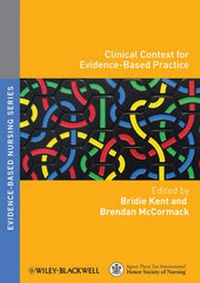
Clinical Context for Evidence-Based Practice
Description

Reviews / Votes
"This is an important area for nurses and an appreciation of theapplication of research is needed by all. A book such as thiscovering contextual issues of evidence-based practice should beavailable to all nurses, and this volume in particular isrecommended." (Journal of Renal Nursing, 6 November 2011) "The editors of this book, both heads of nursing researchcenters, gather international contributors to explore theprofessional, educational, and organizational context issues thatinfluence how evidence is implemented in clinical practice. Eachchapter considers a specific context, such as primary care, acutecare, perioperative settings, aged care, pediatrics, mental health,and midwifery. Final chapters examine the place of evidence inpolicy making. Case examples detail implementation approaches. Thebook's audience includes nurses and other health careprofessionals." (Reference and Research Book News, February2011)More details
Other editions
Additional editions
Persons
Content
Cover Image.
Notes on Contributors.
1 Introduction (Bridie Kent and Brendan McCormack).
References.
2 Context: overview and application (Bridie Kent and Brendan McCormack ).
Introduction.
Defi ning context.
Models and frameworks.
Context Assessment Index.
The Ottawa Model of Research Use.
Mode 2 thinking and context for evidence-based practice.
Global factors.
Conclusion.
References.
3 Making context work in primary health care (John Rosenberg and Debbie Kralik).
Introduction.
What is primary health care?
PHC as a set of strategies.
Assessing community need.
Engaging community.
Conclusion.
References.
4 Making context work in acute care (Alison Hutchinson and Tracey Bucknall).
Introduction.
The acute care context in relation to use of evidence in practice.
Characteristics of acute care contexts.
Evidence of the influence of acute care context on the use of research in practice.
Interventions and strategies to implement interventions.
Application of research evidence in the acute care context-a case example.
Conclusion.
References.
5 Making context work in pediatrics (Valerie Wilson).
Introduction
Medication safety.
Evidence from practice.
Overcoming the barriers to implementing evidence into practice.
Empowering families
Changing practice.
Conclusion.
References.
6 Making context work in the perioperative setting (Victoria M. Steelman).
Introduction.
Meta-analyses.
Randomized clinical trials.
Non-experimental studies.
Other sources of evidence.
Clinical practice guidelines and perioperative standards.
Summary.
Additional resources.
References.
7 Midwifery in the context of new and developing technologies (Marlene Sinclair).
Introduction.
Defi ning healthcare technology.
Defi ning birth technologies.
Understanding the complexity of technology and its relevance to midwifery.
Philosophical perspectives on birth technology.
Midwives and birth technology: major theoretical positions.
Birth technology competence.
Pregnant women's use of the Internet in pregnancy.
Current context of midwifery care.
The midwifery model of care.
International definition of the midwife.
Global health: The World Health Organization.
Global statistics on Internet usage.
Inappropriate use of technology.
Use of technology during pregnancy and childbirth.
Conclusion: the Instantaneous Age and the role of modern technology in childbirth.
References.
8 Making context work in mental health (Dawn Freshwater and Jane Cahill).
Introduction.
Contextualizing mental health care.
The practice of reviewing: the evolution of scientific literature.
Interpreting the evidence.
Implications of "context" for practice: effect of peer review on practice.
Benchmarking practice: its place in the hierarchy of evidence.
Interpreting the evidence.
Implications of benchmarking practice for mental health practice.
Summary of how the different contexts of reviewing and benchmarking practices impact on mental health and practice environments.
Concluding comments.
References.
9 Making context work in aged care (Nadine Janes).
Introduction.
Aged care settings and providers.
Best practice in aged care.
A program of research on evidence-based aged care.
Infl uences on evidence-based aged care.
Summary: maximize relationships, minimize stress.
References.
10 Enabling context with policy (Gill Harvey).
Introduction
Evidence and policy making.
The policy-making process.
The place of evidence in the policy process.
From policy to practice.
Taking account of policy in implementation strategies.
Bridging the gaps between practice, policy, and research.
Summary.
References.
11 Context in context (Bridie Kent and Brendan McCormack).
Introduction.
Considering these individual contexts-context within contexts.
The impact of the changing world on contextual.
factors for evidence-based healthcare?
Way forward.
References.
Index.
