

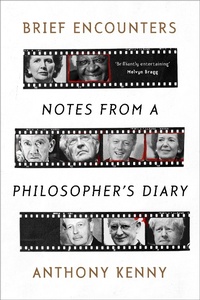
Brief Encounters
Description

Cardinals, directors, dissidents, dons, judges, novelists, philosophers, prime ministers, scientists, world statesmen. . . Throughout his long and distinguished career, Sir Anthony Kenny has encountered some of the most notable and influential leaders of the post-war world.
In these brilliantly vivid vignettes Kenny offers telling and often unexpected insights into the achievements, flaws and foibles of sixty public figures - past and present - each of whom has contributed in decisive ways to our political, spiritual and cultural heritage.
More details
Other editions
Additional editions
Person
Sir Anthony Kenny FBA was born in Liverpool in 1931, and was educated at Upholland College and the Pontifical Gregorian University in Rome. From 1963 to 1989 he was at Balliol College, Oxford, first as Fellow and Tutor in Philosophy, and then as Master. He later became Warden of Rhodes House, President of the British Academy and of the Royal Institute of Philosophy, and Chair of the Board of the British Library. He is the author of over forty books on philosophy and history, including OUP's four-volume New History of Western Philosophy and The Enlightenment: A very brief history (SPCK 2017).
Content
- Intro
- Introduction
- 1 Three priests: Alexander Jones, Jack Kennedy, Herbert McCabe
- 2 Three cardinals: William Theodore Heard, John Carmel Heenan, Cormac Murphy-O'Connor
- 3 Three Anglicans: Austin Farrer, Henry Chadwick, Richard Harries
- 4 Three Oxford dons: Christopher Cox, Russell Meiggs, Richard Cobb
- 5 Three heads of house: Christopher Hill, Isaiah Berlin, Daphne Park
- 6 Three benefactors: Bill Coolidge, Irwin Miller, David Astor
- 7 Three businessmen: Warwick Fairfax, Robert Maxwell, John Templeton
- 8 Three Oxford philosophers: Gilbert Ryle, Richard Hare, Philippa Foot
- 9 Three Wittgensteinians: Elizabeth Anscombe, Peter Geach, Georg Henrik von Wright
- 10 Three overseas philosophers: Willard Van Orman Quine, Ernst Tugendhat, Jacques Derrida
- 11 Three prime ministers: Harold Macmillan, Ted Heath, Margaret Thatcher
- 12 Three British statesmen: Denis Healey, Roy Jenkins, Chris Patten
- 13 Three privy councillors: Peter Brooke, Boris Johnson, Yvette Cooper
- 14 Three heads of state: King Olav V, Francesco Cossiga, Bill Clinton
- 15 Three judges: Jim Kilbrandon, Tom Bingham, Laurie Ackermann
- 16 Three dissidents: Ivan Supek, Mihailo Markovic, Julius Tomin
- 17 Three Irish leaders: Charles Haughey, Garret FitzGerald, Mary Robinson
- 18 Three South African leaders: Desmond Tutu, Mamphela Ramphele, Nelson Mandela
- 19 Three novelists: Graham Greene, Iris Murdoch, David Lodge
- 20 Three scientists: Noam Chomsky, Richard Dawkins, Denis Noble
- Plates
