

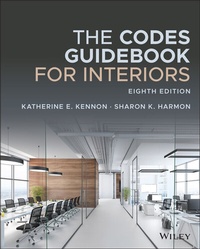
The Codes Guidebook for Interiors
Description

If you are involved with the design or management of buildings and spaces, it is important to remain up-to-date on the ever-evolving codes and standards that keep communities safe. With over 80,000 copies sold, The Codes Guidebook for Interiors continues to provide comprehensive explanations of the major codes and standards applicable to commercial and residential interior projects. The -easily navigable format gives clear perspective to how these often confusing concepts and requirements are integrated into real world practice, helping designers incorporate the relevant standards into their -projects. Updated with the most recent changes and insights to the codes and standards of the ICC, NFPA, ANSI, ADA, and other standards, the Eighth Edition provides unparalleled and integrated guidance on building safety, accessibility, sustainability, energy efficiency, and more.
Updates to the Eighth Edition include:
* Explanations of code requirements, highlighting the latest changes in the 2018 and 2021 ICC codes, including the International Building Code and the NFPA's Life Safety Code
* Clarifications to how and when the ADA, ABA and the ICC/ANSI accessibility requirements will apply to a project
* Introduction to the codes and standards that address sustainability in typical projects
* In-depth examinations of fire and smoke resistant assemblies, fire protection systems, and plumbing and mechanical requirements
* A companion website with printable study flashcards, instructor's manual, and PowerPoint slides for use in academic settings
* Digital and printable code checklists that can guide code research for professional projects and use in a design studio
Current, practical, and relevant to nearly any interior or architectural project, The Codes Guidebook for Interiors provides invaluable insight and reference for both student and professional interior designers and architects.
More details
Other editions
New editions
Additional editions
Persons
Sharon K. Harmon has more than twenty-five years' experience in interior design and project management. She is owner and founder of Life Design for Health, which combines her experience with interior design with her strong interest in natural health.
Content
- Cover
- Title Page
- Copyright Page
- Contents
- Inset Index
- Preface
- Acknowledgments
- How to Use This Book
- Terms to Know
- Using Codes in the Design Process
- Organization of the Book
- Available Codes and Standards
- Prescriptive and Performance
- Accessibility Regulations
- Sustainability Requirements
- Figures in the Book
- Getting Started
- Minimum Requirements
- Abbreviations
- Chapter 1 About the Codes
- A Brief History
- Code Publications
- Building Codes
- Performance Codes
- Fire Codes
- Life Safety Code®
- Plumbing Codes
- Mechanical Codes
- Electrical Codes
- Energy Codes
- Sustainability Codes
- Residential Codes
- Existing Building Codes
- Federal Regulations
- Accessibility Legislation
- Energy Policy Act
- Standards Organizations
- American National Standards Institute
- National Fire Protection Association
- International Code Council
- ASTM International
- NSF International
- American Society of Heating, Refrigeration, and Air-Conditioning Engineers
- Underwriters Laboratories
- Global Standards
- Special Use Codes
- Research: Using the Codes
- Chapter 2 Accessibility
- A Brief History
- Codes and Standards
- Building Codes
- ICC A117.1
- State or Local Accessibility Codes
- Federal Regulations
- Architectural Barriers Act
- Fair Housing Act
- Americans with Disabilities Act
- Level of Accessibility
- New Construction
- Alterations
- Existing Facilities
- Limited Accessibility
- Accommodation
- Enforcement and Responsibility
- Research: Using the Codes
- Documentation
- Chapter 3 OccupancyClassificationsand Loads
- Understanding Occupancy Classifications
- Description of Occupancies
- Assembly (A) Occupancy
- Business (B) Occupancy
- Educational (E) Occupancy
- Factory (F) Occupancy
- Hazardous (H) Occupancy
- Institutional (I) Occupancy
- Mercantile (M) Occupancy
- Residential (R) Occupancy
- Storage (S) Occupancy
- Utility (U) Occupancy
- Other Occupancy Considerations
- New versus Existing
- Change in Occupancy
- More Than One Occupancy Type
- Incidental Use
- Accessory Occupancies
- Mixed Occupancies
- Multiple Occupancies
- Accessibility Requirements
- Determining Occupant Loads
- Occupant Load by Load Factor
- Modifying the Occupant Load
- Occupant Load for Converging Spaces
- Occupant Load for a Building Floor
- Occupant Load for Multipurpose Spaces
- Occupant Load for Fixed Seats
- Occupant Load for Unusual Uses
- Using the Occupant Load
- Research: Using the Codes
- Documentation
- Chapter 4 Construction Types and Building Sizes
- Understanding Construction Types
- Materials in Construction Types
- Ratings of the Building Elements
- Identifying Construction Types
- Construction Types
- Mixed Construction Types
- Construction Type by Occupancy
- Sustainability Considerations
- Maintaining the Construction Type
- Understanding Building Height and Area
- Allowable Height and Area Factors
- Using the Charts
- Allowable Height and Number of Stories
- Allowable Area
- Research: Using the Codes
- Documentation
- Chapter 5 Means of Egress
- Means of Egress System
- Exit Accesses
- Doorways
- Stairways
- Escalators and Moving Walks
- Ramps
- Corridors
- Aisles and Aisle Accessways
- Adjoining or Intervening Rooms
- Exits
- Exterior Exit Doors
- Exit Stairs
- Horizontal Exits
- Exit Passageways
- Emergency Escape and Rescue Opening
- Elevators
- Areas of Refuge
- Exit Discharges
- Exit Lobby
- Exit Foyer or Vestibule
- Discharge Corridor
- Egress Court
- Small Alley or Sidewalk
- Means of Egress Capacity
- Number of Exits
- Exit Widths
- Arrangement of Exits
- Exit Remoteness
- Common Path of Travel
- Travel Distance
- Dead-End Corridors
- Signage
- Exit Signs
- Instructional Signs
- Accessible Exit Signs
- Emergency Lighting and Communication
- Research: Using the Codes
- Documentation
- Chapter 6 Fire and Smoke Resistant Assemblies
- Passive Systems
- Active Systems
- Exiting Systems
- Compartmentation in a Building
- Fire Walls
- Fire Barriers, Horizontal Assemblies, and Fire Partitions
- Fire Areas
- Occupancy Separation
- Tenant Separation
- Dwelling and Sleeping Unit Separation
- Incidental Use
- Vertical Shaft Enclosures
- Means of Egress Components
- Smoke Barriers and Smoke Partitions
- Smoke Compartments
- Smokeproof Vertical Shafts
- Lobbies and Vestibules
- Opening Protectives
- Rated Door Assemblies
- Fire Window Assemblies
- Rated Glazing and Frames
- Through-Penetration Protectives
- Fire-Stops and Smoke Stops
- Fireblocks and Draft Stops
- Damper Systems
- Test Ratings
- Tests for Wall and Floor/Ceiling Assemblies
- Tests for Opening and Through-Penetration Protectives
- Using Rated Materials and Assemblies
- Sustainability Considerations
- Research: Using the Codes
- Documentation
- Chapter 7 Fire Protection Systems
- Detection Systems
- Smoke Detection
- Heat Detection
- Alternative Detection
- Manual Fire Alarms
- Carbon Monoxide Detection
- Alarm Systems
- Visual and Audible Alarm Systems
- Emergency Communication Systems
- Accessible Warning Systems
- Extinguishing Systems
- Fire Extinguishers
- Standpipes and Fire Hoses
- Sprinkler Systems
- Alternative Extinguishing Systems
- Sustainability Considerations
- Research: Using the Codes
- Documentation
- Chapter 8 Plumbing and Mechanical Requirements
- Number of Plumbing Fixtures
- Calculating Required Fixtures
- Accessibility Percentages
- Plumbing Fixture Requirements
- Water Closets
- Urinals
- Lavatories
- Sinks
- Drinking Fountains
- Bathtubs
- Showers
- Dishwashers and Clothes Washers
- Toilet and Bathing Facilities
- Single-User Toilet Facilities
- Multiple-Fixture Facilities
- Single-User Bath Facilities
- Multiple-User Bathing Facilities
- Finish Requirements
- Grab Bars
- Accessories
- Signage
- Plumbing Sustainability Considerations
- Mechanical Requirements
- Mechanical Rooms
- Heating and Cooling Loads
- Zoning and Thermostat Locations
- Exhaust Requirements
- Ventilation Requirements
- Plenum Requirements
- Duct Requirements
- Access Requirements
- Mechanical Sustainability Considerations
- Research: Using the Plumbing and Mechanical Codes
- Researching Plumbing Requirements
- Researching Mechanical Requirements
- Documentation
- Chapter 9 Electrical and Communication Requirements
- Electrical Components and Devices
- Electrical Panels and Rooms
- Electrical Cabling and Conduit
- Circuitry
- Electrical Boxes
- Grounding and Circuit Interrupters
- Ground Fault Circuit Interrupters
- Arc Fault Circuit Interrupters
- Light Fixtures
- Types of Light Fixtures
- Location of Light Fixtures
- Required Electrical Systems
- Emergency Power Systems
- Standby Power Systems
- Electrical Sustainability Considerations
- Communication Components and Devices
- Communication Equipment and Rooms
- Low-Voltage Cabling
- Types of Communication Systems
- Telecommunication Systems
- Television and Radio Systems
- Alarm and Voice Communication Systems
- Audiovisual Systems
- Security Systems
- Communication Sustainability Considerations
- Research: Using the Electrical Codes
- Research: Using the Communication Codes
- Documentation
- Chapter 10 Finish and Furniture
- Types of Finishes and Furnishings
- Standards and Testing
- Steiner Tunnel Test
- Radiant Panel Test
- Pill Test
- Vertical Flame Tests
- Room Corner Tests
- Smolder Resistance Tests
- Toxicity Test
- Upholstered Seating Tests
- Mattress Tests
- DETERMINING FINISH REQUIREMENTS
- Finish Classifications
- The Code Table
- Example
- Other Finish Requirements
- Obtaining Test Results
- Pretested Finishes and Furniture
- Nontested Finishes and Furniture
- Accessibility Requirements
- Floor Finishes
- Accessible Furniture
- Acoustical Partitions and Materials
- Decorative Materials
- Signage
- Other Code Restrictions
- Sustainability Considerations
- Sustainable Product Standards
- Product Certifications
- Research: Using the Codes
- Documentation
- CHAPTER 11 Code Officials and the Code Process
- Authority Having Jurisdiction
- Code Jurisdiction
- Code Department
- Code Official
- Code Review and Enforcement
- Agency Review
- Sustainability Programs
- Federal Laws and Regulations
- The Code Process
- Code Research and Design
- Preliminary Review
- Appeals Request
- Plan Review and Permit
- Inspections during Construction
- Final Inspection and Approval
- Documentation
- Construction Documents
- Performance Design Documentation
- Sustainability Design Documentation
- Technology and Process
- Minimum Requirements and Best Practices
- Appendix A Sustainability
- Green Rating Systems
- LEED
- Green Globes
- Living Building Challenge
- Sustainable Standards and Certification Programs
- Life Cycle Assessments
- Environmental Product Declarations
- Tools and Resources
- Appendix B Existing and Historic Buildings
- Existing Buildings
- Repairs
- Alterations
- Change in Use or Occupancy
- Additions
- Accessibility Requirements
- Historic Buildings
- Sustainability Considerations
- Appendix C Family Residences
- Construction Types and Building Size
- Means of Egress
- Fire and Smoke Resistance
- Fire Detection and Protection
- Plumbing
- Mechanical
- Electrical and Communication
- Finishes and Furniture
- Accessibility Considerations
- Sustainability Considerations
- Glossary
- Index
- EULA
HOW TO USE THIS BOOK
Codes, standards, and federal regulations are an essential part of designing buildings. This book is intended to help whether you are an interior designer, architect, engineer, builder, building owner, or facility manager. Although most of the code publications address the entire building-exterior and interior-this book concentrates on the codes that pertain to the interior of a building. The Codes Guidebook for Interiors is designed help you understand the system of code requirements and to help determine which codes and regulations apply whether you are space planning the interior of a new building, designing a new tenant space in part of a building, or making some minor changes in an existing building. This will help you to minimize your research time. Incorporating these requirements into the design should become a natural part of every interior project. I hope that it will also make the many interior codes, standards, and federal regulations more user-friendly.
In this eighth edition of the Codes Guidebook, each section has been updated to inform you of the most current interior-related codes, standards, and federal regulations. Referencing both the 2018 and 2021 editions of the codes, this book concentrates on the requirements of the International Building Code and the Life Safety Code, two of the most widely used codes. However the parallel and prominent NFPA codes are also discussed. Most chapters also discuss interior-related information from the fire codes, the electrical and energy-related codes, and the plumbing and mechanical codes. The most current accessibility and sustainability requirements are discussed including the 2010 ADA Standards.
It is suggested that you read through the book systematically at least once. In this way, you can get an overall understanding of how the various codes, standards, and regulations work during the progression of a design. Then you may refer to each individual chapter as needed to clarify or be reminded about the codes that address that part of the project. To help you understand the application of specific requirements, multiple examples, explanatory diagrams, and checklists are provided in each chapter.
Note
This book deals with interior codes only. Unless otherwise noted, it is assumed that the exterior walls-including doors and windows-and the existing shell of the building are either existing or already determined.
TERMS TO KNOW
Certain terms when used by the codes have specific meanings. Sometimes these meanings are different than how we may use them in our typical conversation. For example, although the terms corridor, passageway, and hallway may be somewhat interchangeable in our daily language, they are very different in code language. It is important to understand the specific definition of terms when using the codes. Each code typically has a chapter of terms used in the code to clarify how each term in defined. You may want to check the code specific definition of the terms used in this book. Many are defined in the glossary in the back of the book. Here are some common terms used throughout this book.
ACCESSIBLE: Unless otherwise noted, this term refers to areas, products, or devices usable by persons with disabilities, as required by the codes, federal legislation such as the Americans with Disabilities Act, and other accessibility standards.
AUTHORITY HAVING JURISDICTION (AHJ): Used by the code organizations to indicate organizations, offices, or individuals that administer and enforce the codes. In this book, we designate these as code jurisdictions, code departments, and code officials, respectively.
CODE OFFICIAL: Also known as a building official; an employee of a codes department who has the authority to interpret, administer, and enforce the codes, standards, and regulations within that jurisdiction. A code official can have several different titles, including plans examiner, building inspector, and, sometimes, fire marshal. Also generally referred to as the AHJ by the codes.
CODES DEPARTMENT: A local government agency that administers and enforces the codes within a jurisdiction. Some small jurisdictions may have a codes department that consists of only one person or code official, and some large jurisdictions may include many different agencies and departments. Also generally referred to as the AHJ by the codes.
GREEN DESIGN: Design of products, environments, and buildings that treats environmental attributes as an important design objective. It aims to minimize the potential harmful effects on human health and the environment by choosing eco-friendly building materials and construction practices. It may also include systems that increase the efficiency of a building so that it uses less materials, energy, and water. (See also Sustainable Design.)
JURISDICTION: A determined geographical area that uses the same codes, standards, and regulations. Each jurisdiction passes a law specifying which codes and standards are required and how they will be regulated. A jurisdiction can be as small as a township or as large as an entire state. The code jurisdiction of a project is determined by the location of the building. Also generally referred to as the AHJ by the codes.
PERFORMANCE CODE: A code that is more generally described and gives an objective but not specific instructions on how to achieve it. The focus is on the desired outcome, not a single solution, and compliance is based on meeting the criteria established by the performance code. (Engineering tools and methodologies are often used to substantiate the use of the code criteria.)
PRESCRIPTIVE CODE: A code providing a specific requirement that must be met for the design, construction, and maintenance of a building. The focus is on a specific solution to achieve an objective or outcome based on historical experience and established engineering. Historically, codes in the United States have been prescriptive in nature.
SUSTAINABLE DESIGN: More encompassing than green design, sustainability typically includes three main tenets: environmental responsibility, economic strength, and social responsibility. Buildings and spaces that incorporate sustainable design are designed to lessen their impact on the environment, stimulate the economy, and provide improvements to those involved in the development and the community.
Note
Sustainable design and green design are not the same; sustainable design is more comprehensive.
USING CODES IN THE DESIGN PROCESS
The best time to research codes and use this book is in the early stages of a design project, preferably in the programming phase or schematic phase while the designs are still preliminary. It is especially advisable to review these requirements before construction documents are started and construction costs are estimated. Figure I.1 summarizes how the various phases of the typical design process relate to the steps taken during the suggested code review process. Refer to this chart as you work on a project to make sure you are covering the necessary code steps. (A more detailed flowchart of the code process is included in Chapter 11.) The Codes Guidebook is organized so that you can follow it while working on a design project from beginning to end, in the order in which you would typically research the codes.
ORGANIZATION OF THE BOOK
Chapter 1 in The Codes Guidebook for Interiors gives a brief history of codes and provides some background on each of the main code publications, federal regulations, and standards organizations. This edition concentrates on the International Codes® (I-Codes®) by the International Code Council (ICC) and a few NFPA codes including the NFPA 101 Life Safety Code (LSC) and the National Electrical Code (NEC). Chapter 1 explains these individual codes. Chapter 1 is helpful in determining which codes and standards publications and which federal regulations apply to an interior project. Chapter 11, the last chapter in this book, discusses code officials and the code process. It describes how they work and how to work with them. If you are new to codes research, you may want to review Chapter 1 and Chapter 11 together to gain a basic understanding before reading the rest of the book.
Design Process Code Process Description Programming/Predesign Preliminary Research- Determine applicable codes, standards, and federal regulations.
- Preliminary code research to determine important code issues such as occupancy type, occupancy load, etc.
- Determine level of sustainability required: code, standard, rating system, and/or a green building program.
- Incorporate code and sustainability compliance into design, keeping in mind means of egress, rated walls, etc.
- Meet with code official to review conflicting code requirements (optional unless using performance codes, but could be helpful).
- May also be done during Schematic Design Phase.
- Check specific technical requirements such as aisle widths, stair...
