

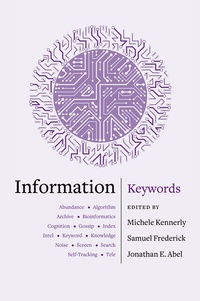
Information
Keywords
1st Edition
Published on 20. January 2021
232 pages
978-0-231-55280-6 (ISBN)
Description

For decades, we have been told we live in the "information age"-a time when disruptive technological advancement has reshaped the categories and social uses of knowledge and when quantitative assessment is increasingly privileged. Such methodologies and concepts of information are usually considered the provenance of the natural and social sciences, which present them as politically and philosophically neutral. Yet the humanities should and do play an important role in interpreting and critiquing the historical, cultural, and conceptual nature of information.
This book is one of two companion volumes that explore theories and histories of information from a humanistic perspective. They consider information as a long-standing feature of social, cultural, and conceptual management, a matter of social practice, and a fundamental challenge for the humanities today.
Bringing together essays by prominent critics, Information: Keywords highlights the humanistic nature of information practices and concepts by thinking through key terms. It describes and anticipates directions for how the humanities can contribute to our understanding of information from a range of theoretical, historical, and global perspectives. Together with Information: A Reader, it sets forth a major humanistic vision of the concept of information.
This book is one of two companion volumes that explore theories and histories of information from a humanistic perspective. They consider information as a long-standing feature of social, cultural, and conceptual management, a matter of social practice, and a fundamental challenge for the humanities today.
Bringing together essays by prominent critics, Information: Keywords highlights the humanistic nature of information practices and concepts by thinking through key terms. It describes and anticipates directions for how the humanities can contribute to our understanding of information from a range of theoretical, historical, and global perspectives. Together with Information: A Reader, it sets forth a major humanistic vision of the concept of information.
More details
Other editions
Additional editions
Book
01/2021
Columbia University Press
€31.00
Shipment within 10-20 days
Book
01/2021
Columbia University Press
€114.08
Shipment within 10-20 days
Persons
Michele Kennerly is associate professor of communication arts and sciences and of classics and ancient Mediterranean studies at the Pennsylvania State University.
Samuel Frederick is associate professor of German at the Pennsylvania State University.
Jonathan E. Abel is associate professor of comparative literature and Japanese at the Pennsylvania State University.
Samuel Frederick is associate professor of German at the Pennsylvania State University.
Jonathan E. Abel is associate professor of comparative literature and Japanese at the Pennsylvania State University.
Content
Acknowledgments
Introduction: Information and Humanities, by Michele Kennerly, Samuel Frederick, and Jonathan E. Abel
Abundance, by Damien Smith Pfister
Algorithm, by Jeremy David Johnson
Archive, by Laura Helton
Bioinformatics, by Haun Saussy
Cognition, by N. Katherine Hayles
Gossip, by Elizabeth Horodowich
Index, by Dennis Duncan
Intel, by Geoffrey Winthrop-Young
Keyword, by Daniel Rosenberg
Knowledge, by Chad Wellmon
Noise, by Matt Jordan
Screen, by Francesco Casetti and Bernard Dionysius Geoghegan
Search, by David L. Marshall
Self-Tracking, by Deborah Lupton
Tele (¿¿¿e), by Wolf Kittler
Contributors
Index
