

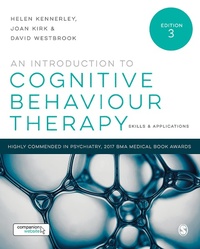
An Introduction to Cognitive Behaviour Therapy
Skills and Applications
3rd Edition
Published on 16. November 2016
512 pages
978-1-4739-9825-4 (ISBN)
Description

This bestselling guide to the basic theory, skills and applications of cognitive behaviour therapy is fully updated to reflect recent developments in CBT theory. It includes in-depth material on working with diversity, and new case studies and exercises to help you reflect and explore how theory can be used to develop effective practice.
The Companion Website features over 40 videos illustrating the CBT skills and strategies discussed in the book, including:
Measuring CBT's effectiveness
Socratic method and applications
Physical techniques and behavioural experiments
Applications of CBT to specific client disorders
Using supervision in CBT.
The Companion Website features over 40 videos illustrating the CBT skills and strategies discussed in the book, including:
Measuring CBT's effectiveness
Socratic method and applications
Physical techniques and behavioural experiments
Applications of CBT to specific client disorders
Using supervision in CBT.
Reviews / Votes
Want to learn to practice CBT with an expert CBT therapist at your side? Then, immerse yourself in the third edition of Kennerley et al's An Introduction to Cognitive Behaviour Therapy, the most complete and up to date introductory CBT text available. Each chapter offers clear guidance for management of common clinical dilemmas. Video links demonstrate skills and help therapists really understand CBT as a living, breathing therapy. Even experienced therapists can benefit. This book offers a comprehensive and sophisticated view of CBT in practice.-- Dr Christine A. Padesky There are many books that give us the basics of CBT. This one gives us the basics and beyond - what to do, when to do it, how to do it, and why we need to do it. Its mix of case material, techniques and illustrations (including truly enlightening videos of therapy in practice) make the book hard to put down. Whatever the disorder, whatever the age group, whatever the complexity - this book will help you to improve your practice. Consider it mandatory reading for any trainee, supervisor or clinician who takes patient care seriously. -- Professor Glenn Waller An Introduction to Cognitive Behaviour Therapy Skills and Applications has been a core text for learners, novice and experienced practitioners, and CBT educators alike since its first edition in 2007. All reputable CBT training programmes have this text on their essential reading lists. The third edition with its comprehensive new features such as the inclusion of videos, new case studies, additional exercises, and a focus on the cultural context of CBT will make what is already a great book indispensable. -- Pamela Myles * University of Reading * This book is not just an introduction to CBT; it is the introduction to CBT. The depth of the authors' expertise as therapists, supervisors and trainers shines through and their knowledge is shared in an accessible way. The new edition includes several contemporary themes and also provides a companion website with video links. Quite simply, new students of CBT should start here. -- Dr Stephen Barton This third edition contains all of the conciseness and clarity of the earlier editions, but with greater depth and scope. Any questions about how to use it in practice can be answered by using the demonstration videos and Companion Website. Comprehensive, authoritative, practical and friendly, this remains the essential guide to CBT. -- Dave Roberts
More details
Edition
Third Edition
Language
English
Place of publication
London
United Kingdom
Target group
College/higher education
Product notice
Reflowable
ISBN-13
978-1-4739-9825-4 (9781473998254)
Copyright in bibliographic data and cover images is held by Nielsen Book Services Limited or by the publishers or by their respective licensors: all rights reserved.
Schweitzer Classification
Other editions
Additional editions
Helen Kennerley | Joan Kirk | David Westbrook
An Introduction to Cognitive Behaviour Therapy
Skills and Applications
Book
11/2016
3rd Edition
SAGE Publications Ltd
€182.72
Shipment within 15-20 days
Helen Kennerley | Joan Kirk | David Westbrook
An Introduction to Cognitive Behaviour Therapy
Skills and Applications
Book
11/2016
3rd Edition
SAGE Publications Ltd
€43.79
Shipment within 15-20 days
Persons
Helen Kennerley, D.Phil, is a Consultant Clinical Psychologist (NHS) and a Senior Associate Tutor (University of Oxford). She has practiced CBT for over 40 years, having trained in Oxford and the US. Most of her time is dedicated to the Oxford Cognitive Therapy Centre (OCTC), where she leads the University's postgraduate courses in Psychological Trauma & Personality Development, and Supervision & Training. Her clinical work has been predominantly with survivors of childhood trauma. She is a founding fellow of OCTC and has written several popular cognitive therapy books. Her book, "Overcoming Anxiety" was highly commended in the BMA medical book awards, as was the 3rd Edition of this text. At the BABCP 25th Anniversary, she was shortlisted for the award of most influential female cognitive therapist in Britain.
Content
1. Basic Theory, Development and Current Status of CBT
2. Distinctive Characteristics of CBT
3. The Therapeutic Relationship
4. Assessment and Formulation
5. Measurement of CBT
6. Helping Clients Become their Own Therapists
7. Socratic Methods
8. Cognitive Techniques
9. Behavioural Experiments
10. Physical Techniques
11. The Course of Therapy
12. Depression
13. Anxiety Disorders
14. Anxiety Disorders: Specific Models and Treatment Protocols
15. Wider Applications of CBT
16. Alternative Methods of Delivery
17. Developments in CBT
18. Evaluating CBT Practice
19. Using Supervision in CBT
2. Distinctive Characteristics of CBT
3. The Therapeutic Relationship
4. Assessment and Formulation
5. Measurement of CBT
6. Helping Clients Become their Own Therapists
7. Socratic Methods
8. Cognitive Techniques
9. Behavioural Experiments
10. Physical Techniques
11. The Course of Therapy
12. Depression
13. Anxiety Disorders
14. Anxiety Disorders: Specific Models and Treatment Protocols
15. Wider Applications of CBT
16. Alternative Methods of Delivery
17. Developments in CBT
18. Evaluating CBT Practice
19. Using Supervision in CBT
