

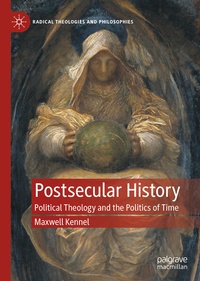
Postsecular History
Description

This book explores how contemporary approaches to the meaning of time and history follow patterns that are simultaneously political and theological. Even after postsecular critiques of Christianity, religion, and secularity, many influential ways of dividing time and history continue to be formed by providential narratives that mediate between experience and expectation in movements from promise to fulfilment. In response to persistent theological influences within ostensibly secular ways of understanding time and history, Postsecular History revisits and revises the concept of periodization by tracing powerful efforts to divide time into past, present, and future, and by critiquing historical partitions between the Reformation and Enlightenment. Developing a postsecular critique of theopolitical periodization in six chapters, Postsecular History questions how relations of possession, novelty, freedom, and instrumentality implied in the prefix 'post' are reproduced in postsecular discourses and the field of political theology.
Reviews / Votes
"Postsecular History's strength lies in its weaving together of a diverse collection of literature that attends to broad historical themes of periodization and progress . . Kennel provides illuminating close readings of his chosen texts, his tendency to summarize source material can make the book read like a literature review at times." (Jonas Brandt, Reading Religion, readingreligion.org, December 6, 2023)
"This book is an interesting, engaging, and wide-ranging argument that displays considerable depth. . I conclude with the assessment that Kennel's work is important to Christian political theology. He offers insightful engagements . and brings to view what goes on in seemingly innocent activities and habit of mind, such as periodization. . This book serves as a solid contribution to political theology at this early stage of Kennel's career; I look forward to hearing more from his distinctive voice soon." (Paul Doerksen, Mennonite Quarterly Review, Vol. 96, October, 2022)
More details
Other editions
Additional editions
Person
Content
1. Introduction.- 2. Political Theology and the Politics of Time.- 3. Postsecular History and the Seventeenth-Century Dutch Collegiants.- 4. Fanaticism, Anachronism, and Melville's Intervals.- 5. Periodization and Providence Between Nietzsche and Augustine.- 6. The Regulation of the Subject by the Technology of Time.- 7. Dorothee Sölle's Postsecular Political Theology of Waiting.- 8. Conclusion.
