

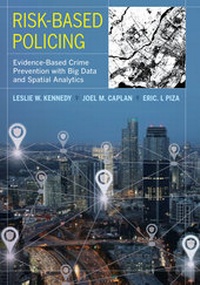
Risk-Based Policing
Evidence-Based Crime Prevention with Big Data and Spatial Analytics
1st Edition
Published on 20. November 2018
168 pages
978-0-520-96834-9 (ISBN)
Description

Risk-based policing is a research advancement that improves public safety, and its applications prevent crime specifically by managing crime risks. In Risk-Based Policing, the authors analyze case studies from a variety of city agencies including Atlantic City, New Jersey; Colorado Springs, Colorado; Glendale, Arizona; Kansas City, Missouri; Newark, New Jersey; and others. They demonstrate how focusing police resources on risky places and basing police work on smart uses of data can address the worst effects of disorder and crime while improving community relations and public safety. Topics include the role of big data; the evolution of modern policing; dealing with high-risk targets; designing, implementing, and evaluating risk-based policing strategies; and the role of multiple stakeholders in risk-based policing. The book also demonstrates how risk terrain modeling can be extended to provide a comprehensive view of prevention and deterrence.
More details
Other editions
Additional editions
Leslie W. Kennedy | Joel M. Caplan | Eric L. Piza
Risk-Based Policing
Evidence-Based Crime Prevention with Big Data and Spatial Analytics
Book
11/2018
1st Edition
University of California Press
€42.09
Article not available at the moment
Persons
KennedyLeslie W.:
Leslie W. Kennedy is University Professor of Criminal Justice at Rutgers University and Director of the Rutgers Center on Public Security.
Joel M. Caplan is Associate Professor at Rutgers University's School of Criminal Justice and Deputy Director of the Rutgers Center on Public Security. He has professional experience as a police officer, 9-1-1 dispatcher, and emergency medical technician.
Eric L. Piza is Associate Professor at John Jay College of Criminal Justice, City University of New York. Prior to joining academia, he served as the Geographic Information Systems Specialist for the Newark Police Department in New Jersey.
Leslie W. Kennedy is University Professor of Criminal Justice at Rutgers University and Director of the Rutgers Center on Public Security.
Joel M. Caplan is Associate Professor at Rutgers University's School of Criminal Justice and Deputy Director of the Rutgers Center on Public Security. He has professional experience as a police officer, 9-1-1 dispatcher, and emergency medical technician.
Eric L. Piza is Associate Professor at John Jay College of Criminal Justice, City University of New York. Prior to joining academia, he served as the Geographic Information Systems Specialist for the Newark Police Department in New Jersey.
Content
Preface Acknowledgments
PART 1: THE BASIC PRINCIPLES OF RISK-BASED POLICING
1. Introduction to Risk and Big Data
Introduction to Risk-Based Policing in Crime Prevention
The Importance of Risk
Big Data
Risk-Based Policing
Conclusion
2. The Evolution of Modern Policing
Introduction
Police Reform and Professionalization
From Professionalism to Problem-Solving
The Importance of Places and Data Analysis in Contemporary Policing
Conclusion
3. Policing in the New Era of Public Safety and Law Enforcement
Focus on Places with Risk Terrain Modeling
The Central Tenets of Risk-Based Policing
Develop Spatial Risk Narratives
Solicit and Value Input from Multiple Stakeholders
Make Data-Driven Decisions
Balance Strategies for Crime Risk Reduction
Conclusion
4. Risk-Based Policing and ACTION
Introduction
Risk Governance and the Police Leader
ACTION Meetings
A Detailed Breakdown of the ACTION Agenda
The Uncertainty in Risk Governance
Conclusion
PART 2: METHODS AND CASE STUDIES OF RISK-BASED POLICING
5. The Theory of Risky Places
Introduction
Theories Relevant to Risk-Based Policing
Conclusion
6. High-Risk Target Areas and Priority Places
Introduction
Studying Exposure and Vulnerability to Crime
Brooklyn as a Case Study
Conclusion
7. The Role of Police in Risk-Based Policing: Case Studies of Colorado Springs, Glendale, Newark, and Kansas City
Introduction
Risk Assessment Methodology
Findings
Connecting Risk Assessments to Intervention
Conclusion
8. Facilitators and Impediments to Designing, Implementing, and Evaluating Risk-Based Policing Strategies: Insights from Completed Researcher-Practitioner Partnerships
Introduction
Researcher-Practitioner Partnerships
Planned Change and Program Implementation
Risk-Based Policing Partnerships
Findings
Conclusion
9. The Roles of Multiple Stakeholders in Risk-Based Policing: Case Studies of Jersey City and Atlantic City
Introduction
ACTION Meetings in Jersey City
Risk-Based Policing in Atlantic City
Conclusion
10. People Make Risk-Based Policing and Data Actionable Valuing Data: Lessons Learned
Beyond Training and into Active Problem Solving
Conclusion
Epilogue
References
Index
PART 1: THE BASIC PRINCIPLES OF RISK-BASED POLICING
1. Introduction to Risk and Big Data
Introduction to Risk-Based Policing in Crime Prevention
The Importance of Risk
Big Data
Risk-Based Policing
Conclusion
2. The Evolution of Modern Policing
Introduction
Police Reform and Professionalization
From Professionalism to Problem-Solving
The Importance of Places and Data Analysis in Contemporary Policing
Conclusion
3. Policing in the New Era of Public Safety and Law Enforcement
Focus on Places with Risk Terrain Modeling
The Central Tenets of Risk-Based Policing
Develop Spatial Risk Narratives
Solicit and Value Input from Multiple Stakeholders
Make Data-Driven Decisions
Balance Strategies for Crime Risk Reduction
Conclusion
4. Risk-Based Policing and ACTION
Introduction
Risk Governance and the Police Leader
ACTION Meetings
A Detailed Breakdown of the ACTION Agenda
The Uncertainty in Risk Governance
Conclusion
PART 2: METHODS AND CASE STUDIES OF RISK-BASED POLICING
5. The Theory of Risky Places
Introduction
Theories Relevant to Risk-Based Policing
Conclusion
6. High-Risk Target Areas and Priority Places
Introduction
Studying Exposure and Vulnerability to Crime
Brooklyn as a Case Study
Conclusion
7. The Role of Police in Risk-Based Policing: Case Studies of Colorado Springs, Glendale, Newark, and Kansas City
Introduction
Risk Assessment Methodology
Findings
Connecting Risk Assessments to Intervention
Conclusion
8. Facilitators and Impediments to Designing, Implementing, and Evaluating Risk-Based Policing Strategies: Insights from Completed Researcher-Practitioner Partnerships
Introduction
Researcher-Practitioner Partnerships
Planned Change and Program Implementation
Risk-Based Policing Partnerships
Findings
Conclusion
9. The Roles of Multiple Stakeholders in Risk-Based Policing: Case Studies of Jersey City and Atlantic City
Introduction
ACTION Meetings in Jersey City
Risk-Based Policing in Atlantic City
Conclusion
10. People Make Risk-Based Policing and Data Actionable Valuing Data: Lessons Learned
Beyond Training and into Active Problem Solving
Conclusion
Epilogue
References
Index
