

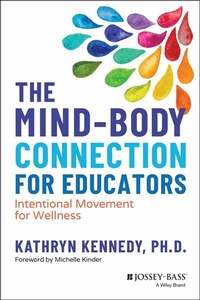
The Mind-Body Connection for Educators
Description

In The Mind-Body Connection for Educators: Intentional Movement for Wellness, Kathryn Kennedy, founder and executive director of Wellness for Educators, delivers a research-based, practical approach to supporting educators with trauma- and equity-informed somatic strategies for mental health and wellbeing. The book explains how our minds and our bodies are intricately connected, and, consequently, both are highly affected by trauma and prolonged stress. As research shows, when this residual pain is not healed, new learning cannot take place. To support educators' healing and learning processes, the book provides an overview of several mind-body disciplines, including yoga, mindfulness, meditation, Qigong, and breathwork. In addition to overviews of each discipline, Kathryn shares what the research says and provides engaging practices for educators.
Readers will also find:
* Identification of system-level contributing factors that bolster educator well-being, including supportive administration, social emotional learning programs, mentoring programs, points of connection, sense of belonging, and workplace wellness programs
* Acknowledgement of systemic issues that can serve as barriers of educators' healing processes, especially those who identify as people of color, people of culture, and/or LGBTQIA2SI+
* Strategies to empower educators to address and work with their own trauma and negative emotions
* Ways for educators to understand and heal secondary traumatic stress
An essential resource for primary, secondary, and post-secondary educators, The Mind-Body Connection for Educators: Intentional Movement for Wellness is a great addition to the libraries of school administrators, principals, and other education professionals.
More details
Other editions
Additional editions
Person
Content
CHAPTER 1
My Path to Educator Wellness
Throughout this book, you will be invited to take an intentional pause. This will be a place where you can check in with yourself to see how your mind and body are feeling. You'll see the words Intentional Pause with the lotus image and a list of questions. This practice of intentionally pausing can help you build and strengthen your mind-body connection, and, when practiced regularly, heal trauma and prolonged stress.
INTENTIONAL PAUSE*
- What do I notice in my mind? (observe without judgment)
- What do I notice in my body? (observe without judgment)
- What do I notice in my feelings? (observe without judgment)
- What do I notice in my thoughts? (observe without judgment)
- What do I need at this moment to feel supported? (observe without judgment and give yourself what you need to feel supported)
*Note: Take an intentional pause whenever you feel like you need one, not just in the places where you are invited to do so.
I first started talking about my interest in educator wellbeing in 2017. Many of my friends and colleagues in the digital learning space were curious and confused, and rightfully so. Why would someone like me, a researcher in online and digital learning for almost two decades, want to delve into educator wellbeing?
From 2004 to 2018, I worked as a digital librarian and an instructional technology professor at a handful of universities, and as a director of research at a couple of nonprofit organizations. I'm a qualitative researcher, so over the years, I distributed questionnaires and surveys, conducted interviews and focus groups, collected and reviewed digital and analog artifacts - all in order to listen to, understand, and share educators' stories and lived experiences. I've heard from thousands of educators over time, including teachers, special education staff, English language learning specialists, school counselors, school psychologists, school librarians, educational technology coordinators, district administrators, school administrators, state policy makers, and more.
Even though the research projects I've worked on and continue to work on are mostly focused on online and digital learning, the main theme across all of them has been educator stress (including secondary traumatic stress), trauma, and burnout. Anyone close to or involved directly in the field of education knows that educators have been pushed to the limits by constant change; intense focus on high-stakes, standards-based teaching; initiative fatigue; among many other stressors. Hearing these stories again and again as an educator myself was really hard to handle without doing something about it. Additionally and simultaneously, since 1985, I have been on a personal journey to understand and support my own mental health and wellbeing.
MY MENTAL HEALTH JOURNEY
I was six years old when my father tried to kill my mother. I was in the room with them when it happened. I didn't know it at the time, but this was my father's second attempt at trying to hurt my mother. Because he was a Korean War veteran, my father was hospitalized at the Bedford VA Hospital in Massachusetts. The health professionals diagnosed him with bipolar disorder. The hospital and my family encouraged him to get the help he needed, which included medication and a regular therapy schedule. He didn't want anything to do with that, and instead of staying near the hospital and our family for the support we all needed, he wanted to escape from the pressure.
That escape came in 1987 when my father decided to move us to Florida. No one except my father wanted it to happen. No one could stop him either. On the day we were leaving for Florida, everyone gathered at our house in Medford, where my parents had lived for over 30 years. The camper was packed, and when we started to pull away, I ran to the back window, waving frantically and crying uncontrollably, while those who could keep me safe grew smaller and smaller.
Like all the other times we traveled in our camper, I laid in the top bunk above the driver's cabin and counted the lines on the highway as we trekked south to the Sunshine State. After four nights at campgrounds along the way, we arrived at Fort Myers Beach, where we lived in our camper for the summer. Right before school started, my parents found a house in Cape Coral and enrolled me in 4th grade.
On my first day of school, my teacher introduced herself and laid out the ground rules of her classroom. She had an apple tree made of construction paper on the back wall of the classroom. Each student's name was assigned to an apple. Our teacher explained that if you didn't do your homework, if you were late to school, or if you did something wrong, you would have to put a worm in your apple. To do this, you would go to the front of the classroom, get a worm from the teacher, and walk to the back of the room to put the worm in your apple. By the end of the week, if you had five or more worms in your apple, you didn't go to recess.
Given what I had been through and what I was still going through, I rebelled by not completing my schoolwork, and by being oppositional and exhibiting what adults thought of as "bad behavior." Consequently, I had the most worms in my apple every week and didn't participate in recess at all that year. Even though I was hell-bent on causing as many problems as I could at school, I advanced to 5th grade.
This is when I met Mr. Weaver, the educator who had the biggest impact on my life. Even on the first day of school, I knew things would be different. Mr. Weaver sat us down and took the time to get to know each of us. He took the time to establish meaningful relationships with us and make the learning environment safe and inclusive. He encouraged healthy collaboration with others. He got to know the "why" behind our behaviors and the "how" and "what" we needed to feel supported. I'm grateful each day I think back on Mr. Weaver. Things could have gone much differently for me had we not crossed paths. I never missed a day of recess that year, and I improved academically.
Fast-forward to 1992. I was 14. My dad tried to hurt my mom again. I was in the room with them when it happened. The next day, without my dad knowing, my mom and I flew to Boston to live with family. My mom almost went through with a divorce, but within three months, despite my family's objections and my dad's continued refusal to get help to support himself, my mom and I moved back to Florida to live with him again.
For a long time, one of the questions I reflected on in therapy was what did it feel like to live in a space that was not safe, especially as a child? My brain did its job to suppress what happened when I was six since I didn't have the capacity to process it at that time. Despite that, my body and mind remembered the trauma. I experienced recurring nightmares and anxiety into my teenage years because I didn't express and work through my emotions and experiences (and really didn't know how to at the time). I engaged with counselors and therapists, including an art therapist who helped me get rid of my recurring nightmare. I used cognitive behavioral therapy to shift the challenging feelings and emotions brought on by trauma and prolonged stress. Though the cognitive-based therapy helped me work through my understanding of my experiences, I was still not 100%.
The toll that trauma had taken on me resurfaced in 2009 when I was 30. I was in the middle of my doctoral program at the University of Florida. At the time, I was working on my dissertation focused on the importance of teaching teachers how to teach online. I was conducting three research studies alongside one of my doctoral advisors. I was teaching two undergraduate courses to preservice teachers. I was enrolled in three graduate courses. I was serving as a supervisor teacher for six masters-level preservice teachers who were interested in learning what it's like to teach in an online school. I was working a part-time job in order to put myself through school. At that time, I had multiple loans I was paying back so they wouldn't incur interest. I was in an unhealthy long-distance relationship. Long story short, I was under a lot of pressure and stress.
Around that time, I found out one of my family members tried to commit suicide, and they didn't want me to tell anyone else. My mom, who was 75 at the time, came to visit me in Florida for the winter, and while she was with me, she fell down the stairs at my apartment complex and suffered a hematoma and severe concussion. She was okay, thank goodness.
Once I knew my mom was okay, I suffered a nervous breakdown and was admitted to the hospital. I started having frequent panic attacks, which I had never had before. After being pushed to take medication that caused me to have suicidal thoughts, I started seeing a university counselor who told me to "put on my big girl panties" and keep taking the meds. I listened because I honestly didn't know what else to do at that point. But after having a scary experience where I woke up at 3 a.m. on the bottom of my tub with the shower head pouring down on me and the water up to my nose, I decided to take a three-month leave of absence from my doctoral program and moved to Maine to live with my family.
During that time, I couldn't do anything. My...
