

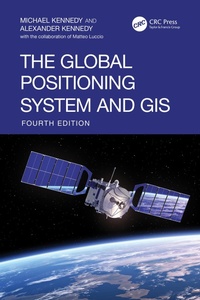
The Global Positioning System and GIS
4th Edition
Published on 28. November 2025
442 pages
978-1-040-40199-6 (ISBN)
Description

Now in its fourth edition, The Global Positioning System and GIS arrives at a critical moment of transition- a time when new methods for collecting position and attribute data are reshaping how information is integrated into Geographic Information Systems (GIS).
This edition is uniquely structured to reflect this shift: each chapter is divided into two sections- one covering "Newer Technology," including the latest advances in hardware, software, and cloud- based data collection, and the other preserving and refining "Older Technology" techniques from the third edition.
As GIS platforms represent the Earth with increasing precision and Global Navigation Satellite Systems (GNSS) deliver accuracy down to the centimeter, this book equips readers with proven, practical methods for building highly accurate and actionable geospatial datasets across a wide variety of devices and platforms.
Features:
* Step- by- step tutorials for hands- on learning, balancing theoretical foundations with practical application.
* Covers both ArcGIS Pro (ESRI) and QGIS (open- source), ensuring students and professionals can work across essential GIS platforms.
* Supports a broad range of devices: Android, iOS, and Trimble receivers.
* Provides downloadable datasets for instructors to use in exercises, examples, and exams.
* Features an entirely new chapter by GPS World former Editor- in- Chief Matteo Luccio, along with exclusive interviews with GPS and GIS pioneers Brad Parkinson, Charlie Trimble, and Jack Dangermond.
Clear, practical, and deeply informed by the evolution of the field, The Global Positioning System and GIS, first published in 1996, remains the definitive resource for anyone working where geospatial accuracy matters- from students and researchers to GIS professionals across all disciplines.
This edition is uniquely structured to reflect this shift: each chapter is divided into two sections- one covering "Newer Technology," including the latest advances in hardware, software, and cloud- based data collection, and the other preserving and refining "Older Technology" techniques from the third edition.
As GIS platforms represent the Earth with increasing precision and Global Navigation Satellite Systems (GNSS) deliver accuracy down to the centimeter, this book equips readers with proven, practical methods for building highly accurate and actionable geospatial datasets across a wide variety of devices and platforms.
Features:
* Step- by- step tutorials for hands- on learning, balancing theoretical foundations with practical application.
* Covers both ArcGIS Pro (ESRI) and QGIS (open- source), ensuring students and professionals can work across essential GIS platforms.
* Supports a broad range of devices: Android, iOS, and Trimble receivers.
* Provides downloadable datasets for instructors to use in exercises, examples, and exams.
* Features an entirely new chapter by GPS World former Editor- in- Chief Matteo Luccio, along with exclusive interviews with GPS and GIS pioneers Brad Parkinson, Charlie Trimble, and Jack Dangermond.
Clear, practical, and deeply informed by the evolution of the field, The Global Positioning System and GIS, first published in 1996, remains the definitive resource for anyone working where geospatial accuracy matters- from students and researchers to GIS professionals across all disciplines.
More details
Edition
4th edition
Language
English
Place of publication
London
United Kingdom
Publishing group
Taylor & Francis Ltd
Target group
College/higher education
Professional and scholarly
Illustrations
6 Tables, black and white; 9 Line drawings, color; 20 Line drawings, black and white; 126 Halftones, color; 3 Halftones, black and white; 135 Illustrations, color; 23 Illustrations, black and white
File size
33,98 MB
ISBN-13
978-1-040-40199-6 (9781040401996)
Copyright in bibliographic data and cover images is held by Nielsen Book Services Limited or by the publishers or by their respective licensors: all rights reserved.
Schweitzer Classification
Other editions
Additional editions
Michael Kennedy | Alexander Kennedy
The Global Positioning System and GIS
Book
approx. 12/2025
4th Edition
CRC Press
€191.60
Not yet published

Michael Kennedy
The Global Positioning System and GIS
Book
08/2025
CRC Press
Unfortunately, price unknown
Available (delivery time upon request)
Persons
Michael Kennedy's principal expertise lies in the application of computers to interesting problems and is deeply involved in the growing area of Geographic Information Systems (GIS). Since the early 1970s he has conducted work on "making a computer believe it's a map." In 1991 he founded the GIS program in the Department of Geography at the University of Kentucky. Professor Kennedy is the author of several textbooks and "Introducing Geographic Information Systems with ArcGIS -- A Workbook Approach to Learning GIS, Third Edition" published by Wiley, is one of them. Over the years Professor Kennedy has had a wide range of experiences relating computers and environmental matters. Primarily to be able to talk to planners about the newly emerging field of GIS he became certified as a planner by the American Institute of Certified Planners (AICP). He was Director of the Computer-Aided Design Laboratory at the University of Kentucky for several years. He has been invited to teach GIS and/or programming at Simon Fraser University and several state or provincial universities: North Carolina, Florida, and British Columbia.
Alexander Kennedy is a Software Engineer, Data Visualization Engineer, and Data Journalist who specializes in interactive data storytelling for environmental and public health issues. His public-facing work has been published in People Magazine and Undark Magazine. In 2022 his interactive feature Below Dozens of Aging Dams a Potential Toxic Calamity (co-authored with James Dinneen) was awarded the ASJA Donald Robinson Memorial Award for Investigative Journalism, nominated for ASME's National Magazine Award in the Reporting category, and nominated for the NIHCM Foundation's Digital Media Journalism Award. Alexander has led data visualization workshops, including a D3.js workshop at Impact Labs. Alexander is an active advocate for open data policies and civic data art. From 2019 to 2021 he co-curated and co-organized Data Through Design (DxD), an annual exhibition celebrating tangible, multimedia expressions of New York City's Open Data. DxD is produced in partnership with the NYC Mayor's O?ce of Data Analytics, BetaNYC, NYC Open Data Week, and the US Census. In his spare time, Alexander loves to make music and dance.
Alexander Kennedy is a Software Engineer, Data Visualization Engineer, and Data Journalist who specializes in interactive data storytelling for environmental and public health issues. His public-facing work has been published in People Magazine and Undark Magazine. In 2022 his interactive feature Below Dozens of Aging Dams a Potential Toxic Calamity (co-authored with James Dinneen) was awarded the ASJA Donald Robinson Memorial Award for Investigative Journalism, nominated for ASME's National Magazine Award in the Reporting category, and nominated for the NIHCM Foundation's Digital Media Journalism Award. Alexander has led data visualization workshops, including a D3.js workshop at Impact Labs. Alexander is an active advocate for open data policies and civic data art. From 2019 to 2021 he co-curated and co-organized Data Through Design (DxD), an annual exhibition celebrating tangible, multimedia expressions of New York City's Open Data. DxD is produced in partnership with the NYC Mayor's O?ce of Data Analytics, BetaNYC, NYC Open Data Week, and the US Census. In his spare time, Alexander loves to make music and dance.
Content
1. Basic Concepts. 2. More on GPS Data Collection. 3. Examining GPS Data. 4. Differential Correction, DOQs, and ESRI Data. 5. Integrating GPS Data with GIS Data. 6. Attributes and Positions. 7. GNSS: Past, Present, and Future.
