

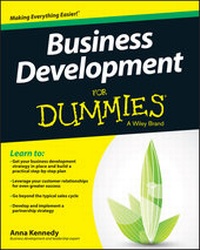
Business Development For Dummies
Description

Business Development For Dummies helps maximise thegrowth of small- or medium-sized businesses, with a step-by-stepmodel for business development designed specifically for B2B or B2Cservice firms. By mapping business development to customer lifecycle, this book helps owners and managers ensure a focus on growththrough effective customer nurturing and management. It's not justsales! In-depth coverage also includes strategy, marketing, clientmanagement, and partnerships/alliances, helping you develop robustbusiness practices that can be used every day. You'll learn how tostructure, organise, and execute an effective development plan,with step-by-step expert guidance.
Realising that you can't just "hire a sales guy" and expectimmediate results is one of the toughest lessons small businessCEOs have to learn. Developing a business is about more than justgaining customers - it's about integrating every facet ofyour business in an overarching strategy that continually workstoward growth. Business Development For Dummies provides amodel, and teaches you what you need to know to make it work foryour business.
* Learn the core concepts of business development, and how itdiffers from sales
* Build a practical, step-by-step business developmentstrategy
* Incorporate marketing, sales, and customer management ingeneral planning
* Develop and implement a growth-enhancing partnershipstrategy
Recognising that business development is much more than justsales is the first important step to sustained growth. Developmentshould be daily - not just when business starts to tail off,or you fall into a cycle of growth and regression. Plan for growth,and make it stick - Business Development For Dummiesshows you how.
More details
Other editions
Additional editions
Person
Content
Introduction 1
About This Book 1
Foolish Assumptions 2
Icons Used in This Book 3
Beyond the Book 4
Where to Go from Here 4
Part I: Getting Started with Business Development 5
Chapter 1: Introducing Business Development for Services Firms 7
Answering the Question: So What Is Business Development Anyway? 7
Recognizing that business is a serious business 8
Understanding how business development differs from selling 9
Breaking business development into bite-sized chunks 11
Placing the Customer Experience Center Stage 12
Deconstructing the customer lifecycle 13
Mapping business development to the customer lifecycle 14
Making Business Development Manageable in a Small Business 14
Dealing with overwhelm 14
Anticipating growth and its impact on your business 15
Taking stock of where you are 16
Chapter 2: Finding Damaging Gaps in Your Business Development 19
Spotting Patchy Business Development 20
Recognizing the tell-tale signs of weak business development 20
Looking for the obvious and the not-so-obvious problems 21
Thinking like your customers 23
Understanding Business Development Challenges for Services Firms 25
Identifying value in a services firm 25
'You're the top!' The owner-led sale 26
Being proactive rather than reactive 27
Taking Stock of Where You Are 30
What you're not doing - and being okay with it 30
It's a numbers game: How's your firm really doing? 32
Chapter 3: Diving Inside Your Customer's Head 33
Uncovering Your Customers' Real Needs 34
Understanding what customers need today and whether they know it 36
Staying current with your customers' needs 37
Powering Growth Using Your Customer's Viewpoint 39
Focusing on your customer: Why you should care 39
Mapping your customer's journey 42
Tailoring your solution to your customer's need (not vice versa) 46
Using influence to get the outcome you want 48
Chapter 4: Using the Lifecycle to Your Advantage 51
Clarifying Precisely What You're Selling - and How 52
Being in control 52
Keeping your offer fresh 55
Investing to stay up-to-date 58
Creating the customer experience 59
Considering the Pre-Sales Stage 62
Selling without looking like you're selling 62
Dating the customer: EDUCATE stage 62
Courting and proposing: PRESENT and PROPOSE stages 65
Confronting reality: CONTRACT stage 66
Handling the After-the-Sale Process 67
Moving from 'Yes' to 'Done': DELIVER stage 67
Wrapping up delivery: COMPLETE and EVALUATE stages 68
Part II: Planning for Business Development 71
Chapter 5: Getting Ready for Business Development 73
Developing an Offer that Sells 73
Ensuring that you're giving the market what it needs 75
Making your specialty really valuable 78
Assessing your competition 80
Accepting that the grass isn't always greener 81
Developing focus - or it's all over 83
'Really? You do that?' Articulating your offer 83
Presenting Your Offer 84
Finding your customer 84
'Tell me what you want, what you really, really want' 85
Who drives the customer? Engaging effectively 87
Getting to the sale 88
Building your contract process 89
Continuing Your Great Work beyond the Sale 89
Understanding the importance of relationships 89
Completing the work 91
Learning from Your Customers 92
Gathering intelligence: The importance of data 93
Evaluating your offer 94
Chapter 6: Building Your Business Development Plan 97
Planning for Business Development Success 98
Winging business development doesn't work 98
Knowing where you're going 99
Creating Your Winning Plan 100
Choosing where to start planning 101
Working on metrics 108
Components of your plan: Creating the blueprint 110
Monitoring progress 113
Chapter 7: Putting Your Plan into Action 115
Checking Your Plan before Lift-off 116
Setting milestones, tactics and metrics 116
Identifying initial tasks 121
Calling on helpers 122
Determining your investment 125
Lift-Off! Launching Your Plan 125
Communicating your plan internally 126
Enrolling 'friends' 127
Making use of friendly feedback 128
Getting the team going 130
Considering a few final thoughts as the plan takes off 131
Managing Risk while Implementing Your Plan 132
Thinking the unthinkable: What can possibly go wrong? 132
Dealing with large challenges 133
Part III: Making the Most of Marketing 135
Chapter 8: Appreciating the Benefits of Marketing for Your Business 137
Working Together in Harmony: Marketing and Sales 138
Enjoying the perfect relationship (not!): Marketing and sales 139
Making your marketing sales-oriented 140
Setting Out Your Stall: Marketing for Services Firms 144
Selecting the best marketing techniques for you 145
Energizing your team 146
Using your network 148
Forming partnerships and alliances 149
Understanding technology and the online dimension 150
Finding some quick wins in marketing 152
Deciding whether Your Firm Needs Branding 154
Understanding the importance of brands 154
Identifying yourself with a brand 155
Marketing your brand 155
Chapter 9: Driving Sales Success with Effective Marketing 157
Revving up the Marketing Engine 158
Appreciating the differences between sales and marketing 159
Ensuring that marketing drives results 160
Tuning up the marketing engine 162
Carrying out the hard work of marketing 165
Setting Accountabilities between Sales and Marketing 166
What am I striving for? Establishing the goal 167
'How will I know that marketing is achieving its goals?' Measuring marketing 168
Ensuring that Marketing Generates Interest 170
'Hey, we're over here!' Getting attention 170
'Over to you!' Timing lead handover correctly 172
Chapter 10: Creating Your Marketing Plan 175
Preparing To Market Your Business 175
Defining your plan 176
Researching marketing opportunities 177
Choosing your channels 179
Brainstorming your tactics 182
Putting Marketing into Practice 186
Creating your marketing programs 186
Creating your marketing calendar 192
Creating and managing collateral and content 194
Making the Most of Your Resources 196
Breaking the plan down to decide on resources 196
Satisfying marketing's appetite: Who does the marketing? 197
Making marketing accountable 198
Chapter 11: Automating Marketing - More Leads with Less Effort 199
Introducing the Automated Demand Generation Game 200
Understanding the buyer's journey 201
Providing insights for your prospective customers 202
Attracting an audience 202
Asking whether Demand Generation Is Right for You 203
Deciding when to consider automated demand generation 203
Gathering the required resources 205
Adding Automation to Your Marketing Armory 206
Choosing your infrastructure tools 207
Building your database 210
Designing demand generation programs 212
Testing and evaluating your programs 216
Making the phone ring 218
Chapter 12: Forming a Winning Team: Marketing and Sales Cohesion 221
'We Can Work It Out': Sales and Marketing Join Forces 221
Reassessing roles as your business grows 222
Laying out the connections between marketing and sales 223
Setting common goals and targets 225
'Come On, Come On, Let's Stick Together!' Marketing and Sales Can Collaborate 227
Clearing up misunderstandings that threaten unified business development 228
Acting to support unified business development 230
Helping marketing and sales to get on 231
Part IV: Seeing What Sales Can Do for You 235
Chapter 13: Becoming the Leader of the (Sales) Pack 237
Appreciating the Importance of Sales Leadership 238
Getting clear what your business sells 238
Establishing a sales process 240
Tooling up for sales 246
Setting goals and metrics 248
Building and Leading Your Sales Dream Team 249
Creating your pack of sales maestros 250
Using people outside the pack 251
Enrolling people to execute your sales strategy 251
Delving Deeper into Leading the Sales Process 253
'Put that it your pipe and smoke it!' Managing a sales pipeline 253
Working your sales process 255
Engaging in collaborative selling 259
Avoiding knee-jerk reactions to problems 259
Taking the right action at the right time 261
Chapter 14: Taking the Lead: Selling Under Control 265
Okay, You're In! Qualifying Leads into Prospects 266
Getting your interactions right with customers 266
Handling leads, whatever the source 267
Determining who to sell to 269
Gathering the tools to help qualifying 269
Taking the meeting 270
Gating prospects through your sales pipeline 273
Pitching Your Services to Customers 274
What prospects want: Understanding customer mentality 275
Limbering up to pitch 279
Writing good proposals 280
'Let's dance': Pitching on the day 282
The inquest: Assessing how the pitch went 284
Chapter 15: Closing the Sale to Your Satisfaction 285
'Signed, Sealed, Delivered': Closing the Deal 285
Picking your way through negotiation 286
Getting to the real 'yes' without begging 286
Contracting for a win-win 287
'This Much I Know': Managing the Transition from Sales to Delivery 290
Staying on the team 291
Passing on all you know 291
Backing out gracefully 293
Re-engaging with the customer 293
'Say Hello, Wave Goodbye': Finishing Up the Sale 294
Tidying up: Capture everything 294
Learning from experience: Win/loss reviews 295
Recognizing the value of evaluation 295
Part V: Managing Your Customers for Business Success 297
Chapter 16: Generating Success from the Customer Relationship 299
Back Off, He's Mine! Remembering that the Customer Belongs to Everyone 300
Sharing the customer relationship 300
Collaborating for customer success 302
Creating a lifetime customer 307
Tell Me What I Mean To You: Securing Value from Your Customers 308
Understanding your value through the customer's eyes 308
Asking for more 311
Turning the customer into an active advocate 313
Chapter 17: Joining Together to Maximize Business and Customer Value 315
You Know It Makes Sense: Seeing How Business Development Benefits All 316
Creating an organization in which everyone sells 316
Being a motivating business 318
Talking about team communication 319
Making the Most of Account Planning 322
Analyzing where your revenue will come from 323
Turning goals into reality 323
Deciding what to include in your account plan 324
Growing, Growing, Gone! Account Managers' Role in Your Growth Plans 325
Showing account managers how to do business development 326
Thinking about monthly, quarterly and annual reviews 328
Bringing Delivery to the Feedback Party 329
Spreading delivery's tentacles into the market 330
Gathering new ideas and best practices 330
Ensuring that sales learns from delivery 331
Making delivery feel valued 331
Chapter 18: Standing Tall To Get More Customers: Vertical Industries 333
'The Only Way Is Up!' Understanding Why Verticals Matter 334
Working with verticals makes sense 335
Identifying your verticals: Is going vertical right for you? 336
Listening to what customers say about their vertical 338
Leveraging Your Knowledge for Vertical Success 340
Understanding similarities and differences between verticals 340
Breaking down your services experience from a vertical perspective 341
Finding gold in them there vertical hills 342
Checking whether you're ready to go vertical 343
Designing and Executing Vertical Campaigns 343
Writing vertically based promotional materials 344
Getting your vertical message out there 344
Part VI: Making Influential Friends: Partnerships 345
Chapter 19: Seeking Partners for Mutual Benefit 347
Considering the Types of Partnership Available 348
Sticking to What You Do Best 349
Keeping to your set path 350
Going deep not wide 350
Traveling Alone or Partnering Up 352
'We belong together': Finding reasons to partner - or not 352
'Picture this': Considering your business with partners 354
'Service Firm WLTM Companion for Business Growth': Finding Good Partners 355
Creating partnership goals 355
Getting your criteria together: Profiling ideal partners 357
Chapter 20: Pursuing Your Plans for a Successful Partnership 361
Locating Partnerships within Business Development 361
Partnering Up Effectively 362
Dating: Getting to know each other 362
Testing the cultural fit: What do you have in common? 364
Setting boundaries to stay realistic 367
Agreeing shared goals 368
Understanding why partnerships don't work 369
Going to Market Together 370
Appointing a partner manager 370
Creating a unified go-to-market strategy 370
Defining roles and responsibilities 372
Tackling the question of who owns the customer 373
Wondering whether to white label or not 374
Coping with co-branding 374
Sharing the wealth 375
Part VII: The Part of Tens 377
Chapter 21: Ten Regular Actions that Benefit Your Business 379
Making Five Business Phone Calls 379
Calling Customers and Partners 380
Talking to Employees 380
Reading Some Blogs 380
Sending Out Three Value-Added Emails 380
Updating Your CRM/SFA 380
Making Five New Connections on LinkedIn 381
Tweeting Something 381
Reviewing How Your Day Went 381
Planning Tomorrow 381
Chapter 22: Ten Key Metrics to Watch 383
Knowing How Big Your Sales Pipeline Needs to Be 383
Maintaining the Right Number of Opportunities 383
Shortening Your Sales Cycle 384
Planning Projected Revenue 384
Producing the Right Number of New Leads 384
Assessing Planned versus Actual Revenue 384
Checking Profitability by Customer 385
Monitoring Cash Flow: Days Sales Outstanding 385
Keeping the Customer Happy with Satisfaction Scores 385
Minimizing Staff Attrition 385
Chapter 23: Ten Great Resources for Business Development 387
Discovering Online For Dummies Resources for Business Development 387
Signing up for Business Insider 387
Using the Business Training Institute 388
Improving with Influence Ecology 388
Casting a Wider Net with the American Marketing Association 388
Getting Better with the Sales Management Association 388
Blogging for Success: Sales Benchmark Index 388
Being In with the In-Crowd: LinkedIn Groups 389
Leading with Confidence: Vistage 389
Contacting the Author: RainMakers US 389
Index 391
Chapter 1
Introducing Business Development for Services Firms
In This Chapter
Defining business development
Looking through your customer's eyes
Making time for business development
If you ask ten people what they think business development is, you probably get ten different answers. Chances are that even your own view of business development isn't completely aligned with others in your organization, unless you've taken special and unusual steps to make it so.
Whether you're a business owner, involved in business development or just interested in discovering more, you probably inherited your view of business development from your business experiences, gleaned it from Google, created it yourself or perhaps used a mix of all these influences.
In this chapter, I set the scene for the whole book, providing a clear definition of business development, which involves strategy (see the chapters in Part II), marketing (Part III), sales (Part IV), customer management (Part V) and partnerships (Part VI) - and I set out why business development matters. I also describe the central role of your customers and tackle the problem of becoming overwhelmed, discussing how and why you need to find time for business development in your company.
Answering the Question: So What Is Business Development Anyway?
Here's the $64,000 question: What is business development? Is it something to do with sales? For sure. Is it related to business growth? It had better be! Does is have anything to do with your business strategy? Probably.
When you set out to create something, say, a new company, a growth plan or a new service, nothing says how it ought to be: in other words, your 'something' is what you create it to be. You may have noticed, however, that in business what gets created soon becomes the norm, the accepted way, the way it has to be. So that when you try to change something, someone always says, 'but we've always done it this way'. Boy, don't some people take themselves seriously!
When this happens, you can find yourself forgetting that you created it, whatever it is, and that therefore you can recreate it. Successful businesses take recreation seriously - recreation is built into their DNA. Recreating is how they keep their offer (the service they bring to the marketplace and something I discuss in detail in Chapter 5) fresh, how they assimilate new ways to market themselves, how they reduce their sales cycles and how they find great partners to help them grow their businesses.
Check out Chapter 2 for lots more on the importance of business development.
Recognizing that business is a serious business
If you're thinking that business is a serious matter, I agree with you. Professional football is a serious game (and a big money business). It has a purpose (get that ball over the touchline - or in the goal if you're thinking soccer), it has rules and it's clear what winning looks like (and the winners receive prizes!). Think about business like that and it becomes fun; well, some of the time.
Given the different ideas people hold about business development, having a definition is useful. Here's mine:
Business development is the discipline required to achieve growth through the acquisition of profitable net new customers and expansion of existing customers.
Clearly business development is concerned with growth and most companies achieve growth by getting new customers. Even if you grow by acquisition, you're still, at the root of it, acquiring new customers (though note that, unless they're profitable to you, you really don't want them). You also have existing customers and many firms neglect the opportunity for growth that lies within those existing (or historical) customers.
Discipline is required to acquire, keep and grow customers. Discipline has two meanings here:
- Discipline is the serious study of business development as a business competence. I'm frequently amazed how many people think that they can do business development when they've never studied it for a moment. If you think about your offer and the knowledge and experience it takes to do what you do for your customers, you probably don't take that lightly. So start thinking of business development the same way. You have to study it, become an expert and use the discipline.
- Discipline is the rigor of doing business development every day. When small firms have plenty of business, they neglect business development, and when they're running out of business they panic and start scurrying around for new opportunities. This approach is disastrous. Getting new business takes time. If you're not looking ahead to where your revenue is going to come from in three or six months' time, you're facing the spectre of horrible revenue swings, which stress your company, your cash flow and your co-workers/employees.
Business development gives you a disciplined approach to creating your offer, taking it to the market, acquiring customers, developing them to enhance your success and partnering with others to grow still further.
The discipline helps you smooth out the bumps in the road. You know - the bumps that caused you to pick up this book, whatever they were.
Understanding how business development differs from selling
I need to dispel a myth: a lot of people equate business development with selling, but in fact selling is just one of its functions, not the whole thing.
Selling is only part of business development
Sales is the art and science of presenting a solution to a prospective customer's need and getting to a transaction, where the customer 'buys' your solution.
By contrast, business development is much broader. To develop a business, you have to create solutions to the problems or pains that are sufficiently common in the marketplace for you to build a viable business. Then you have to figure out how to take that offer to the marketplace and generate results.
Business development encompasses:
- Your offer: Creating the solution you have or the reason your business exists. Move on over to Chapter 5 for more on your offer.
- Marketing: Making the market aware of your offer. Chapters 8 to 12 contain all you need to know about marketing in the context of business development.
- Selling: Acquiring new customers. Chapters 13, 14 and 15 are your guides here.
- Customer management: Delivering your solution so that you retain, expand and leverage your customer base. Check out Chapters 16, 17 and 18 for more on customer relationships.
- Partnerships: Joining with other firms to expand your opportunities. Chapters 19 and 20 are your friends here.
- Feedback: Using opinions to improve your offer (in other words, quality assurance). Chapters 3, 7 and 17 cover feedback from customers, from your staff and from the delivery department, respectively.
You can see that business development is cyclical - a feedback loop, with the potential to improve, recreate and enhance your performance. The power of business development lies within that cyclical nature (more on that in Chapters 3 and 4).
People always buy because they have a need. Even a 'want' such as 'I want a diamond ring for my 25th anniversary' is a need. I need to show myself, and everyone else, that my husband still loves me. I need to look good to the neighbors ('did you see that ring he bought her!'). Businesses experience needs as problems or pains that need to be solved. So the purpose of selling is the same whatever the context - fulfilling customer needs.
Businesses that think of business development as only sales often have big gaps in their business development cycle that lose them money. Closing those gaps is one way you can boost your results - often dramatically.
Getting those spectacular results takes more than one person. It takes a village or, in a small company, a few key people pretending to be a village (also known as wearing multiple hats). Growth is dependent on creating the vision for business development and then dealing with the reality (something I tackle in the later section 'Taking stock of where you are').
Problems that result from getting things wrong
When companies confuse sales with the wider practice of business development, they often end up taking the wrong approach to growth.
Imagine that your firm has reached a certain size and as the owner you're totally stressed trying to keep up with everything you have to do. You've exhausted your own network for getting customers, and sales are slowing down.
What do you do? Hire a salesperson, of course! Customer acquisition becomes the salesperson's responsibility and you can get on with all the other stuff. The problem is that salespeople are born to sell and...
