

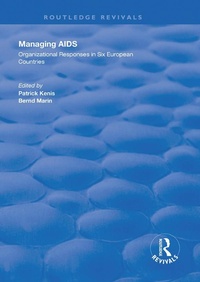
Managing AIDS
Organizational Responses in Seven European Countries
1st Edition
Published on 20. December 2018
398 pages
978-0-429-82774-7 (ISBN)
Description

First published in 1997, this volume examines how, in the last 15 years, HIV/AIDS has become a challenge for public health, public policy and research. Reducing further HIV transmissions as well reducing the personal and social impact of HIV/AIDS requires a wide range of activities developed by a wide range of organizations - the supply of which varies widely between countries, regions and social groups.
The book describes the programmes which seem particularly effective in dealing with HIB/AIDS and sets out to explain the disparities in their distribution. It documents and tries to understand both similarities as well as the variety of national approaches taken to cope with HIV/AIDS in a number of European countries. On the basis of the welfare-mix model, six country studies and an introductory chapter draw particular attention to the different mixes of public policies and private non-profit, community-based activities; the functional mixes between different types of services in the areas of prevention, care, research, control and monitoring, interest representation, fund-raising. The mixes between specialized, so-called "exclusive" HIV/AIDS service organizations and services made available by general, comprehensive, or so-called "inclusive" institutions which provide AIDS-specific programmes among other activities will also be elaborated. The whole range of HIV/AIDS activities, from professional services to self-help, is analysed in a comparative perspective.
The book is based on data from the European Centre / WHO Collaborative Study Managing AIDS. It is a comparative policy study focused on the role of non-profit organizations in public health and welfare policy, covering several thousands of organizations and HIV/AIDS programmes in six European countries.
Unexpected similarities and divergence in AIDS service organizations across Europe were found. The sheer multitude of programmes offered called a surprise to experts in the field, as did remaining conspicuous blank spots or deficiencies in services. Degrees of AIDS policy coherence, prevention efforts, service density and quality, self-help and professionalization, medicalization vs. social integration of HIV/AIDS programmes, sectoral specialization and institutionalization all vary tremendously, as do the efficiency and effectiveness of organizational responses to HIV/AIDS. Interestingly, variations in the supply of activities can hardly be explained by epidemiological patterns and corresponding demand and needs.
AIDS management requires long-term institutional strategies and information which cannot be provided by epidemiological or behavioural analysis alone. An effective struggle against HIV/AIDS also requires institution-building, inter-organizational development and policy-field analysis.
The book describes the programmes which seem particularly effective in dealing with HIB/AIDS and sets out to explain the disparities in their distribution. It documents and tries to understand both similarities as well as the variety of national approaches taken to cope with HIV/AIDS in a number of European countries. On the basis of the welfare-mix model, six country studies and an introductory chapter draw particular attention to the different mixes of public policies and private non-profit, community-based activities; the functional mixes between different types of services in the areas of prevention, care, research, control and monitoring, interest representation, fund-raising. The mixes between specialized, so-called "exclusive" HIV/AIDS service organizations and services made available by general, comprehensive, or so-called "inclusive" institutions which provide AIDS-specific programmes among other activities will also be elaborated. The whole range of HIV/AIDS activities, from professional services to self-help, is analysed in a comparative perspective.
The book is based on data from the European Centre / WHO Collaborative Study Managing AIDS. It is a comparative policy study focused on the role of non-profit organizations in public health and welfare policy, covering several thousands of organizations and HIV/AIDS programmes in six European countries.
Unexpected similarities and divergence in AIDS service organizations across Europe were found. The sheer multitude of programmes offered called a surprise to experts in the field, as did remaining conspicuous blank spots or deficiencies in services. Degrees of AIDS policy coherence, prevention efforts, service density and quality, self-help and professionalization, medicalization vs. social integration of HIV/AIDS programmes, sectoral specialization and institutionalization all vary tremendously, as do the efficiency and effectiveness of organizational responses to HIV/AIDS. Interestingly, variations in the supply of activities can hardly be explained by epidemiological patterns and corresponding demand and needs.
AIDS management requires long-term institutional strategies and information which cannot be provided by epidemiological or behavioural analysis alone. An effective struggle against HIV/AIDS also requires institution-building, inter-organizational development and policy-field analysis.
More details
Series
Edition
1. Auflage
Language
English
Place of publication
London
United Kingdom
Publishing group
Taylor & Francis Ltd
Target group
College/higher education
Product notice
Reflowable
File size
10,72 MB
ISBN-13
978-0-429-82774-7 (9780429827747)
Copyright in bibliographic data and cover images is held by Nielsen Book Services Limited or by the publishers or by their respective licensors: all rights reserved.
Schweitzer Classification
Other editions
Additional editions
Book
02/2020
1st Edition
Routledge
€49.70
Shipment within 10-20 days
Book
08/2018
1st Edition
Routledge
€123.29
Shipment within 10-20 days
Content
1. Managing AIDS: Analysing the Organizational Responses to HIV/AIDS in European Countries. Patrick Kenis / Bernd Marin. 2. Managing AIDS: The Swiss Case (1983-1992). Danielle Buetschi / Sandro Cattacin / Christine Panchaud. 3. The Netherlands: The Strong Civil Society Response. Ineke Kester / Bert de Vroom / Armand van Wolferen. 4. The Role of Non-Profit Organizations in Managing HIV/AIDS in Sweden. Dagmar van Walden Laing / Victor A. Pestoff. 5. Managing AIDS in Flanders (Belgium). Koen Matthijs / Hilde Degezelle. 6. Managing AIDS. Organisational Responses to HIV/Aids in Austria. Patrick Kenis / Christiana Noesterlinger. 7. Managing AIDS in Italy. Emma Fasolo.
