

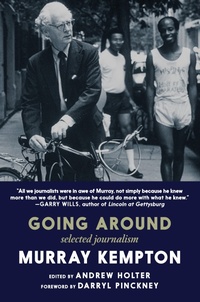
Going Around
Selected Journalism
Published on 7. October 2025
480 pages
978-1-64421-452-7 (ISBN)
Description

A definitive collection of writings by the legendary Pulitzer Prize-winning reporter Murray Kempton (1917-1997) with a foreword by Darryl Pinckney, gathering dozens of columns, essays, and critiques from publications including The New York Post, The New York Review of Books, The New Republic, and Newsday.
With many uncollected and long out-of-print writings, this is the first volume of Kempton's work to appear in 30 years, a book that resdiscovers the legendary figure of journalism that David Remnick called "the greatest newspaperman in town."
"The man is a marvel. It's like listening to Louis Armstrong, or Roy Eldridge: you don't know where the hell he is going, but somehow he gets there and it knocks your socks off." -Frank Sinatra
A courtly man of Southern roots, Murray Kempton worked as a labor reporter for the New York Post, won a Pulitzer Prize while at Newsday, and was arrested at the Democratic National Convention in Chicago along the way. He wore three piece suits and polished oxfords and was known for riding his bicycle around New York City while listening to his CD Walkman and smoking a pipe with wild red hair that later turned white. He developed a taste for baroque prose and became, in the words of Robert Silvers, his editor at The New York Review of Books, ''unmatched in his moral insight into the hypocrisies of politics and their consequences for the poor and powerless.''
He went to court proceedings and traffic accidents and funerals and to speeches by people who either were or wanted to be rich and famous. He wrote about everything and anybody-Tonya Harding and Warren Harding, Fidel Castro and Mussolini, Harry Truman and Sal Maglie, St. Francis of Assisi and James Joyce and J. Edgar Hoover.
From dispatches from a hardscrabble coal town in Western Maryland, a bus carrying Freedom Riders through Mississippi, an Iowa cornfield with Nikita Krushchev, an encampment of guerrillas in El Salvador, and Moscow at the end of the Soviet Union (these last two assignments filed by a reporter in his 70s), Kempton's concerns and interests were extraordinarily broad. He wrote about subjects from H.L. Mencken to Tupac Shakur; organized labor and McCarthyism; the Civil Rights and Black Power movements; presidential hopefuls and Mafiosi; frauds and failures of all stripes; the "splendors and miseries" of life in New York City.
With many uncollected and long out-of-print writings, this is the first volume of Kempton's work to appear in 30 years, a book that resdiscovers the legendary figure of journalism that David Remnick called "the greatest newspaperman in town."
"The man is a marvel. It's like listening to Louis Armstrong, or Roy Eldridge: you don't know where the hell he is going, but somehow he gets there and it knocks your socks off." -Frank Sinatra
A courtly man of Southern roots, Murray Kempton worked as a labor reporter for the New York Post, won a Pulitzer Prize while at Newsday, and was arrested at the Democratic National Convention in Chicago along the way. He wore three piece suits and polished oxfords and was known for riding his bicycle around New York City while listening to his CD Walkman and smoking a pipe with wild red hair that later turned white. He developed a taste for baroque prose and became, in the words of Robert Silvers, his editor at The New York Review of Books, ''unmatched in his moral insight into the hypocrisies of politics and their consequences for the poor and powerless.''
He went to court proceedings and traffic accidents and funerals and to speeches by people who either were or wanted to be rich and famous. He wrote about everything and anybody-Tonya Harding and Warren Harding, Fidel Castro and Mussolini, Harry Truman and Sal Maglie, St. Francis of Assisi and James Joyce and J. Edgar Hoover.
From dispatches from a hardscrabble coal town in Western Maryland, a bus carrying Freedom Riders through Mississippi, an Iowa cornfield with Nikita Krushchev, an encampment of guerrillas in El Salvador, and Moscow at the end of the Soviet Union (these last two assignments filed by a reporter in his 70s), Kempton's concerns and interests were extraordinarily broad. He wrote about subjects from H.L. Mencken to Tupac Shakur; organized labor and McCarthyism; the Civil Rights and Black Power movements; presidential hopefuls and Mafiosi; frauds and failures of all stripes; the "splendors and miseries" of life in New York City.
More details
Other editions
Additional editions
Book
04/2025
Seven Stories Press,U.S.
€28.50
Shipment within 3-4 weeks
Persons
MURRAY KEMPTON was born in 1917 and raised in the Mount Vernon neighborhood of Baltimore. He spent much of his career as a columnist for The New York Post and, later, New York Newsday. He wrote regularly for The New York Review of Books and contributed journalism, essays, and criticism to publications including The Progressive, Esquire, Rolling Stone, and The New Republic, where he worked briefly as an editor. He wrote two books: Part of Our Time: Some Ruins and Monuments of the Thirties (1955) and The Briar Patch: The People of New York vs. Lumumba Shakur, et al. (1973), which won a National Book Award. His other distinctions include two George Polk awards; the inaugural Sidney Hillman Prize; a Grammy for his contribution to the liner notes of a Frank Sinatra boxed set; and the Pulitzer Prize for Commentary in 1985. He died in New York City in 1997.
ANDREW HOLTER (b. 1990) is a historian and writer based in Chicago, formerly of Frederick, Maryland, and Baltimore. His work has appeared in The Times Literary Supplement, Rolling Stone, Los Angeles Review of Books, The Brooklyn Rail, Lapham's Quarterly, and other publications. As an independent historical researcher, he has contributed to books, radio programs, and museum exhibitions, and served as the primary archival consultant for Theo Anthony's 2016 documentary Rat Film, which the New Yorker called one of "62 Films That Shaped the Art of Documentary Filmmaking."
ANDREW HOLTER (b. 1990) is a historian and writer based in Chicago, formerly of Frederick, Maryland, and Baltimore. His work has appeared in The Times Literary Supplement, Rolling Stone, Los Angeles Review of Books, The Brooklyn Rail, Lapham's Quarterly, and other publications. As an independent historical researcher, he has contributed to books, radio programs, and museum exhibitions, and served as the primary archival consultant for Theo Anthony's 2016 documentary Rat Film, which the New Yorker called one of "62 Films That Shaped the Art of Documentary Filmmaking."
