

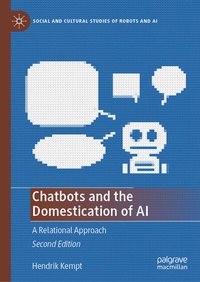
Chatbots and the Domestication of AI
Description

With the publication of chatGPT in December 2022, a new era of artificial dialogue systems and chatbots has emerged. Many established thinkers and figures have published their stance on the development of this technology, not rarely combined with stark language about its transformative potential and potential risks. New terminologies have found entrance to public and philosophical discourse, new regulatory frameworks have been introduced, from small to large scale, and an entire economy has shifted: many apps have sprung into existence using chatGPT and other LLMs as a basis for their services, large corporations take the risks of releasing unfinished language models to undercut the competition. In the meantime, many more stakeholders have entered the economic, regulatory, and social discourses on how to deal with this emerging technology. Taking the latest developments in the field into consideration this completely revised and updated second edition now includes new chapters on the tech-ethics of Large Language Models and LLMs as relational technology. The author considers the consequences of chatbots on human-human relationships, providing analysis on robot rights, human-centered design, and the social tension between robophobes and robophiles.
More details
Other editions
Additional editions
Person
Hendrik Kempt, PhD, is Postdoctoral scholar at the Applied Ethics Group at RWTH Aachen University. He has obtained his PhD from Aachen with works on the ethical concerns of using AI for medical diagnostics and has published several monographs on philosophical challenges regarding emerging technology, including "Synthetic Friends - A Philosophy of Human-Machine Friendship" (2022) and "(Un-)Explainable Technology" (2024), both with Palgrave Macmillan. He is also the author of a number of articles on related topics and the co-editor of "RuPaul's Drag Race and Philosophy" (2019).
Content
Chapter 1. Introduction.- Chapter 2. Methods.- Chapter 3. The Social Dimension.- Chapter 4. The Basics of Communicative AI.- Chapter 5. The Tech-Ethics of Large Language Models.-Chapter 6. Artificial Social Agents.- Chapter 7. Social Reverberations.- Chapter 8. Large Language Models als Relational Technology.- Chapter 9. Conclusions.
