

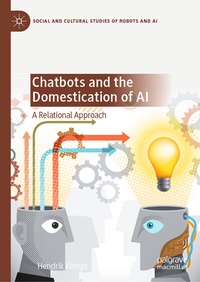
Chatbots and the Domestication of AI
Description

This book explores some of the ethical, legal, and social implications of chatbots, or conversational artificial agents. It reviews the possibility of establishing meaningful social relationships with chatbots and investigates the consequences of those relationships for contemporary debates in the philosophy of Artificial Intelligence. The author introduces current technological challenges of AI and discusses how technological progress and social change influence our understanding of social relationships. He then argues that chatbots introduce epistemic uncertainty into human social discourse, but that this can be ameliorated by introducing a new ontological classification or 'status' for chatbots. This step forward would allow humans to reap the benefits of this technological development, without the attendant losses. Finally, the author considers the consequences of chatbots on human-human relationships, providing analysis on robot rights, human-centered design, and the social tension between robophobes and robophiles.
More details
Other editions
Additional editions
Person
Hendrik Kempt, M.A. is Research Associate at the Institute for Applied Ethics at RWTH Aachen, Germany, and was previously a visiting scholar at the University of Southern California and Brown University, USA. He is author of Moral Progress and AI (in Yearbook of Practical Philosophy , 2019), and editor of RuPaul's Drag Race and Philosophy (2020).
