

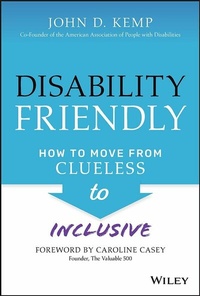
Disability Friendly
Description

Create a true culture of inclusion
Although progress has been made around equality for many marginalized groups, people with disabilities are still massively underrepresented in organizations’ Diversity, Equity, and Inclusion efforts. People with disabilities make up at least 15% of the population, yet they are still too often overlooked. Many people with disabilities are highly motivated, create fantastic work, and add tremendous value to organizations.
Disability Friendly is a clarion call to businesses around the world to realize the opportunities presented by employing people with disabilities. It explains the potential of disabled employees, how to create a culture of inclusion, and, in the process, help people with disabilities become proud contributors.
In this book, you’ll find:
- Concrete strategies for redesigning work and its processes to embrace all contributing citizens
- Ways to incorporate disability supports into a business’ diversity and inclusion practices and initiatives
- Methods for reducing the massive cost associated with government disability support payments and repurpose these as investments in the human potential of people with disabilities
Ideal for executives, managers, and other business leaders, Disability Friendly will also earn a place in the libraries of Diversity and Inclusion and Human Resources professionals seeking to make an impact on their company and on behalf of a marginalized group.
JOHN D. KEMP is widely respected as a leader in the disability movement for more than forty years. John currently serves as president and CEO of Lakeshore Foundation, an organization providing opportunities for individuals with physical disabilities to lead healthy, active, independent lives. As a co-founder of the American Association of People with Disabilities and as an international speaker and disability rights leader, John serves as a catalyst for change and increasing the political and economic power of people with disabilities.
More details
Other editions
Additional editions
Content
- Cover
- Title Page
- Copyright Page
- Contents
- Foreword
- Acknowledgments
- Introduction
- Part I What the World Is Missing When It Overlooks People with Disabilities
- Chapter 1 Disability Inclusion Benefits Everyone
- Chapter 2 The Power of Disability Entrepreneurship
- Are the Odds Stacked Against People with Disabilities Becoming Entrepreneurs?
- What Is the High Cost of Disability Exclusion?
- Chapter 3 Disability Is Essential to the Diversity, Equity, and Inclusion (DEI) Movement
- Where the DEI Movement May Have Originated
- How Do We Incorporate Disability Studies into These DEI Definitions?
- Chapter 4 Inclusive Design: Enabling Work by All
- User-Centered Design (UCD) and Design Thinking
- Benefits of Applying These Inclusive Design Practices to Work
- Part II What People with Disabilities Want Everyone Else to Know
- Chapter 5 Getting to Equal by Erasing Fear
- What Disabled People Want Nondisabled People to Know
- What Nondisabled People Want Disabled People to Know
- Chapter 6 Overcome Ableism by Recognizing Our Common Humanity
- "I'm Not Here to Make You Feel Better About Yourself"
- "Thank God Their Baby's Healthy"
- "At Least Yours Isn't as Bad as _______"
- "I'm Not Going to Sit Here Being Uncomfortable and Watching Her Eat"
- Chapter 7 "You Don't Look Disabled"
- In the Workplace: Disclosure Versus Passing
- So How Do We Resolve This?
- Chapter 8 Personal Experiences That Shaped My Concepts of Disability Culture
- What Is Disability Culture?
- Part III How to Become Disability Friendly: The Pillars of Disability Inclusion
- Chapter 9 Corporate Culture and Disability Culture
- Disability Culture
- What Is "Work" Today?
- Achieving a More Equitable, Embracing, Respecting World of Work for All People
- Attitudes and Stereotypes
- What Does Inclusive Mean?
- Diversity, Equity & Inclusion (Including Disability) Within Corporate Culture
- Chapter 10 Talent Acquisition Through Outreach and Recruitment
- Role of Technology in Hiring
- Myth of the Average
- "Most Qualified" for the Role
- Chapter 11 Hiring and Retaining the Best Talent
- Reasonable Accommodations
- Qualification Standards
- Job Announcements
- Career Development and Advancement
- Retention/Promotion
- The Importance of Accessibility in the DEI Conversation
- Chapter 12 Employers' Slow Progress to Disability-Friendly Inclusion
- Chapter 13 Communicating the Organization's Policies and Practices
- External Communications
- Internal Communications
- Chapter 14 Accessible Information and Communications Technology for All
- Talent Recruitment and Artificial Intelligence (AI)
- The "Business Case" Rationale
- Chapter 15 Blueprint for Disability-Friendly Workplaces of the Future: How to Create Inclusive, Safe, and Captivating Workplaces
- A Focus on Inclusion and Accessibility
- Purposeful Action and Collaboration
- Employees and Business/Employee Resource Groups
- Business Resource (Employee Resource) Groups
- Business Processes
- Customers, Consumers, and Community
- Appendix: The Viscardi Center's Curriculum for Its National Center on Disability Entrepreneurship
- NCDE Curriculum
- References
- About the Author
- Index
- EULA
