

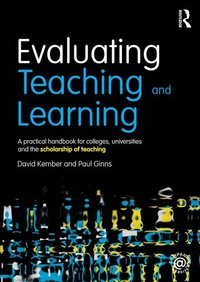
Evaluating Teaching and Learning
A practical handbook for colleges, universities and the scholarship of teaching
1st Edition
Published on 12. March 2012
192 pages
978-1-136-73010-8 (ISBN)
Description

Every semester, colleges and universities ask students to complete innumerable course and teaching evaluation questionnaires to evaluate the learning and teaching in courses they have taken. For many universities it is a requirement that all courses be evaluated every semester. The laudable rationale is that the feedback provided will enable instructors to improve their teaching and the curriculum, thus enhancing the quality of student learning.
In spite of this there is little evidence that it does improve the quality of teaching and learning. Ratings only improve if the instruments and the presentation of results are sufficiently diagnostic to identify potential improvements and there is effective counselling. Evaluating Teaching and Learning explains how evaluation can be more effective in enhancing the quality of teaching and learning and introduces broader and more diverse forms of evaluation.
This guide explains how to develop questionnaires and protocols which are valid, reliabile and diagnostic. It also contains proven instruments that have undergone appropriate testing procedures, together with a substantial item bank. The book looks at the specific national frameworks for the evaluation of teaching in use in the USA, UK and Australia.
It caters for diverse methodologies, both quantitative and qualitative and offers solutions that allow evaluation at a wide range of levels: from classrooms to programmes to departments and entire institutions. With detail on all aspects of the main evaluation techniques and instruments, the authors show how effective evaluation can make use of a variety of approaches and combine them into an effective project.
With a companion website which has listings of the questionnaires and item bank, this book will be of interest to those concerned with organising and conducting evaluation in a college, university, faculty or department. It will also appeal to those engaged in the scholarship of teaching and learning.
In spite of this there is little evidence that it does improve the quality of teaching and learning. Ratings only improve if the instruments and the presentation of results are sufficiently diagnostic to identify potential improvements and there is effective counselling. Evaluating Teaching and Learning explains how evaluation can be more effective in enhancing the quality of teaching and learning and introduces broader and more diverse forms of evaluation.
This guide explains how to develop questionnaires and protocols which are valid, reliabile and diagnostic. It also contains proven instruments that have undergone appropriate testing procedures, together with a substantial item bank. The book looks at the specific national frameworks for the evaluation of teaching in use in the USA, UK and Australia.
It caters for diverse methodologies, both quantitative and qualitative and offers solutions that allow evaluation at a wide range of levels: from classrooms to programmes to departments and entire institutions. With detail on all aspects of the main evaluation techniques and instruments, the authors show how effective evaluation can make use of a variety of approaches and combine them into an effective project.
With a companion website which has listings of the questionnaires and item bank, this book will be of interest to those concerned with organising and conducting evaluation in a college, university, faculty or department. It will also appeal to those engaged in the scholarship of teaching and learning.
Reviews / Votes
'The strength of the book is the fact that the questionnaires have been tried and tested. In adapting these researchers will need to be mindful of the context and the mechanisms that may influence or not the students' learning.' - Lesley Moore, SRHE News 2012More details
Language
English
Place of publication
London
United Kingdom
Publishing group
Taylor & Francis Ltd
Target group
College/higher education
Professional and scholarly
Product notice
Reflowable
Illustrations
16 s/w Abbildungen, 19 s/w Tabellen
19 Tables, black and white; 16 Illustrations, black and white
File size
3,34 MB
ISBN-13
978-1-136-73010-8 (9781136730108)
Copyright in bibliographic data and cover images is held by Nielsen Book Services Limited or by the publishers or by their respective licensors: all rights reserved.
Schweitzer Classification
Other editions
Additional editions
David Kember | Paul Ginns
Evaluating Teaching and Learning
A practical handbook for colleges, universities and the scholarship of teaching
Book
12/2011
1st Edition
Routledge
€261.60
Shipment within 15-20 days
David Kember | Paul Ginns
Evaluating Teaching and Learning
A practical handbook for colleges, universities and the scholarship of teaching
Book
12/2011
1st Edition
Routledge
€82.10
Shipment within 15-20 days
Persons
David Kember is Professor in Higher Education, University of Hong Kong.
Paul Ginns is Senior Lecturer in Educational Psychology, University of Sydney, Australia.
Paul Ginns is Senior Lecturer in Educational Psychology, University of Sydney, Australia.
Content
Acknowledgements 1. Evaluation Principles 2. Questionnaire design 3. Questionnaires 4. Item Bank 5. Collecting and Processing Questionnaire Data 6. Collection of Qualitative Data 7. Analysis of Qualitative Data 8. Observation 9. Use of Assessment for Evaluation 10. Using Evaluation Data for the Scholarship of Teaching 11. International Perspectives on Teaching Evaluation 12. Institutional Use of Teaching Evaluation Data 13. Conclusion
