

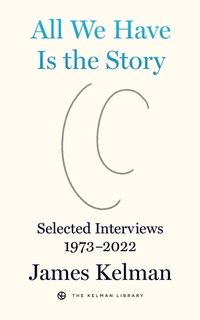
All We Have is the Story
Description

Novelist, playwright, essayist, and master of the short story. Artist and engaged working-class intellectual; husband, father, and grandfather as well as committed revolutionary activist.
From his first publication (a short story collection An Old Pub Near the Angel on a tiny American press) through his latest novel (God's Teeth and other Phenomena) and work with Noam Chomsky (Between Thought and Expression Lies a Lifetime?both published on a slightly larger American press), All We Have Is the Story chronicles the life and work?to date?of ?Probably the most influential novelist of the post-war period.? (The Times)
Drawing deeply on a radical tradition that is simultaneously political, philosophical, cultural, and literary, James Kelman articulates the complexities and tensions of the craft of writing; the narrative voice and grammar; imperialism and language; art and value; solidarity and empathy; class and nation state; and. above all, that it begins and ends with the story.
?One of the things the establishment always does is isolate voices of dissent and make them specific?unique if possible. It's easy to dispense with dissent if you can say there's him in prose and him in poetry. As soon as you say there's him, him, and her there, and that guy here and that woman over there, and there's all these other writers in Africa, and then you've got Ireland, the Caribean?suddenly there's this kind of mass dissent going on, and that becomes something dangerous, something that the establishment won't want people to relate to and go Christ, you're doing the same as me. Suddenly there's a movement going on. It's fine when it's all these disparate voices; you can contain that. The first thing to do with dissent is say 'You're on your own, you're a phenomenon.' I'm not a phenomenon at all: I'm just a part of what's been happening in prose for a long, long while.? ?James Kelman from a 1993 interview
More details
Other editions
Additional editions
Person
James Kelman was born in Glasgow, June 1946, and left school in 1961. He began work in the printing trade then moved around, working in various jobs in various places. He was living in England when he started writing: ramblings, musings, sundry phantasmagoria. He committed to it and kept at it. In 1969 he met and married Marie Connors from South Wales. They settled in Glasgow and still live in the dump, not far from their kids and grandkids. He still plugs away at the ramblings, musings, politicking and so on, supported by the same lady.
Content
- Cover
- Title Page
- Copyright
- Contents
- Acknowledgments
- 1: 1973: Interview by Anne Stevenson
- 2: 1974: Interview by Jack Haggerty
- 3: 1984 & 1985: Two Interviews by Duncan McLean
- 4: 1989: Interview by Kirsty McNeill
- 5: 1990: Interview by Variant
- 6: 1990-91: Interview by the Shadow, Glasgow
- 7: 1990: Interview by Chris Mitchell
- 8: 1992: Interview by Socialist Review
- 9: 1992: Conversation with Jeff Torrington
- 10: 1995: Interview by Scottish Trade Union Review
- 11: 2000: Interview by William Clark
- 12: 2002: Interview by "Wayne" for Writing on the Wall
- 13: 2002: Interview by Fabio Vericat
- 14: 2003: Interview by Michael Gardiner
- 15: 2003: Interview by Andrej Skubic
- 16: 2008: Interview by Darran Anderson
- 17: 2008: Interview by Jesse Wichterman
- 18: 2009: Interview by Paul Shanks
- 19: 2009: Interview by Roxy Harris
- 20: 2010: Interview by Viola Fort
- 21: 2012: Interview by Rosemary Goring
- 22: 2013: Interview by Seth Satterlee
- 23: 2015: Interview by Scott Hames
- 24: 2016: Interview by Ernest De Clerck
- 25: 2017: Interview by Robin Lloyd-Jones
- 26: 2018: Interview by Jim Gibson
- 27: 2018: Interview by thi wurd Literary Journal
- 28: 2019: Interview by Brian Hamill
- 29: 2022: Interview by Rastko Novakovic
- Index
- About the Author
