

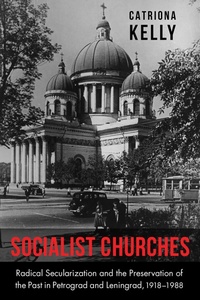
Socialist Churches
Radical Secularization and the Preservation of the Past in Petrograd and Leningrad, 1918-1988
Published on 1. November 2016
440 pages
978-1-5017-5758-7 (ISBN)
Description

In Russia, legislation on the separation of church and state in early 1918 marginalized religious faith and raised pressing questions about what was to be done with church buildings. While associated with suspect beliefs, they were also regarded as structures with potential practical uses, and some were considered works of art. This engaging study draws on religious anthropology, sociology, cultural studies, and history to explore the fate of these "socialist churches," showing how attitudes and practices related to them were shaped both by laws on the preservation of monuments and anti-religious measures.
Advocates of preservation, while sincere in their desire to save the buildings, were indifferent, if not hostile, to their religious purpose. Believers, on the other hand, regarded preservation laws as irritants, except when they provided leverage for use of the buildings by church communities. The situation was eased by the growing rapprochement of the Orthodox Church and Soviet state organizations after 1943, but not fully resolved until the Soviet Union fell apart. Based on abundant archival documentation, Catriona Kelly's powerful narrative portrays the human tragedies and compromises, but also the remarkable achievements, of those who fought to preserve these important buildings over the course of seven decades of state atheism. Socialist Churches will appeal to specialists, students, and general readers interested in church history, the history of architecture, and Russian art, history, and cultural studies.
Advocates of preservation, while sincere in their desire to save the buildings, were indifferent, if not hostile, to their religious purpose. Believers, on the other hand, regarded preservation laws as irritants, except when they provided leverage for use of the buildings by church communities. The situation was eased by the growing rapprochement of the Orthodox Church and Soviet state organizations after 1943, but not fully resolved until the Soviet Union fell apart. Based on abundant archival documentation, Catriona Kelly's powerful narrative portrays the human tragedies and compromises, but also the remarkable achievements, of those who fought to preserve these important buildings over the course of seven decades of state atheism. Socialist Churches will appeal to specialists, students, and general readers interested in church history, the history of architecture, and Russian art, history, and cultural studies.
Reviews / Votes
Having confiscated all the wealth of the church against which radicals raged for decades, the socialist regime begun by Lenin had to figure out what to do with buildings that had thereby become 'socialist churches.' This is the quandary that is splendidly explored in this groundbreaking study: what to do with all these liturgical structuresThe book illuminates a neglected aspect of the history of a city and its life, and of the religious communities that sought to survive under an uncongenial regime.
(Slavonic and East European Review) Catriona Kelly, a recognized expert on St. Petersburg, has written an insightful and well-contextualized study of the diverse fortunes of the churches of this city during the Soviet period. Having scoured the archives and mastered the secondary sources, she has also provided a very rich bibliography as well as notes that reward reading.
(Journal of Church and State) One of the major strengths of Kelly's book is in this chronological scope, which allows her to narrate an entire history of the Soviet project to eradicate religion and the contradictory process that stemmed from this effort. Kelly's story is remarkably researched, packed full of insights, and highly readable.
(Journal of Modern History) Kelly clearly outlines the balancing act that officials undertook between state atheism and religious freedom, including employing inaction that achieved secularist goals through lack of financial support for repair. The work effectively challenges the assumption that Soviet Russia was entirely hostile to religious belief and practice.
(Publishers Weekly) Bringing together a wide range of sources and the author's intimate knowledge of St. Petersburg history, this study is a pleasure to read and can form an excellent bridge for specialists in twentieth-century cultural, urban, and religious history who wish to understand how Soviet Russia fits into transnational trends.
(American Historical Review)
More details
Series
Language
English
Place of publication
United States
Publishing group
Cornell University Press
Target group
College/higher education
ISBN-13
978-1-5017-5758-7 (9781501757587)
Copyright in bibliographic data and cover images is held by Nielsen Book Services Limited or by the publishers or by their respective licensors: all rights reserved.
Schweitzer Classification
Other editions
Additional editions
Catriona Kelly
Socialist Churches
Radical Secularization and the Preservation of the Past in Petrograd and Leningrad, 1918-1988
Book
11/2016
Northern Illinois University Press
€78.28
Shipment within 3-4 weeks
Person
Catriona Kelly is professor of Russian at the University of Oxford and a fellow of New College. She has written widely on Russian cultural history, including St Petersburg.
