

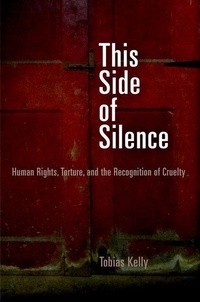
This Side of Silence
Human Rights, Torture, and the Recognition of Cruelty
1st Edition
Published on 29. November 2011
232 pages
978-0-8122-0523-7 (ISBN)
Description

We are accustomed to thinking of torture as the purposeful infliction of cruelty by public officials, and we assume that lawyers and clinicians are best placed to speak about its causes and effects. However, it has not always been so. The category of torture is a very specific way of thinking about violence, and our current understandings of the term are rooted in recent twentieth-century history. In This Side of Silence, social anthropologist Tobias Kelly argues that the tensions between post-Cold War armed conflict, human rights activism, medical notions of suffering, and concerns over immigration have produced a distinctively new way of thinking about torture, which is saturated with notions of law and trauma.
This Side of Silence asks what forms of suffering and cruelty can be acknowledged when looking at the world through the narrow legal category of torture. The book focuses on the recent history of Britain but draws wider comparative conclusions, tracing attempts to recognize survivors and perpetrators across the fields of asylum, criminal law, international human rights, and military justice. In this thorough and eloquent ethnography, Kelly avoids treating the legal prohibition of torture as the inevitable product of progress and yet does not seek to dismiss the real differences it has made in concrete political struggles. Based on extensive archival research and ethnographic fieldwork, the book argues that the problem of recognition rests not in the inability of the survivor to communicate but in our inability to listen and take responsibility for the injustice before us.
This Side of Silence asks what forms of suffering and cruelty can be acknowledged when looking at the world through the narrow legal category of torture. The book focuses on the recent history of Britain but draws wider comparative conclusions, tracing attempts to recognize survivors and perpetrators across the fields of asylum, criminal law, international human rights, and military justice. In this thorough and eloquent ethnography, Kelly avoids treating the legal prohibition of torture as the inevitable product of progress and yet does not seek to dismiss the real differences it has made in concrete political struggles. Based on extensive archival research and ethnographic fieldwork, the book argues that the problem of recognition rests not in the inability of the survivor to communicate but in our inability to listen and take responsibility for the injustice before us.
Reviews / Votes
"This Side of Silence approaches the problem of torture in an unconventional and illuminating way. Human rights scholars and students will relish its clarity and insightfulness. As for human rights campaigners, they will find in it a warning about the inherent limitations of the legal process and thus an invitation to think more deeply and imaginatively about when and how to use legal means in order to oppose the blight of torture and, indeed, other injustices too." (Human Rights Quarterly) "Tobias Kelly's critical, historically informed, and carefully researched book on the evolving concept of torture is an exciting and useful addition to the ongoing new wave of critical scholarship on human rights in political and legal anthropology. Kelly's work demonstrates the best of where anthropologists of human rights have arrived in the past ten to fifteen years and yet remains a unique contribution," (PoLAR: Political and Legal Anthropology Review) "This Side of Silence is an engagingly written, thoroughly researched, and brilliantly analyzed account of the rise of torture as one of the dominant legal and moral categories of our time. The meaning and use of the term 'torture' has undergone profound changes, and Tobias Kelly expertly charts how it has been shaped by recent developments in international law and medicine, media representations of the body and suffering, and the vagaries of the politics of human rights since 1945. This Side of Silence is an indispensible and compelling account of the new ethical prioritization of torture that pushes the boundaries of the anthropology of law and human rights and deserves to be read widely." (Richard A. Wilson, Professor of Anthropology and Law and Director of the Human Rights Institute at the University of Connecticut) "Where does our sense that torture is wrong come from? When do we find torture established? What harms committed by whom escape our attention and why? Probing the actions of doctors, lawyers, and judges in the UK, Tobias Kelly shows how the denunciation of torture succeeds only in limited circumstances. Ethically disturbing but politically necessary, his original, clear, and excellently informed account is a must-read for anyone interested in the fight against torture and/or the defence of human rights." (Marie-Benedicte Dembour, University of Sussex) "This Side of Silence is innovative, thought-provoking, and superbly written, a standout among the plethora of books on torture that have appeared since the Abu Ghraib prison scandal. Tobias Kelly analyzes the meaning of torture as a cultural and legal category. He demonstrates empirically, rather than conceptually or theoretically, that torture is 'a notoriously slippery subject' at every step of defining, documenting, diagnosing, recognizing, and prosecuting it." (Antonius C. G. M. Robben, Utrecht University)More details
Series
Language
English
Place of publication
Pennsylvania
United States
Target group
College/higher education
Professional and scholarly
File size
0,58 MB
ISBN-13
978-0-8122-0523-7 (9780812205237)
Copyright in bibliographic data and cover images is held by Nielsen Book Services Limited or by the publishers or by their respective licensors: all rights reserved.
Schweitzer Classification
Other editions
Additional editions
Book
10/2013
University of Pennsylvania Press
€33.00
Shipment within 10-20 days
Book
11/2011
University of Pennsylvania Press
€50.84
Article exhausted; check different version
Person
Tobias Kelly teaches social anthropology at the School of Social and Political Science, University of Edinburgh, and is coeditor of Traitors: Suspicion, Intimacy, and the Ethics of State-Building, also available from the University of Pennsylvania Press.
Content
Introduction
Chapter 1. Talking about Torture after the Human Rights Revolution
Chapter 2. The Legal Recognition of Torture Survivors
Chapter 3. Clinical Evidence about Torture
Chapter 4. Predicting the Future Risk of Torture
Chapter 5. Prosecuting Torture
Chapter 6. The Shame of Torture
Conclusion
Notes
Bibliography
Index
Acknowledgments
Chapter 1. Talking about Torture after the Human Rights Revolution
Chapter 2. The Legal Recognition of Torture Survivors
Chapter 3. Clinical Evidence about Torture
Chapter 4. Predicting the Future Risk of Torture
Chapter 5. Prosecuting Torture
Chapter 6. The Shame of Torture
Conclusion
Notes
Bibliography
Index
Acknowledgments
