

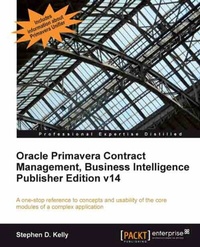
Oracle Primavera Contract Management, Business Intelligence Publisher Edition v14
A one-stop reference to concepts and usability of the core modules of a complex application with this book and ebook.
1st Edition
Published on 13. January 2025
208 pages
978-1-84968-691-4 (ISBN)
Description

A one-stop reference to concepts and usability of the core modules of a complex application with this book and ebook.Key Features - Contract Management concepts
- Understand PCM from thirty-thousand feet to the ground
- What you learn can be used when working with previous versions
- Section on the new Primavera Unifier
Book DescriptionOracle's Primavera Contract Management, Business Intelligence Publisher Edition is a document management, job cost, and field controls solution that keeps construction projects on schedule and on budget through complete project control. "Oracle Primavera Contract Management, Business Intelligence Publisher Edition v14" explains the concepts behind the core modules and how to use them."Oracle Primavera Contract Management, Business Intelligence Publisher Edition v14" makes this complex application understandable. You will understand the concepts behind the core modules and how to use them. This book starts with some basic introduction to Contract management and then covers the advantages and disadvantages of using a spreadsheet in managing information on a project. The book then covers in detail the concepts involved with how it works from a 30,000 foot view and explains the concept of how Oracle Primavera Contract Management is diametrically opposed to a spreadsheet mentality. The book also covers the aspects of how Oracle Primavera Contract Management manages the money and contractual relationships on a project.What you will learn - The concepts of Contract Management differs with each organization, learn how PCM is designed to work your way
- Learn how to manage the over-abundance of data in a project and find what you are looking for quickly
- There is too much information to keep in your head; use PCM for easy storage and retrieval.
- The Cost Worksheet is your friend, learn how to use it to your benefit.
- The Change Process can be daunting, learn the various methods to manage this potentially complex procedure.
- Learn to set up the Change Process to match your business; don t be forced into a box.
- Payments are key to a successful business, learn how to manage them quickly and easily
- Improperly managed submittals are the second highest reason for losing money on a project; learn that your project does not need to be part of this statistic.
- Learn how to use the drawings module to know who has what and when.
- Learn how PCM can help out in the field
Who this book is forAnyone who is using or is considering using contract management tools such as Oracle Primavera Contract Management. This books provides a great basis of understanding of how these types of tools work and how you can use them. Includes a section of the new Primavera Unifier as well.
- Understand PCM from thirty-thousand feet to the ground
- What you learn can be used when working with previous versions
- Section on the new Primavera Unifier
Book DescriptionOracle's Primavera Contract Management, Business Intelligence Publisher Edition is a document management, job cost, and field controls solution that keeps construction projects on schedule and on budget through complete project control. "Oracle Primavera Contract Management, Business Intelligence Publisher Edition v14" explains the concepts behind the core modules and how to use them."Oracle Primavera Contract Management, Business Intelligence Publisher Edition v14" makes this complex application understandable. You will understand the concepts behind the core modules and how to use them. This book starts with some basic introduction to Contract management and then covers the advantages and disadvantages of using a spreadsheet in managing information on a project. The book then covers in detail the concepts involved with how it works from a 30,000 foot view and explains the concept of how Oracle Primavera Contract Management is diametrically opposed to a spreadsheet mentality. The book also covers the aspects of how Oracle Primavera Contract Management manages the money and contractual relationships on a project.What you will learn - The concepts of Contract Management differs with each organization, learn how PCM is designed to work your way
- Learn how to manage the over-abundance of data in a project and find what you are looking for quickly
- There is too much information to keep in your head; use PCM for easy storage and retrieval.
- The Cost Worksheet is your friend, learn how to use it to your benefit.
- The Change Process can be daunting, learn the various methods to manage this potentially complex procedure.
- Learn to set up the Change Process to match your business; don t be forced into a box.
- Payments are key to a successful business, learn how to manage them quickly and easily
- Improperly managed submittals are the second highest reason for losing money on a project; learn that your project does not need to be part of this statistic.
- Learn how to use the drawings module to know who has what and when.
- Learn how PCM can help out in the field
Who this book is forAnyone who is using or is considering using contract management tools such as Oracle Primavera Contract Management. This books provides a great basis of understanding of how these types of tools work and how you can use them. Includes a section of the new Primavera Unifier as well.
All prices
More details
Other editions
Additional editions
Steve Kelly | Stephen D. Kelly
Oracle Primavera Contract Management Bi Version 14
Book
11/2012
Packt Publishing
€45.40
Shipment within 3-4 weeks
Person
Kelly Stephen :
Stephen D. Kelly graduated from Oregon State University in 1982 with a degree in Construction Engineering Management. He got his start with a mid-sized general contractor who was willing to take a chance with this college graduate and they both saw the benefits of a computer system in the contracting world. Even though the personal computer had not yet come to the scene, Steve was very interested in how computers could help the construction industry to manage time, cost and improve efficiencies. Steve used his knowledge gained at the University and a lot of "on-the-job training" along with his love for computers to advance in the construction industry. He then moved to computerized estimating and building estimating databases to allow estimators to become more efficient and more accurate. The problem was that the more accurate the estimator became, the more projects he would lose as he was more accurate and not bound to miss anything. After working for many years in the construction industry in various positions and organizations, Steve decided he wanted to work for many companies at once and help them computerize their business in the construction industry. At this time, Primavera had already placed itself in the forefront of the computerized scheduling market with its DOS product, Primavera Project Planner (P3). Primavera then bought Expedition and started to market this as a project communication and cost controls tool to accompany their flagship product. The rest (as they say) is history. Steve has been implementing and training with the Primavera suite since 1985. He has worked around the world in many large organizations to help them understand project controls and how to properly implement and use a tool such as Oracle Primavera Contract Management. His company, Pro Management Systems, Inc. has built many third-party applications to enhance the abilities of PCM. Steve has a passion, and is known for his desire to understand a business before even talking about the various tools available. Like he says, "I want to learn how you do business and then figure out how to possibly improve those processes and wrap the tools around them." He relates project management to the fireman profession. He has given speeches on this comparison saying, "Even if a fire is put out quickly, there is always residual damage to deal with." In other words, it is better to keep the fires from starting at all. He likens that concept to project management and uses the Primavera tools to allow his clients to be proactive rather than reactive. He says, "Why not let the computer tell me what information needs my attention, it is much smarter and faster than I ever dreamed." Steve has a wonderful, supportive wife of 30 years, five children, and two grandchildren. He lives on a small farm in Oregon where he enjoys time in the out of doors.
Stephen D. Kelly graduated from Oregon State University in 1982 with a degree in Construction Engineering Management. He got his start with a mid-sized general contractor who was willing to take a chance with this college graduate and they both saw the benefits of a computer system in the contracting world. Even though the personal computer had not yet come to the scene, Steve was very interested in how computers could help the construction industry to manage time, cost and improve efficiencies. Steve used his knowledge gained at the University and a lot of "on-the-job training" along with his love for computers to advance in the construction industry. He then moved to computerized estimating and building estimating databases to allow estimators to become more efficient and more accurate. The problem was that the more accurate the estimator became, the more projects he would lose as he was more accurate and not bound to miss anything. After working for many years in the construction industry in various positions and organizations, Steve decided he wanted to work for many companies at once and help them computerize their business in the construction industry. At this time, Primavera had already placed itself in the forefront of the computerized scheduling market with its DOS product, Primavera Project Planner (P3). Primavera then bought Expedition and started to market this as a project communication and cost controls tool to accompany their flagship product. The rest (as they say) is history. Steve has been implementing and training with the Primavera suite since 1985. He has worked around the world in many large organizations to help them understand project controls and how to properly implement and use a tool such as Oracle Primavera Contract Management. His company, Pro Management Systems, Inc. has built many third-party applications to enhance the abilities of PCM. Steve has a passion, and is known for his desire to understand a business before even talking about the various tools available. Like he says, "I want to learn how you do business and then figure out how to possibly improve those processes and wrap the tools around them." He relates project management to the fireman profession. He has given speeches on this comparison saying, "Even if a fire is put out quickly, there is always residual damage to deal with." In other words, it is better to keep the fires from starting at all. He likens that concept to project management and uses the Primavera tools to allow his clients to be proactive rather than reactive. He says, "Why not let the computer tell me what information needs my attention, it is much smarter and faster than I ever dreamed." Steve has a wonderful, supportive wife of 30 years, five children, and two grandchildren. He lives on a small farm in Oregon where he enjoys time in the out of doors.
Content
- Intro
- Oracle Primavera Contract Management, Business Intelligence Publisher Edition v14
- Table of Contents
- Oracle Primavera Contract Management, Business Intelligence Publisher Edition v14
- Credits
- About the Author
- About the Reviewers
- www.PacktPub.com
- Support files, eBooks, discount offers and more
- Why Subscribe?
- Free Access for Packt account holders
- Instant Updates on New Packt Books
- Preface
- PCM history
- PCM versions
- Quick look at Version 14
- PCM concepts
- What this book covers
- Who this book is for
- Conventions
- Reader feedback
- Customer support
- Errata
- Piracy
- Questions
- 1. Welcome to Oracle Primavera Contract Management v14
- Contracts
- The contract in simplified terms
- Oracle Primavera Contract Management in a nutshell
- Don't be afraid
- Summary
- 2. Information Overload
- Types of project information
- Where does all this information come from
- Using a hierarchical structure
- Storage of information
- Summary
- 3. So Much to Manage
- Types of information
- Information sent or received
- Information sent
- Information received
- Module Types
- Requests
- Notices
- Noncompliance Notice
- Proposals
- Changes
- Summary
- 4. The Almighty Spreadsheet
- Overusage of the spreadsheet
- Accountability
- My spreadsheet
- Spreadsheet = silo
- Summary
- 5. There Is a Better Way
- What to use
- Accessibility
- Security
- Integration
- Capabilities
- Configuration and customization
- Output
- Forms
- Reports
- Letters
- Dunning Letters
- There are options
- Summary
- 6. The Big Picture
- Thirty-thousand foot view
- The money
- A matter of perspective
- Understanding the hierarchy
- Project hierarchy
- The cost hierarchy
- Summary
- 7. System versus Silo
- Typical silo approach
- What's wrong with this approach
- The system approach
- Summary
- 8. Follow the Money
- It starts with the Cost Worksheet
- Contracts
- Actuals
- Procurement
- Variances
- Miscellaneous
- Drilling down to the detail
- Summary
- 9. The Only Constant Is Change
- Understanding the process
- What happens on the Cost Worksheet?
- Example of a Change Management matrix
- Budget Contract Estimated Phase
- Document Type
- To and From
- Cost Worksheet
- Commitment Contract(s) Estimated Phase
- Document Type
- To and From
- Cost Worksheet
- Commitment Contract(s) Quoted Phase
- Document Type
- To and From
- Cost Worksheet
- Budget Contract Quoted Phase
- Document Type
- To and From
- Cost Worksheet
- The Negotiated Phase
- Budget Contract Negotiated Phase
- Document Type
- To and From
- Cost Worksheet
- Commitment Contract Negotiated Phase
- Document Type
- To and From
- Cost Worksheet
- The Final Phase
- Budget Contract Final Phase
- Document Type
- To and From
- Cost Worksheet
- Commitment Contract Final Phase
- Document Type
- To and From
- Cost Worksheet
- Budget Contract Beyond Final Phase
- Document Type
- To and From
- Cost Worksheet
- Commitment Contract Beyond Final Phase
- Document Type
- To and From
- Cost Worksheet
- Following a change
- Issues
- Initiating the change
- Rejecting a change
- Types of changes
- Summary
- 10. Time to Get Paid
- Cost Worksheet and payments
- Difference between Payment Requisitions and Invoices
- Setting up the Payment Certificates module
- Cost options
- Project Settings
- Cost Settings (Contract level)
- Creating the Payment Requisition template
- Adjusting and adding Pay Items
- Processing payments
- Invoices
- Summary
- 11. Reading your Crystal Ball
- How is this possible
- Forecasting
- Trends
- Summary
- 12. Managing Drawings
- What are drawings
- Adding drawings to my project
- One by one
- Import
- Third-party import tools
- Managing drawings
- Revising drawings
- Distributing drawings
- Summary
- 13. Processing Submittals
- Submittal overview
- Concepts for submittal management
- Multiple reviewers
- The submittal register
- Submittal setup
- Submittal packages
- Group by specification section
- Group by vendor
- Managing submittals
- Transmittals
- Summary
- 14. Out in the Field
- Request for Information
- Meeting Minutes
- Daily Reports
- Punch List
- Summary
- 15. P6 and PCM
- Connecting the tools
- P6 connected to PCM
- All modules
- Daily reports
- Submittals
- Payment requisitions
- PCM connected to P6
- Schedule information
- Update cost information
- Dictionary information
- Summary
- 16. Where Do We Go from Here?
- One man's opinion
- The next step
- No one likes change
- Proper implementation
- Proper training
- Mentoring
- Summary
- 17. The New Contract Management Tool
- History
- What does this mean?
- What does Unifier do for you?
- Summary
- Index

