

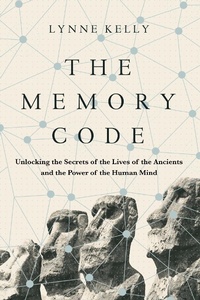
The Memory Code
Unlocking the Secrets of the Lives of the Ancients and the Power of the Human Mind
Published on 2. February 2017
336 pages
978-1-78239-907-0 (ISBN)
Description

In ancient, pre-literate cultures across the globe, tribal elders had encyclopedic memories. They could name all the animals and plants across a landscape, identify the stars in the sky and recite the history of their people. Yet today, most of us struggle to memorize more than a short poem.
Using traditional Aboriginal Australian song lines as a starting point, Lynne Kelly has since identified the powerful memory technique used by our ancestors and indigenous people around the world. In turn, she has then discovered that this ancient memory technique is the secret purpose behind the great prehistoric monuments like Stonehenge, which have puzzled archaeologists for so long.
The stone circles across Britain and northern Europe, the elaborate stone houses of New Mexico, huge animal shapes in Peru, the statues of Easter Island - these all serve as the most effective memory system ever invented by humans. They allowed people in non-literate cultures to memorize the vast amounts of information they needed to survive. But how?
For the first time, Lynne Kelly reveals the purpose of these monuments and their uses as 'memory places', and shows how we can use this ancient technique to train our minds.
Using traditional Aboriginal Australian song lines as a starting point, Lynne Kelly has since identified the powerful memory technique used by our ancestors and indigenous people around the world. In turn, she has then discovered that this ancient memory technique is the secret purpose behind the great prehistoric monuments like Stonehenge, which have puzzled archaeologists for so long.
The stone circles across Britain and northern Europe, the elaborate stone houses of New Mexico, huge animal shapes in Peru, the statues of Easter Island - these all serve as the most effective memory system ever invented by humans. They allowed people in non-literate cultures to memorize the vast amounts of information they needed to survive. But how?
For the first time, Lynne Kelly reveals the purpose of these monuments and their uses as 'memory places', and shows how we can use this ancient technique to train our minds.
Reviews / Votes
Dr Kelly has developed an intriguing and highly original account of the purpose of Stonehenge, Avebury and other stone monuments; the depth and breadth of her research, and the experimental experience she has brought to her study, command respect and invite serious attention. -- Ros Cleal, author of STONEHENGE IN ITS LANDSCAPE This is an exquisite thesis. Dr Lynne Kelly provides a perfectly rational explanation of ancient monuments as "memory spaces" where non-literate man could memorise pragmatic knowledge crucial to survival. -- Dominic O'Brien, World Memory Champion Takes the reader on a fascinating journey into the past and around the world... An engaging and exciting read. -- Iain Davidson, Emeritus Professor, University of New EnglandMore details
Edition
Main
Language
English
Place of publication
London
United Kingdom
Target group
College/higher education
Professional and scholarly
Illustrations
3x8pp colour plates and integrated illos
File size
12,22 MB
ISBN-13
978-1-78239-907-0 (9781782399070)
Copyright in bibliographic data and cover images is held by Nielsen Book Services Limited or by the publishers or by their respective licensors: all rights reserved.
Schweitzer Classification
Other editions
Additional editions
Lynne Kelly
The Memory Code
Unlocking the Secrets of the Lives of the Ancients and the Power of the Human Mind
Book
02/2017
Atlantic Books
€44.76
Shipment within 3-4 weeks
Person
Dr Lynne Kelly is a science writer and an Honorary Research Associate at La Trobe University.
Content
- Cover
- Title Page
- Dedication
- Contents
- Preface
- Chapter 1 Encyclopaedic memories of the elders
- Indigenous knowledge of animals
- Indigenous knowledge of plants
- Performed and restricted knowledge
- Songlines
- Memory spaces and ancient Greeks
- Ceremonies serve a multiplicity of purposes
- Longevity of stories
- Integrated knowledge systems
- Chapter 2 Memory spaces, large and small
- Skyscapes of memory
- Miniature memory spaces
- Strings: twisted, turned and knotted
- Bundles of non-utilitarian objects
- Representation of mythological ancestors
- Pueblo corn stories: mythology and science
- Genealogies and totems
- Chapter 3 Memory spaces in a modern world
- The landscape as a memory space
- Skyscapes as a memory space
- Decks of cards as memory spaces
- Miniature memory spaces
- A myriad memory spaces
- Chapter 4 A journey through time
- The first modern humans
- Monumental memory spaces
- Chapter 5 The ever-changing memory spaces at Stonehenge
- A mind game of transition to settlement
- Stonehenge and the British Neolithic
- First stage: 3000-2920 BCE (Middle Neolithic)
- Henge ditches
- Stonehenge: the theories
- Second stage: 2620-2480 BCE (Late Neolithic)
- Third stage: 2480-2280 BCE (Copper Age)
- Fourth stage: 2280-2020 BCE (Early Bronze Age)
- Fifth stage: 1680-1520 BCE (Middle Bronze Age)
- Portable objects
- Memory spaces, mines and moving on
- Chapter 6 The megalithic complexes of Avebury and Orkney
- Avebury
- Windmill Hill
- West Kennet Long Barrow
- Avebury henge
- The Sanctuary
- Silbury Hill
- Orkney
- Skara Brae
- Carved stone balls
- Stones of Stenness
- Chambered cairns
- Maeshowe
- The Ring of Brodgar
- Chapter 7 Newgrange and the passage cairns of Ireland
- County Meath passage cairns
- Neolithic art
- The purpose of the passage cairns
- Circles of timber and stone
- Decorated stones
- Smaller passage cairns across County Meath
- Individual burials
- Chapter 8 The tall stones and endless rows of Carnac
- The Carnac Mounds and the Tumulus de Saint-Michel
- The Middle Neolithic passage cairns
- The stone rows of Carnac
- Gallery and lateral entrance graves
- Chapter 9 The unparalleled architecture of Chaco Canyon
- Pueblo Bonito
- Learning from contemporary Pueblo
- The Ancestral Puebloans at Chaco Canyon
- Great houses
- Enigmatic decorated objects
- Buying knowledge at Chaco Canyon
- Chapter 10 Giant drawings on the desert floor at Nasca
- Astronomy
- Making the lines
- The animal glyphs
- Trapezoids, squares and rectangles
- Straight lines dominate the pampa
- Time and change on the pampa
- Chapter 11 Memory spaces across the Americas
- The hunter-gatherers of Watson Brake and Poverty Point
- Memory spaces grow more complex
- Writing represents sound in Mesoamerica
- The earthworks of North America gain complexity
- The literate Aztecs and non-literate Inca
- Chapter 12 Polynesian navigators create a unique world on Easter Island
- The original settlers
- The amazing skill of the Pacific navigators
- Arriving on Easter Island
- Settling another small Polynesian island: Rarotonga
- Adapting to a different environment: New Zealand
- Knowledge structured by genealogy
- A memory space beyond the shoreline
- The collapse of a culture
- The Birdman cult
- Art in many forms
- Epilogue
- Acknowledgements
- About the author
- Notes
- Index
- Picture section
- Copyright
