

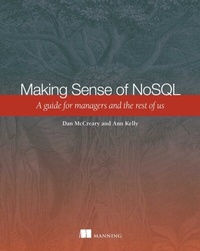
Making Sense of NoSQL
A guide for managers and the rest of us
1st Edition
Published on 2. September 2013
312 pages
978-1-63835-142-9 (ISBN)
Description

Summary
Making Sense of NoSQL clearly and concisely explains the concepts, features, benefits, potential, and limitations of NoSQL technologies. Using examples and use cases, illustrations, and plain, jargon-free writing, this guide shows how you can effectively assemble a NoSQL solution to replace or augment the traditional RDBMS you have now.
About this Book
If you want to understand and perhaps start using the new data storage and analysis technologies that go beyond the SQL database model, this book is for you. Written in plain language suitable for technical managers and developers, and using many examples, use cases, and illustrations, this book explains the concepts, features, benefits, potential, and limitations of NoSQL.
Making Sense of NoSQL starts by comparing familiar database concepts to the new NoSQL patterns that augment or replace them. Then, you'll explore case studies on big data, search, reliability, and business agility that apply these new patterns to today's business problems. You'll see how NoSQL systems can leverage the resources of modern cloud computing and multiple-CPU data centers. The final chaptersshow you how to choose the right NoSQL technologies for your own needs.
Managers and developers will welcome this lucid overview of the potential and capabilities of NoSQL technologies.
Purchase of the print book includes a free eBook in PDF, Kindle, and ePub formats from Manning Publications.
What's Inside
About the Authors
Dan McCreary and Ann Kelly lead an independent training and consultancy firm focused on NoSQL solutions and are cofounders of the NoSQL Now! Conference.
Table of Contents
Making Sense of NoSQL clearly and concisely explains the concepts, features, benefits, potential, and limitations of NoSQL technologies. Using examples and use cases, illustrations, and plain, jargon-free writing, this guide shows how you can effectively assemble a NoSQL solution to replace or augment the traditional RDBMS you have now.
About this Book
If you want to understand and perhaps start using the new data storage and analysis technologies that go beyond the SQL database model, this book is for you. Written in plain language suitable for technical managers and developers, and using many examples, use cases, and illustrations, this book explains the concepts, features, benefits, potential, and limitations of NoSQL.
Making Sense of NoSQL starts by comparing familiar database concepts to the new NoSQL patterns that augment or replace them. Then, you'll explore case studies on big data, search, reliability, and business agility that apply these new patterns to today's business problems. You'll see how NoSQL systems can leverage the resources of modern cloud computing and multiple-CPU data centers. The final chaptersshow you how to choose the right NoSQL technologies for your own needs.
Managers and developers will welcome this lucid overview of the potential and capabilities of NoSQL technologies.
Purchase of the print book includes a free eBook in PDF, Kindle, and ePub formats from Manning Publications.
What's Inside
- NoSQL data architecture patterns
- NoSQL for big data
- Search, high availability, and security
- Choosing an architecture
About the Authors
Dan McCreary and Ann Kelly lead an independent training and consultancy firm focused on NoSQL solutions and are cofounders of the NoSQL Now! Conference.
Table of Contents
- NoSQL: It's about making intelligent choices
- NoSQL concepts
- Foundational data architecture patterns
- NoSQL data architecture patterns
- Native XML databases
- Using NoSQL to manage big data
- Finding information with NoSQL search
- Building high-availability solutions with NoSQL
- Increasing agility with NoSQL
- NoSQL and functional programming
- Security: protecting data in your NoSQL systems
- Selecting the right NoSQL solution
More details
Other editions
Additional editions
Book
09/2013
Manning Publications
€33.00
Article exhausted; check different version
Persons
Ann Kelly is a NoSQL developer and NoSQL project manager with over 20 years experience in the computer and insurance industries. She has built NoSQL solutions for federal agencies as well as commercial projects. She is a CPCU (Chartered Property Casualty Underwriter)
Dan McCreary is a consultant with a focus on advanced technologies. He has worked for Bell Labs, the supercomputing industry, Steve Jobs NeXT Computer and cofounded a75-person consulting company. Beginning in 2000 he has focused on XML integration
Dan McCreary is a consultant with a focus on advanced technologies. He has worked for Bell Labs, the supercomputing industry, Steve Jobs NeXT Computer and cofounded a75-person consulting company. Beginning in 2000 he has focused on XML integration
Content
- Intro
- Copyright
- Brief Table of Contents
- Table of Contents
- Foreword
- Preface
- Acknowledgments
- About this Book
- Part 1. Introduction
- Chapter 1. NoSQL: It's about making intelligent choices
- Chapter 2. NoSQL concepts
- Part 2. Database patterns
- Chapter 3. Foundational data architecture patterns
- Chapter 4. NoSQL data architecture patterns
- Chapter 5. Native XML databases
- Part 3. NoSQL solutions
- Chapter 6. Using NoSQL to manage big data
- Chapter 7. Finding information with NoSQL search
- Chapter 8. Building high-availability solutions with NoSQL
- Chapter 9. Increasing agility with NoSQL
- Part 4. Advanced topics
- Chapter 10. NoSQL and functional programming
- Chapter 11. Security: protecting data in your NoSQL systems
- Chapter 12. Selecting the right NoSQL solution
- Index
- List of Figures
- List of Tables
- List of Listings
