

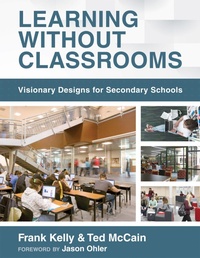
Learning Without Classrooms
Description

With foreword by Jason Ohler
Despite technological advancements, most secondary schools still function on ideas that are more than 100 years old. Learning Without Classrooms outlines new guidelines for how schools must operate to remain relevant and effective as we move further into the 21st century. Making a persuasive argument for moving beyond the long-established idea of operating schools with traditional classroom instruction to a personalized learning environment for individual students, the authors detail six crucial elements of school management (community, instruction, time, technology, school facilities, and funding) and how to address them concurrently to improve secondary school learning environments.
Transform secondary schools systemwide, from restructuring the physical learning environment to supporting personalized learning:
- Learn the six elements of schooling, and understand how changing any one element influences the others.
- Explore nine critical skills students need for success in the modern world.
- Review the structure and methodology behind an advisory-based concept for school management.
- Consider scenarios of what learning will look like in the near future as powerful new technological tools become available.
- Study seven visionary designs for how to renovate existing secondary school facilities to support technologically infused, personalized learning environments.
Contents:
Introduction
Part 1: Understanding 21st Century Learning
Chapter 1: The Classroom Has Run Its Course
Chapter 2: Key Principles for Modern Schooling
Chapter 3: Nine Essential Skills for the Modern World
Chapter 4: How Technology Will Change Education
Part 2: Designing 21st Century Schools
Chapter 5: Schooling for the Future
Chapter 6: How to Make It Happen
Chapter 7: Concepts for New Advisory-Based Schools
Part 3: Reimagining Seven Schools for the 21st Century
Chapter 8: Additional Considerations for Transitioning to an Advisory Format
Chapter 9: The Capital School
Chapter 10: The Green School
Chapter 11: The Connected School
Chapter 12: The Open School
Chapter 13: The District School
Chapter 14: The Tech School
Chapter 15: The Academy School
Epilogue
More details
Other editions
Additional editions
Content
- Intro
- Acknowledgments
- Table of Contents
- About the Authors
- Foreword
- Introduction
- Chapter 1
- Chapter 2
- Chapter 3
- Chapter 4
- Chapter 5
- Chapter 6
- Chapter 7
- Chapter 8
- Chapter 9
- Chapter 10
- Chapter 11
- Chapter 12
- Chapter 13
- Chapter 14
- Chapter 15
- Epilogue
- References and Resources
- Index
