

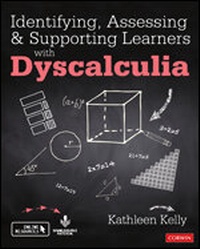
Identifying, Assessing and Supporting Learners with Dyscalculia
1st Edition
Published on 13. July 2020
368 pages
978-1-5297-3294-8 (ISBN)
Description

***** Online Resources are open access. No code is required *****
It is vital to understand the challenges and provide the right support for learners with dyscalculia and specific learning difficulties in mathematics.
The book provides:
* an overview of current research explaining the nature and causation of dyscalculia
* guidance on the identification of dyscalculia
* examples of how to carry out informal and formal assessments
* an explanation of the principles of multisensory mathematics teaching
* an outline of a structured programme (for learners aged 5-14), together with examples of lesson planning and activities.
Designed for teachers specialising in the assessment and teaching of learners with dyscalculia, and those undertaking courses leading to Approved Teacher Dyscalculia (ATD) and Associate Membership of the British Dyslexia Association (AMBDA), the book is useful to any professional looking for an understanding of this area of specific difficulty.
It is vital to understand the challenges and provide the right support for learners with dyscalculia and specific learning difficulties in mathematics.
The book provides:
* an overview of current research explaining the nature and causation of dyscalculia
* guidance on the identification of dyscalculia
* examples of how to carry out informal and formal assessments
* an explanation of the principles of multisensory mathematics teaching
* an outline of a structured programme (for learners aged 5-14), together with examples of lesson planning and activities.
Designed for teachers specialising in the assessment and teaching of learners with dyscalculia, and those undertaking courses leading to Approved Teacher Dyscalculia (ATD) and Associate Membership of the British Dyslexia Association (AMBDA), the book is useful to any professional looking for an understanding of this area of specific difficulty.
Reviews / Votes
Kelly provides up-to-date and accessible information for practitioners supporting children with dyscalculia. A strength of this book is the integration of theory and practice; providing those working with children the knowledge base they need to support children effectively. -- Dr Helen Curran A comprehensive, engaging and accessible book offering pertinent insights into the nature, identification and assessment of dyscalculia along with practical guidance on effective intervention. Essential reading for any professional who wishes to enhance their knowledge and practice in supporting learners who struggle with mathematics. -- Dr Pamela Moffett This long awaited text books clearly explains the complexity of dyscalculia while providing practical guidance and helpful examples of how to support learners in the classroom. Well written, accessible and full of practical ideas, it is an essential text book for anyone interested in supporting learners with SpLD. -- Rhiannon PackerMore details
Series
Language
English
Place of publication
London
United Kingdom
Publishing group
Sage Publications Ltd
Target group
Professional and scholarly
ISBN-13
978-1-5297-3294-8 (9781529732948)
Copyright in bibliographic data and cover images is held by Nielsen Book Services Limited or by the publishers or by their respective licensors: all rights reserved.
Schweitzer Classification
Other editions
Additional editions
Book
08/2020
1st Edition
Corwin UK
€162.60
Shipment within 15-20 days
Book
08/2020
1st Edition
Corwin UK
€95.50
Shipment within 15-20 days
Person
Dr Kathleen Kelly PhD, MA (SEN), Dip TESL, AMBDA, is an independent consultant and trainer in the field of specific learning difficulties. For many years she was a Senior Lecturer at Manchester Metropolitan University in the Centre for Inclusion and Disability Studies where she was Programme Leader for the MA in Specific Learning Difficulties and the Post Graduate Certificate in Dyscalculia. For several years she has taught courses on specific learning difficulties as part of the initial teacher training programme in addition to postgraduate awards. She has presented papers in this area at a number of international conferences and was part of the MMU research team that evaluated the Department for Education funded project 'Teaching for neurodiversity' led and coordinated by the British Dyslexia Association (2017). She has considerable experience in delivering courses to meet the criteria set out by the British Dyslexia Association for Approved Teacher Status (ATS) and is an Associate Member of the British Dyslexia Association (AMBDA). She was a member of the SASC/BDA working party (2019) which was set up to develop a new definition of dyscalculia and to produce guidance on identification and assessment.
Kathleen has taught a wide range of learners with dyslexia, from children as young as 4 years to 16 years. She has worked in both mainstream and special schools, for language support and learning support services, as a SENCO in a primary school, and as Head of Sixth Form in a special school. She has many years of experience in supporting multilingual children with special educational needs (including specific learning difficulties). Multilingualism and dyslexia is a particular area of interest, and her doctorate was also in this area. She is co-author of Phillips and Kelly (2018) Assessment of Learners with Dyslexic-Type Difficulties, 2nd edition and author of Kelly (2020) Identifying, Assessing and Supporting Learners with Dyscalculia.
Kathleen has taught a wide range of learners with dyslexia, from children as young as 4 years to 16 years. She has worked in both mainstream and special schools, for language support and learning support services, as a SENCO in a primary school, and as Head of Sixth Form in a special school. She has many years of experience in supporting multilingual children with special educational needs (including specific learning difficulties). Multilingualism and dyslexia is a particular area of interest, and her doctorate was also in this area. She is co-author of Phillips and Kelly (2018) Assessment of Learners with Dyslexic-Type Difficulties, 2nd edition and author of Kelly (2020) Identifying, Assessing and Supporting Learners with Dyscalculia.
Content
Introduction
Part I: Dyscalculia and Mathematics Related Difficulties: Setting the Context
Chapter 1: The Nature of Dyscalculia
Chapter 2: Differences and Similarities between Dyscalculia and other Mathematics Related Difficulties
Chapter 3: The Role of Memory in Learning Mathematics
Chapter 4: Cognitive Processing Difficulties (and Abilities)
Chapter 5: Mathematics Anxiety
Part II: Identification and Assessment of Dyscalculia
Chapter 6: Screening Procedures
Chapter 7: Assessment of Memory
Chapter 8: Assessment of Basic Number Skills
Chapter 9: Assessment of Cognitive Thinking Style in Mathematics
Chapter 10: Assessment for Visual Stress
Chapter 11: Writing an Assessment Report on Mathematics Related Difficulties
Part III: Planning an Intervention for Learners with Mathematics Difficulties
Chapter 12: Models of Mathematical Development
Chapter 13: Planning a Programme of Support
Chapter 14: Multisensory Mathematics Teaching and Lesson Planning
Chapter 15: Mathematical Vocabulary
Chapter 16: Developing Number Concept and Mathematical Relationships
Chapter 17: Deductive, Inductive and Abductive Reasoning
Part IV: Practical Teaching Examples
Chapter 18: Using Mathematical Models to Develop Relational Understanding
Chapter 19: Visualisation
Chapter 20: Problem-solving Approaches
Chapter 21: Linking Concepts to Everyday Events
Appendices
Appendix 1 (a) Digit Span Tasks
Appendix 1 (b) Visual Sequential Memory: Symbols
Appendix 1 (c) Visual-spatial Memory: Grids
Appendix 2: Outline of Programme (and Record Sheet)
Appendix 3 Solution to Algebra Problem (Grid Method)
Part I: Dyscalculia and Mathematics Related Difficulties: Setting the Context
Chapter 1: The Nature of Dyscalculia
Chapter 2: Differences and Similarities between Dyscalculia and other Mathematics Related Difficulties
Chapter 3: The Role of Memory in Learning Mathematics
Chapter 4: Cognitive Processing Difficulties (and Abilities)
Chapter 5: Mathematics Anxiety
Part II: Identification and Assessment of Dyscalculia
Chapter 6: Screening Procedures
Chapter 7: Assessment of Memory
Chapter 8: Assessment of Basic Number Skills
Chapter 9: Assessment of Cognitive Thinking Style in Mathematics
Chapter 10: Assessment for Visual Stress
Chapter 11: Writing an Assessment Report on Mathematics Related Difficulties
Part III: Planning an Intervention for Learners with Mathematics Difficulties
Chapter 12: Models of Mathematical Development
Chapter 13: Planning a Programme of Support
Chapter 14: Multisensory Mathematics Teaching and Lesson Planning
Chapter 15: Mathematical Vocabulary
Chapter 16: Developing Number Concept and Mathematical Relationships
Chapter 17: Deductive, Inductive and Abductive Reasoning
Part IV: Practical Teaching Examples
Chapter 18: Using Mathematical Models to Develop Relational Understanding
Chapter 19: Visualisation
Chapter 20: Problem-solving Approaches
Chapter 21: Linking Concepts to Everyday Events
Appendices
Appendix 1 (a) Digit Span Tasks
Appendix 1 (b) Visual Sequential Memory: Symbols
Appendix 1 (c) Visual-spatial Memory: Grids
Appendix 2: Outline of Programme (and Record Sheet)
Appendix 3 Solution to Algebra Problem (Grid Method)
