

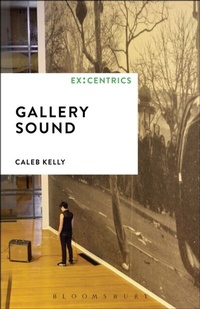
Gallery Sound
1st Edition
Published on 24. August 2017
176 pages
978-1-5013-0438-5 (ISBN)
Description

Sound is an integral part of contemporary art. Once understood to be a marginal practice, increasingly we encounter sound in art exhibitions through an array of sound making works in various art forms, at times played to very high audio levels. However, works of art are far from the only thing one might hear: music performances, floor talks, exhibition openings and the noisy background sounds that emanate from the gallery cafe fill contemporary exhibition environments. Far from being hallowed spaces of quiet reflection, what this means is that galleries have swiftly become very noisy places. As such, a straightforward consideration of artworks alone can then no longer account for our experiences of art galleries and museums. To date there has been minimal scholarship directed towards the intricacies of our experiences of sound that occur within the bounds of this purportedly 'visual' art space. Kelly addresses this gap in knowledge through the examination of historical and contemporary sound in gallery environments, broadening our understanding of artists who work with sound, the institutions that exhibit these works, and the audiences that visit them. Gallery Sound argues for the importance of all of the sounds to be heard within the walls of art spaces, and in doing so listens not only to the deliberate inclusion of sound within the art gallery in the form of artworks, performances, and music, but also to its incidental sounds, such as their ambient sounds and the noise generated by audiences. More than this, however, Gallery Sound turns its attention to the ways in which the acoustic characteristics specific to gallery spaces have been mined by artists for creative outputs, ushering in entirely new art forms.
Reviews / Votes
Gallery Sound underlines a shared history of experimental music and visual arts as well as the role of both in generating cross-genre interventions via the gallery space. Kelly's critical reading is timely, especially in relation to current debates and practices in sound art. * Journal of Sonic Studies * [A] short but wonderfully rich book ... For anyone interested in the often fractious relationship between art institutions and sound, this book is pretty much essential reading. * The Wire * [A] new remarkable book. * Neural * Caleb Kelly's Gallery Sound challenges the term 'sound art' by turning an ear toward the gallery itself as a site for (and of) sonic investigation. Kelly reminds us that galleries are rich with sound and that a full experiential encounter with artworks demands listening alongside looking. Lucidly written, Gallery Sound considers artworks that treat the sound of the gallery as a fundamental condition, as a container for noise, and as a site where music becomes a medium to be explored and exhibited. * Brian Kane, Associate Professor of Music, Yale University, USA * Gallery Sound responds to keen growing interest in sound in contemporary art. It inverts focus on sound art by showing how audio has been a latent force in the art gallery for at least half a century, and that the gallery can indeed be musical. Sound for Caleb Kelly is not simply a material or a medium but a phenomenon. The myth of the white cube space parallels the impossibility of silence as Kelly moves with alacrity through John Cage and Janet Cardiff, from Akio Suzuki via Bruce Nauman to Marina Rosenfeld. * Atau Tanaka, Professor of Media Computing, Goldsmiths, University of London, UK * Caleb Kelly has written a richly rewarding critical genealogy of sound in the art gallery. His book is at once authoritative and invigorating in its range and the buzzing excitement of its analyses. With Gallery Sound, he has secured his place as one of the leading commentators on the sonic arts. * Steven Connor, Grace 2 Professor of English, University of Cambridge, UK * Rich with details and examples of artists who are using contemporary galleries for sound-based art, even music making/performance ... Gallery Sound provides an engaging account of how contemporary artists have mined the sonic qualities of contemporary galleries for creative output and the production of new forms of contemporary art. * Leonardo Music Journal *More details
Series
Edition
1. Auflage
Language
English
Place of publication
New York
United States
Publishing group
Bloomsbury Publishing PLC (Digital)
Illustrations
11 bw illus
ISBN-13
978-1-5013-0438-5 (9781501304385)
Copyright in bibliographic data and cover images is held by Nielsen Book Services Limited or by the publishers or by their respective licensors: all rights reserved.
Schweitzer Classification
Other editions
Additional editions
Person
Caleb Kelly is an academic and curator engaged in sound as it relates to art and music. He is the author of Cracked Media: The Sound of Malfunction, and the editor of Sound. Kelly is a curator and a senior academic at UNSW Art & Design, Australia.
Content
Acknowledgements
Introduction
a. Listening to Visual Art
b. A Sound Context
1. The Empty Sounding Gallery
a. Silence and the Void
b. Silence
c. Sense of Sensing: Robert Irwin and James Turrell
d. Unified Sensory Situation: Michael Asher
e. Rendered Acoustical: Bruce Nauman
f. Eternal Music: La Monte Young
g. Echoing Resonance: Alvin Lucier
2. Noises in the Gallery
a. The New Loud Art Museum
b. Intervention and Interference: Marco Fusinato
c. Condoned Noise
d. Social Sounds
e. Walking and listening
3. Musical Galleries
a. Anti-Illusion: Steve Reich and Philip Glass
b. Off Site and impermanent.audio: Experimental and Improvised
c. Music as Art
Endnotes
Bibliography
Index
Introduction
a. Listening to Visual Art
b. A Sound Context
1. The Empty Sounding Gallery
a. Silence and the Void
b. Silence
c. Sense of Sensing: Robert Irwin and James Turrell
d. Unified Sensory Situation: Michael Asher
e. Rendered Acoustical: Bruce Nauman
f. Eternal Music: La Monte Young
g. Echoing Resonance: Alvin Lucier
2. Noises in the Gallery
a. The New Loud Art Museum
b. Intervention and Interference: Marco Fusinato
c. Condoned Noise
d. Social Sounds
e. Walking and listening
3. Musical Galleries
a. Anti-Illusion: Steve Reich and Philip Glass
b. Off Site and impermanent.audio: Experimental and Improvised
c. Music as Art
Endnotes
Bibliography
Index
