

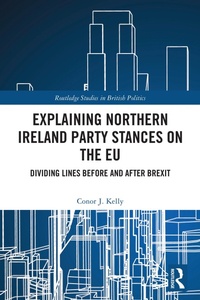
Explaining Northern Ireland Party Stances on the EU
Dividing Lines Before and After Brexit
Published on 11. June 2026
248 pages
978-1-040-61755-7 (ISBN)
Description

This book explores the European stances of three of Northern Ireland's political parties, culminating in one of the most tumultuous episodes in recent UK, Irish, and European politics.
It examines how and why Sinn Fein, the Ulster Unionist Party (UUP), and the Democratic Unionist Party (DUP) developed their respective positions on Europe and reveals that each party adopted approaches to the European Union (EU) that do not neatly align with expectations about the influence of party voters and members. To make sense of this, the book offers an alternative account grounded in historical institutionalism, incorporating additional factors that capture the transnational nature of Northern Ireland's politics. It stresses the importance of understanding how participation in different political institutions over time has shaped these parties' behaviour. It argues that an institutional analysis of party politics in Northern Ireland can add valuable insights, including into the tumultuous Brexit period, and demonstrates that the ways in which these parties approached European integration are key to understanding the wider story of the UK and Ireland's relationship with the EU.
This book will be of key interest to students and scholars of Irish politics and Irish studies, British politics, European politics and integration, and party politics.
It examines how and why Sinn Fein, the Ulster Unionist Party (UUP), and the Democratic Unionist Party (DUP) developed their respective positions on Europe and reveals that each party adopted approaches to the European Union (EU) that do not neatly align with expectations about the influence of party voters and members. To make sense of this, the book offers an alternative account grounded in historical institutionalism, incorporating additional factors that capture the transnational nature of Northern Ireland's politics. It stresses the importance of understanding how participation in different political institutions over time has shaped these parties' behaviour. It argues that an institutional analysis of party politics in Northern Ireland can add valuable insights, including into the tumultuous Brexit period, and demonstrates that the ways in which these parties approached European integration are key to understanding the wider story of the UK and Ireland's relationship with the EU.
This book will be of key interest to students and scholars of Irish politics and Irish studies, British politics, European politics and integration, and party politics.
Reviews / Votes
"The material is extremely timely and the book can be a reference point to all scholars, politicians and students, who are interested in shaping the constitutional future of these islands."Giada Lagana, Cardiff University, UK
"Well-written, well-organised, and empirically rich, as well as theoretically engaging."
Tim Bale, Queen Mary, University of London, UK
"This is an impressive book that is highly original empirically, covering new ground on party development and change in relation to the EU. It is novel theoretically in challenging the idea that traditional cleavages based on socio-economic, religious, or centre-periphery faultlines can explain the approaches of the parties towards Europe. Instead, multi-level historical institutionalism, based largely upon the variety of political institutions in which those parties sit (and interact with others) offers a more fruitful exploration of party behaviour."
Jon Tonge, University of Liverpool, UK
More details
Series
Language
English
Place of publication
London
United Kingdom
Publishing group
Taylor & Francis Ltd
Target group
College/higher education
Professional and scholarly
Product notice
Reflowable
Illustrations
11 Tables, black and white; 3 Line drawings, black and white; 3 Illustrations, black and white
File size
1,51 MB
ISBN-13
978-1-040-61755-7 (9781040617557)
Copyright in bibliographic data and cover images is held by Nielsen Book Services Limited or by the publishers or by their respective licensors: all rights reserved.
Schweitzer Classification
Other editions
Additional editions
Conor J. Kelly
Explaining Northern Ireland Party Stances on the EU
Dividing Lines Before and After Brexit
Book
approx. 06/2026
1st Edition
Routledge
€191.50
Not yet published
Person
Conor J. Kelly is the Bingham Fellow in Constitutional Studies at Balliol College, University of Oxford, UK.
Content
1. Introduction 2. Approaches to Understanding Party Behaviour 3. History of the Parties' European Positions (1973-2019) 4. Explaining Sinn Fein's EU Position 5. Explaining The Ulster Unionist Party's EU Position 6. Explaining The Democratic Unionist Party's EU Position 7. The Two Approaches After Brexit (2020-2024) 8. Conclusion
