

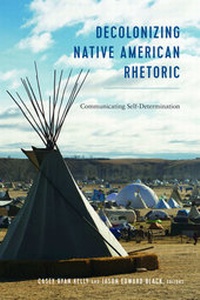
Decolonizing Native American Rhetoric
Description

As survivors of genocide, mnemonicide, colonization, and forced assimilation, American Indians face a unique set of rhetorical exigencies in US public culture. Decolonizing Native American Rhetoric brings together critical essays on the cultural and political rhetoric of American indigenous communities, including essays on the politics of public memory, culture and identity controversies, stereotypes and caricatures, mascotting, cinematic representations, and resistance movements and environmental justice.
This volume brings together recognized scholars and emerging voices in a series of critical projects that question the intersections of civic identity, including how American indigenous rhetoric is complicated by or made more dynamic when refracted through the lens of gender, race, class, and national identity. The authors assembled in this project employ a variety of rhetorical methods, theories, and texts committed to the larger academic movement toward the decolonization of Western scholarship. This project illustrates the invaluable contributions of American Indian voices and perspectives to the study of rhetoric and political communication.
More details
Other editions
Additional editions
Persons
Casey Ryan Kelly, Ph.D., University of Minnesota, is Associate Professor of Rhetoric & Public Culture at the University of Nebraska.
Jason Edward Black, Ph.D., University of Maryland, is Professor and Chair in the Department of Communication Studies at the University of North Carolina at Charlotte.
Content
List of Illustrations - Acknowledgments - Mary E. Stuckey: Foreword: The Questions of Decolonization - Casey Ryan Kelly/Jason Edward Black: Introduction: Decolonizing Native American Rhetoric - Part One: Time, Memory, and Identity - Randall A. Lake/Tyler Hiebert/Chris Robbins: Chapter One: Decolonizing Reconciliation: Art and Conciliation from the Ground Up Among Canadian Aboriginal Peoples - Catherine Palczewski: Chapter Two: Women at the Greasy Grass/Little Bighorn Battlefield National Monument: Remapping the Gendered/Sexed Circumference of Memory - Lee M. Pierce: Chapter Three: Melancholic Mirages and Ethopoeic Enemies: Reconsidering Temporality in Canada's Apologies to First Peoples - Matthew Brigham/Paul Mabrey: Chapter Four: "The Original Homeland Security, Fighting Terrorism Since 1492": A Public Chrono-Controversy - Part Two: Representations, Caricatures, and the Popular - Christopher J. Gilbert: Chapter Five: Decolonizing Caricature: Prosopographia in the Comic Politics of Marty Two Bulls, Sr. - Amanda Morris/Casey R. Schmitt: Chapter Six: Indians Aren't Funny: Native Stand-Up as Contact Zone - Danielle Endres: Chapter Seven: A Critical Rhetorical History of the Utes Nickname - Raymond Blanton: Chapter Eight: Survive or Surrender: The Rhetoric of Indigenous Land in Hell or High Water and Wind River - Part Three: "Rhetorics of Resistance" - Stephanie Houston Grey: Chapter Nine: The Tail of the Black Snake: Social Protest and Survivance in South Louisiana - Margret McCue-Enser: Chapter Ten: Intersectional Rhetoric and the Perversity of Form: Ada Deer's Confirmation Statement as Resistive Rhetoric - Kelly Young: Chapter Eleven: The Rhetorical Persona of the Water Protectors: Anti-Dakota Pipeline Resistance with Mirror Shields - Rachel Presley: Chapter Twelve: Between a Rock and a Hard Place: Rhetorical Strategies for Environmental Protection and Tribal Resistance in the Dakota Access Pipeline Movement - Kristine Warrenburg Rome: Chapter Thirteen: Counterpublicity and the Trail of Broken Treaties: Why Not "AIM" for New Sites of Deliberation? - Anthony Sutton: Chapter Fourteen: Farming, Fieldwork, and Sovereignty: Addressing Colonialist Systems with Participatory Critical Rhetoric - Contributor Biographies - Index.
