

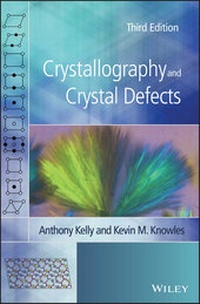
Crystallography and Crystal Defects
Description

This new edition of Crystallography and Crystal Defects explains the modern concepts of crystallography in a clear, succinct manner and shows how to apply these concepts in the analyses of point, line and planar defects in crystalline materials.
Fully revised and updated, this book now includes:
* Original source references to key crystallographic terms familiar to materials scientists
* Expanded discussion on the elasticity of cubic materials
* New content on texture that contains more detail on Euler angles, orientation distribution functions and an expanded discussion on examples of textures in engineering materials
* Additional content on dislocations in materials of symmetry lower than cubic
* An expanded discussion of twinning which includes the description and classification of growth twins
* The inclusion and explanation of results from atomistic modelling of twin boundaries
* Problem sets with new questions, detailed worked solutions, supplementary lecture material and online computer programs for crystallographic calculations.
Written by authors with extensive lecturing experience at undergraduate level, Crystallography and Crystal Defects, Third Edition continues to take its place as the core text on the topic and provides the essential resource for students and researchers in metallurgy, materials science, physics, chemistry, electrical, civil and mechanical engineering.
More details
Other editions
Additional editions
Persons
Anthony Kelly was a Founding Fellow of Churchill College, Cambridge and Director of Studies in Natural Sciences at the College. He also worked at the National Physical Laboratory and Imperial Chemical Industries before becoming Vice-Chancellor of Surrey University, UK. Professor Kelly returned to Cambridge as a Fellow of Churchill College in 1994.
Kevin M. Knowles is a Fellow of Churchill College, Cambridge and a former Director of Studies in Natural Sciences at the College. He is also a Senior University Lecturer in the Department of Materials Science and Metallurgy at Cambridge University, UK.
Content
Part I
1) Lattice Geometry
2) Point Groups and Space Groups
3) Crystal Structures
4) Amorphous Materials and Special Types of Crystal-Solid Aggregates
5) Tensors
6) Strain, Stress, Piezoelectricity and Elasticity
Part II
7) Glide
8) Dislocations
9) Dislocations in Crystals
10) Point Defects
11) Twinning
12) Martensitic Transformations
13) Grain Boundaries
14) Interphase Boundaries
15) Texture
Appendices 1 to 8
Index
