

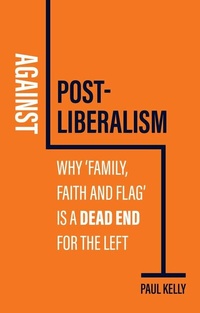
Against Post-Liberalism
Description

Liberal politics is in crisis and it is a crisis of its own making - so say the post-liberals whose new ideology of family, faith and flag is shaping debates about the future of the Left. But are they right? Does post-liberalism offer credible answers to the problems that characterise our increasingly fragmented and unequal world? In this bold analysis, political theorist Paul Kelly responds with a resounding no. He makes a powerful case against post-liberalism and exposes the flaws and contradictions of the dominant strands of post-liberal thinking. Drawing on the ideas of key post-liberal thinkers such as John Gray, Alasdair MacIntyre, Maurice Glasman, Matthew Goodwin, Danny Kruger, J.D. Vance, Patrick Deneen and Adrian Vermuele, he sheds light on some of the darker sources behind the movement, arguing that post-liberalism fails to take seriously the real challenges of late modernity. It is not feasible in its ambitions to return to a form of capitalism superseded by technological globalisation, and in its Trump/Vance US version it is an unattractive assault on equality, social mobility, university education and changes in social roles and expectations. Against Post-Liberalism is both a critique of post-liberal ideas and a passionate defence of liberalism. It is a must-read for anyone interested in contemporary challenges to liberalism and humane values.
More details
Other editions
Additional editions
Person
Paul Kelly is Professor of Political Theory and former Pro-Director at the London School of Economics and Political Science (LSE).
Content
Contents
Preface and Acknowledgements
1. The Post-Liberal Moment?
2. National Populism and the Unmasking of Liberalism
3. Common Good Communitarianism
4. Authoritarianism, Political Theology and the Common Good
5. Liberalism against Post-Liberalism
6. Why 'Faith, Family and Flag' is a Dead End
Notes
1
The Post-Liberal Moment?
The election of Donald Trump as 47th president of the United States, the largest liberal democratic state in the world, has turned out to be an unexpected triumph for post-liberalism. From being a relatively niche corner of political theory and a vocal but modest social media political movement, post-liberalism has ended up just one breath away from the presidency. Of course, no one thinks that Trump is a post-liberal. He has no real ideological commitments and, at worst, he is, according to some, a narcissistic opportunist, riding a wave of populist anti-incumbency. But his pick for vice president, J. D. Vance, is different.
Vance was a surprise pick for this role, as he was only a junior senator who had represented Ohio for two years. That said, he was a best-selling author of an autobiographical memoir, Hillbilly Elegy, which tells the story of the survival of a dysfunctional family in the former industrial region of Appalachia, which borders Kentucky and Ohio.1 It is a story of personal triumph against the odds and a complex reflection of place, belonging and industrial and social change. He goes on to serve in the military, then attends Yale Law School and moves into banking, Silicon Valley and politics. His book is not a philosophical one, but it chimes with much of the post-liberal message of social degradation and collapse that is central to Patrick Deneen's post-liberal manifesto Why Liberalism Failed. Vance subsequently became the focus of a group of post-liberal intellectuals and of a wider post-liberal movement, which captured the attention of Silicon Valley opinion formers such as Peter Thiel as well as of post-liberal academics like Deneen and others, who sought temporary intellectual sanctuary in Budapest with the support of Viktor Orban. In Vance, who, when it comes to the constitution, is just one heartbeat away from the presidency, we do indeed have someone who is associated with post-liberalism in its most vocal US variant; and, given that Trump is a single-term president, there may be more significance still to the political rise of post-liberalism. This phenomenon makes the issue of the nature of post-liberalism a pressing one for more than the usual audience of political theorists and commentators who have a professional interest in these things. The fact that the most significant liberal democracy is in the hands of a post-liberal movement that reclaims the vice president is itself extraordinary, and part of the motivation for this book. What precisely is post-liberalism?
Post-liberalism is a complex phenomenon, and one task of the present book is to unravel and examine it in order for us to fully comprehend the challenge it poses to liberal democracy. But at least one important strand, which stands out clearly both in its current US variant and in its older British variant, is the turn from the so-called agenda of rights and identity (mischaracterised as 'woke liberalism') to a socially conservative moral and political order that is captured by a focus on faith, family and flag. This is an ambiguous agenda, as we shall see, but one that is central to the message of Vance's Hillbilly Elegy, in which community, family and patriotism have been destroyed by distant financial elites - a world that Deneen summarises in the claim that liberalism has failed by succeeding in being liberal. 'Liberalism has failed - not because it fell short, but because it was true to itself. It has failed because it has succeeded. As liberalism has "become more fully itself", its inner logic has become more evident and its self-contradictions manifest.'2
Overcoming this liberal failure, which is precisely what Vance refers to - as does the British post-liberal Adrian Pabst in The Demons of Liberal Democracy - requires going back to a world of local community, attachment and solidarity as the starting point of a new order, beyond or after liberalism. This emphasis on faith, family and flag is paradoxical, as it is an indication of the substance of post-liberal policies and politics; but now it is also a claimed solution to the unpopularity of the left in the United Kingdom and Europe or, most recently, to the failure of the Democrats in the United States. They, too, need to become post-liberal. We have to go back to a socially conservative order to progress beyond the crisis of liberalism. The easy claim is that a coalition of the interest and identity groups of liberalism is no future for the left; instead the left must re-engage with the populist and blue-collar workers' agenda of a socially conservative public policy as a way of accommodating or confronting the challenges of neoliberalism. The idea that the left has gone woke and identitarian and has abandoned the material interests of ordinary people is not new even in the United States, but in the United Kingdom it goes back to the financial crisis of 2008 and the subsequent collapse of the Third Way's flirtation with globalisation. Lord Maurice Glasman, the leading voice of the post-liberal Blue Labour movement, a blue-collar faction within the British Labour Party, prefaces his eponymous book with a nostalgic picture of an old social democratic left based on community, trade unions, self-help and solidarity. In a biographical celebration of his grandmother that echoes a similar celebration of Vance's grandmother in Hillbilly Elegy, Glasman describes how her physical decline at the end of her life was mirrored in what he saw in the Labour movement of the post-crash world, with its 'uncritical embrace of globalisation, the domination of finance capital, combined with a pitiless progressive modernism, that left no place for . workers'.3
In the face of social disruption and economic crash - the fault of policies of austerity as much as of liberalism or social democracy - the post-liberal movement has built a politics of nostalgia for a more integrated, solidaristic and, dare I say, white world, which has now passed. The nostalgia for this lost world is not just a critique of the excess of neoliberalism but a conservative reaction against the benefits of liberal social mobility and change.
Yet there are stories that differ from Glasman's fond memories of working-class Hackney as a pathway to a better post-crash order. For some, the liberalism decried by advocates of faith, family and flag offered opportunity, equality and freedom. After losing his job with Volkswagen in Dublin in the mid 1950s, my dad got on the boat to seek work at the Ford factory in Dagenham - a place that looms large in the Blue Labour pantheon of virtue. But he was stopped on the way to Dagenham and ended up working for Black+Decker as a travelling salesman. I could easily have grown up in the world Paul Embery and Jon Cruddas write about; instead, I grew up as the child of Irish Catholic immigrants in a small Sussex town before moving to the seaside town of Brighton in my teens.4 Most of my schoolmates came from Irish, Polish, Italian, Spanish and German Catholic families. We were all British, second- or third-generation British - but not English. As Catholics, we were brought up to believe that we were different, not better; but as children of immigrants we were also told this by our neighbours. Boys who threw stones at me and my primary school friends in Burgess Hill because we were Catholics eventually became friends at Scouts, a few years and a couple of fights later. That background stayed with me. Opportunity and university meant liberation but not the repudiation of home, or of the past. For me and many of my schoolmates, what some see as the beginning of a dangerous and corrosive meritocracy and conflict between the liberated and the left behind was rather a version of the liberal ideal of fair equality of opportunity that I found in Rawls or in the education policies of Tony Crosland and Shirley Williams when I was growing up. As a child of immigrant Irish Catholics, I know community and I value it, but I also know that its paternalistic enforcement represented a world that my parents left behind and many contemporaries from different backgrounds found stifling, oppressive and often brutal and hostile. The idea that the opening of fair opportunities is a slippery slope towards social disorder and needs to be replaced by a public policy of localism, order, faith, family and flag is the second target of this book. The challenge to egalitarian liberalism posed by the post-liberal movement and its restrictive social conservatism risks closing the door to social mobility and real freedom and equality. These values are worth defending, especially when post-liberals may have the advantage that their capture of the most significant liberal democracy can be their strongest argument for the imposition of an inegalitarian order that brings large-scale social mobility to an end. This book is part of a defence of liberalism from this perspective.
Post-Liberalism: A Negative Ideology for a Political Movement
Before defending liberalism against the post-liberal critique or attempting to reverse that critique into post-liberalism itself, we must answer the obvious first question: what is post-liberalism? Deneen's Why Liberalism Failed invites us to think that liberalism is self-defeating and that we should move beyond it, but what that involves is by no means a straightforward matter. The identity of liberalism itself is also by no means uncontroversial and histories, defences and critiques of liberalism continue to pour from academic and popular...
