

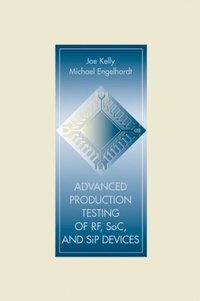
Advanced Production Testing of RF, SoC, and SiP Devices
1st Edition
Published on 1. January 2006
326 pages
978-1-58053-710-0 (ISBN)
Description

Featuring invaluable input from industry-leading companies and highly-regarded experts in the field, this first-of-its kind resource offers experienced engineers a comprehensive understanding of the advanced topics in RF, SiP (system-in-package), and SoC (system-on-a-chip) production testing that are critical to their work involving semiconductor devices. The book covers key measurement concepts for semiconductor device testing and assists engineers in explaining these concepts to management to aid in the reduction of project cost, time, and resources. Based on real-world experience and packed with time-saving equations, this in-depth volume offers professionals practical information on essential topics that have never been presented in a single reference before.
More details
Other editions
Additional editions
Michael Engelhardt | Joseph Kelly
Advanced Production Testing of RF, SoC, and SiP Devices
Book
12/2006
Artech House Publishers
€104.32
Shipment within 10-20 days
Content
- Advanced Production Testing of RF, SoC, and SiP Devices
- Contents vii
- Preface xvii
- Acknowledgments xix
- 1 Concepts of Production Testing of RF, SoC, and SiP Devices 1
- 1.1 Introduction 1
- 1.2 Test and Measurement 2
- 1.3 Production Test Systems 3
- 1.4 The Peripherals of Production Testing 4
- 1.5 The Test Program 7
- 1.6 Calibration 8
- 1.7 Reducing Test Costs 9
- 1.8 Testing RF, SoC, and SiP Devices 10
- References 18
- 2 Tests and Measurements I: Fundamental RF Measurements
- 2.1 S-Parameters 21
- 2.2 PLL Measurements 24
- 2.3 Power Measurements 27
- 2.4 Power-Added Efficiency 31
- References 33
- 3 Tests and Measurements II: Distortion 35
- 3.1 Introduction 35
- 3.2 Linearity 36
- 3.3 Distortion in SoC Devices 36
- 3.4 Transfer Function for Semiconductor Devices 37
- 3.5 Harmonic Distortion 38
- 3.6 Intermodulation Distortion 42
- 3.7 Measuring Intermodulation Distortion
- 3.8 Source Intermodulation Distortion 52
- 3.9 Cross Modulation 53
- 3.10 Gain Compression 54
- 3.11 Minimizing the Number of Averages in Distortion Measurements 56
- References 56
- 4 Tests and Measurements III: Noise 59
- 4.1 Introduction to Noise 59
- 4.2 Noise Figure 66
- 4.3 Phase Noise 82
- References 94
- Selected Bibliography 95
- 5 Advances in Testing RF and SoC Devices 97
- 5.1 Introduction 97
- 5.2 System-Level Testing 98
- 5.3 RF Wafer Probing 99
- 5.4 SiP Versus SoC Architectures 99
- 5.5 Designers' New Responsibilities 100
- 5.6 RF Built-In Self-Test (BIST) 102
- 5.7 Test System Architecture 103
- 5.8 Testing Wide Bandwidth Devices 104
- 5.9 Conclusion 106
- 6 Production Test Equipment
- 6.1 Introduction 109
- 6.2 Tuned RF Receivers Utilizing a Digitizer 110
- 6.3 Modern IC Power Detectors 114
- 6.4 Production Testing Using Digital Channels and PMU 121
- 6.5 Digitizers (ADCs) 125
- 6.6 Arbitrary Waveform Generators 126
- 6.7 Use of DSP in Production Test Equipment 130
- 6.8 Communicating with ATE Hardware 131
- 6.9 Summary 136
- References 136
- 7 Cost of Test 139
- 7.1 Introduction 139
- 7.2 Parameters Contributing to the COT 141
- 7.3 Basic COT Model 143
- 7.4 Multisite and Ping-Pong COT Models 145
- 7.5 COT Considerations When Using Test Houses 152
- 7.6 Accuracy and Guardbands 153
- 7.7 Summary 156
- References 157
- 8 Calibration 159
- 8.1 Overview 159
- References 173
- 9 Contactors 175
- 9.1 Introduction 175
- 9.2 Types of Contactors 177
- 9.3 Contactor Properties 180
- 9.4 Load Board Considerations 195
- 9.5 Handler Considerations 195
- 9.6 Overall Equipment Effectiveness 196
- 9.7 Maintenance and Inspection of Contactors 198
- 9.8 Manual Hold-Downs 199
- 9.9 Cost Considerations 199
- Acknowledgments 199
- References 200
- 10 Handlers 201
- 10.1 Introduction 201
- 10.2 Handler Types 202
- 10.3 Choosing a Handler Type 205
- 10.4 Throughput 207
- 10.5 Testing at Various Temperatures 212
- 10.6 Contacting the Device to the Load Board 214
- 10.7 Handler Footprint 215
- 10.8 Tester Interface Plane 215
- 10.9 Device Input and Output 215
- 10.10 Conversion and Changeover Kits 218
- References 219
- 11 Load Boards 221
- 11.1 Introduction 221
- 11.2 Materials 223
- 11.3 Electrical 231
- 11.4 Mechanical Design Considerations for Load Boards 246
- 11.5 Thermal Design Considerations for Load Boards 248
- 11.6 Load Board Verification 248
- 11.7 General Debugging and Design Considerations 249
- References 250
- 12 Wafer Probing 253
- 12.1 RF Wafer Probing 254
- 12.2 Yield of MCM Justifies Wafer Probing 254
- 12.3 Probe Cards 255
- 12.4 Types of Probe Cards 256
- 12.5 Selecting a Probe Card 258
- 12.6 Tester to Wafer Prober Interface 260
- 12.7 Calibration Methods for Measurements with Wafer Probing 262
- References 263
- Appendix A Power and Voltage Conversions 265
- Appendix B VSWR, Return Loss, and Reflection Coefficient 271
- Appendix C RF Coaxial Cables 275
- Appendix D RF Connectors 277
- Appendix E Decimal to Hexadecimal and ASCII Conversions 283
- Appendix F Numerical Prefixes 287
- About the Authors 289
- Index 291
