

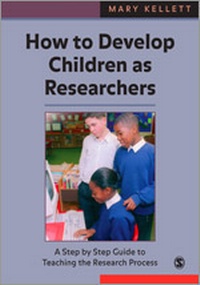
How to Develop Children as Researchers
A Step by Step Guide to Teaching the Research Process
1st Edition
Published on 22. February 2005
192 pages
978-1-84860-082-9 (ISBN)
Description

'This book will be really useful to all teachers of upper Primary/lower Secondary pupils but will be especially useful as a resource for using with gifted children of 9 to12 years, as it will promote and support the type of self-directed, investigative enquiry that they enjoy. The author also emphasises the importance of the research process rather than the written product, which will appeal to all those children who dislike the written presentation of work!
Each chapter outlines the learning outcomes, has a timed teaching content, and suggests a core activity; it also suggests differentiation and includes some simple 'games'. It is fully supported by photocopiable resources, making it a complete programme of work.
Although written for a specific age group, this is such an excellent basic guide, it would be of use to anyone conducting research for the first time' - Eve Wilson, Education Consultant, National Association for Gifted Children
'This inspirational and innovative programme will be welcomed by all those who want to teach research skills to children. Clear discussion notes, activities and games provide everything a busy teacher needs to be able to deliver the programme. No prior knowledge of research is necessary. This is an ideal resource for those who want to offer pupils the opportunity to make their voice heard through the research process' - Dr. Ruth MacConville, Head of SENS, London Borough of Ealing
'An excellent book... a very informative guide to supporting teachers in delivering a comprehensive research training package to children and young people' - Children & Society
Why teach research methodology to children?
An effective and meaningful way of enhancing children's learning, doing research, empowers children to participate actively in their own education and to make original contributions to knowledge. The research carried out by children is also a vital key to improving our own understanding of children and childhood.
This book's unique child-centred perspective provides an easy-to-follow model for teaching research methodology to children aged 10 and upwards. Packed with practical tips and photocopiable resources for the classroom, each chapter contains:
" a core activity designed to distil the teaching content and engage children with the main learning objectives
" ideas for supplementary activities and games
" follow-up homework
" mini boxed glossaries containing key research terms and their definitions
" and suggestions for further reading.
Key topics covered include: research design, data collection techniques, data analysis, dissemination, and children as active researchers.
Each chapter outlines the learning outcomes, has a timed teaching content, and suggests a core activity; it also suggests differentiation and includes some simple 'games'. It is fully supported by photocopiable resources, making it a complete programme of work.
Although written for a specific age group, this is such an excellent basic guide, it would be of use to anyone conducting research for the first time' - Eve Wilson, Education Consultant, National Association for Gifted Children
'This inspirational and innovative programme will be welcomed by all those who want to teach research skills to children. Clear discussion notes, activities and games provide everything a busy teacher needs to be able to deliver the programme. No prior knowledge of research is necessary. This is an ideal resource for those who want to offer pupils the opportunity to make their voice heard through the research process' - Dr. Ruth MacConville, Head of SENS, London Borough of Ealing
'An excellent book... a very informative guide to supporting teachers in delivering a comprehensive research training package to children and young people' - Children & Society
Why teach research methodology to children?
An effective and meaningful way of enhancing children's learning, doing research, empowers children to participate actively in their own education and to make original contributions to knowledge. The research carried out by children is also a vital key to improving our own understanding of children and childhood.
This book's unique child-centred perspective provides an easy-to-follow model for teaching research methodology to children aged 10 and upwards. Packed with practical tips and photocopiable resources for the classroom, each chapter contains:
" a core activity designed to distil the teaching content and engage children with the main learning objectives
" ideas for supplementary activities and games
" follow-up homework
" mini boxed glossaries containing key research terms and their definitions
" and suggestions for further reading.
Key topics covered include: research design, data collection techniques, data analysis, dissemination, and children as active researchers.
Reviews / Votes
`This inspirational and innovative programme will be welcomed by all those who want to teach research skills to children. Clear discussion notes, activities and games provide everything a busy teacher needs to be able to deliver the programme. No prior knowledge of research is necessary. This is an ideal resource for those who want to offer pupils the opportunity to make their voice heard through the research process' - Dr. Ruth MacConville, Head of SENS, London Borough of EalingAll prices
More details
Language
English
Place of publication
London
United Kingdom
Target group
Professional and scholarly
ISBN-13
978-1-84860-082-9 (9781848600829)
Copyright in bibliographic data and cover images is held by Nielsen Book Services Limited or by the publishers or by their respective licensors: all rights reserved.
Schweitzer Classification
Other editions
Additional editions
Mary Kellett
How to Develop Children as Researchers
A Step by Step Guide to Teaching the Research Process
Book
02/2005
1st Edition
SAGE Publications Inc
€79.41
Shipment within 10-20 days
Mary Kellett
How to Develop Children as Researchers
A Step by Step Guide to Teaching the Research Process
Book
02/2005
1st Edition
SAGE Publications Inc
€191.90
Shipment within 10-20 days
Person
Mary Kellett is the Founding Director of the Children's Research Centre at the Open University where she also lectures in Education. She chairs the third year undergraduate course 'Research with Children and Young People' and is co-editor of the widely-adopted readers 'The Reality of Research with Children and Young People' and ' Doing Research with Children and Young People' (SAGE in association with OUP). A former teacher, she has a life-long interest in developing children's learning and in promoting children's rights and increased participation.
Content
PART ONE: THE NATURE OF RESEARCH
What Is Research?
Learning from Other People's Research
Research Ethics
Framing a Research Question
PART TWO: DATA COLLECTION
Observation Techniques
Interview Techniques
Questionnaires and Surveys
Experimental Techniques
PART THREE: DATA ANALYSIS
Analyzing Qualitative Data
Analyzing Quantitative Data
PART FOUR: DISSEMINATION
Producing a Research Report
Presentation Skills
Children As Active Researchers
What Is Research?
Learning from Other People's Research
Research Ethics
Framing a Research Question
PART TWO: DATA COLLECTION
Observation Techniques
Interview Techniques
Questionnaires and Surveys
Experimental Techniques
PART THREE: DATA ANALYSIS
Analyzing Qualitative Data
Analyzing Quantitative Data
PART FOUR: DISSEMINATION
Producing a Research Report
Presentation Skills
Children As Active Researchers
