

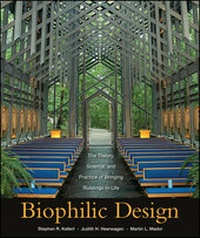
Biophilic Design
The Theory, Science and Practice of Bringing Buildings to Life
Published on 26. September 2011
400 pages
978-1-118-17424-1 (ISBN)
Description

"When nature inspires our architecture-not just how it looks buthow buildings and communities actually function-we will have madegreat strides as a society. Biophilic Design provides us withtremendous insight into the 'why,' then builds us a road map forwhat is sure to be the next great design journey of ourtimes."
-Rick Fedrizzi, President, CEO and Founding Chairman, U.S. GreenBuilding Council
"Having seen firsthand in my company the power of biomimicry tostimulate a wellspring of profitable innovation, I can sayunequivocably that biophilic design is the real deal. Kellert,Heerwagen, and Mador have compiled the wisdom of world-renownedexperts to produce this exquisite book; it is must reading forscientists, philosophers, engineers, architects and designers,and-most especially-businesspeople. Anyone looking for the key to anew type of prosperity that respects the earth should starthere."
-Ray C. Anderson, founder and Chair, Interface, Inc.
The groundbreaking guide to the emerging practice of biophilicdesign
This book offers a paradigm shift in how we design and build ourbuildings and our communities, one that recognizes that thepositive experience of natural systems and processes in ourbuildings and constructed landscapes is critical to human health,performance, and well-being. Biophilic design is about humanity'splace in nature and the natural world's place in human society,where mutuality, respect, and enriching relationships can andshould exist at all levels and should emerge as the norm ratherthan the exception.
Written for architects, landscape architects, planners,developers,environmental designers, as well as building owners, BiophilicDesign: The Theory, Science, and Practice of Bringing Buildings toLife is a guide to the theory, science, and practice of biophilicdesign. Twenty-three original and timely essays by world-renownedscientists, designers, and practitioners, including Edward O.Wilson, Howard Frumkin, David Orr, Grant Hildebrand, StephenKieran, Tim Beatley, Jonathan Rose, Janine Benyus, Roger Ulrich,Bert Gregory, Robert Berkebile, William Browning, and VivianLoftness, among others, address:
* The basic concepts of biophilia, its expression in the builtenvironment, and how biophilic design connects to human biology,evolution, and development.
* The science and benefits of biophilic design on human health,childhood development, healthcare, and more.
* The practice of biophilic design-how to implement biophilic designstrategies to create buildings that connect people with nature andprovide comfortable and productive places for people, in which theycan live, work, and study.
Biophilic design at any scale-from buildings to cities-begins witha few simple questions: How does the built environment affect thenatural environment? How will nature affect human experience andaspiration? Most of all, how can we achieve sustained andreciprocal benefits between the two?
This prescient, groundbreaking book provides the answers.
Reviews / Votes
"Stephen Kellert, a social ecologist, has spent much of his careerthinking and writing about biophilia, the innate human affinity fornature. Biophilic Design is an exploration of how we cut ourselvesoff from nature in the way we design the buildings andneighborhoods where we live and work. And it's an argument forre-connecting these spaces to the natural world, with plenty ofwindows, daylight, fresh air, plants and green spaces, naturalmaterials, and decorative motifs from the natural world." (YaleEnvironment 360, December 2009) "...Kellert asserts that people "learn better, work morecomfortably, and recuperate more successfully in buildings thatecho the environment in which the human species evolved." He saysthere are a number of ways to improve worker productivity andretention and reduce absenteeism. The most basic step is to improvethe availability of natural light. Kellert is analyzing the effectof biophilic design on office work productivity, absenteeism,number of sick days. Kellert believes there is a definiteconnection between biophilic spaces and improved productivity, andsome studies point to a positive relationship."(dirt.asla.org, September 2009) "By applying biophilia to design, the editors and contributorshope to go beyond the standard green architecture goal of simplylowering the environmental impact of buildings. They hope toenhance the human relationship with nature through buildingsbelieving, that one's affinity for light or water should beincorporated into the placement of windows. The book is dividedinto three parts. The first provides a theory of biophilic designand offers general guidelines. The second offers a more focusedlook at health issues and the role of nature. The third examinesapplied instances of biophilic design. Summing Up: Recommended"(Choice, September 2009) "These authors urge architects to do what they can toincorporate nature in the design of buildings."(GreenSource, April 2009) "Biophilic Design collects descriptions of current destructivepractices, analyzes their roots in human nature, and offerslow-cost, low-impact strategies for change." (ArchitectureBoston; Nov/Dec 2008) "Stephen Kellert's Biophilic Design...brings togetherbiologists, ecologists, psychologists, architects, designers andcity planners to probe the confluence of people, nature anddesign." (Miller-McCune.com, 7/14/08) "Make no mistake: Biophilic Design, all 400 pages of it, is oneof the best design books of this decade." (New Urban News,April-May 2008)More details
Other editions
Additional editions
Stephen R. Kellert | Judith Heerwagen | Martin Mador
Biophilic Design
The Theory, Science and Practice of Bringing Buildings to Life
Book
02/2008
Wiley
€96.50
Shipment within 10-20 days
Persons
Stephen R. Kellert is the Tweedy/Ordway Professor of SocialEcology and Co-Director of the Hixon Center for Urban Ecology atYale University, and a Partner in the private equity firmEnvironmental Capital Partners. The recipient of numerous awardsfor teaching and writing, he is the author of more than 150publications, including seven books.
Judith H. Heerwagen is President of J.H. Heerwagen &Associates. She is a psychologist whose research focuses onsustainability, biophilia, and the evolutionary basis ofenvironmental aesthetics. She has authored and delivered numerousarticles and lectures on the topics of workplace, biophilia, andthe psychological value of space.
Martin L. Mador, a researcher on biophilic design at YaleUniversity, has worked on green building and healthy schoolsissues, including the passage of LEED legislation in Connecticut.He is a board member of the Connecticut Sierra Club, as well asseveral other environmental organizations.
Content
Acknowledgements.
Contributors Biographies.
Preface (Stephen R. Kellert and Judith Heerwagen).
Prologue: Afterword, years after (Hillary Brown).
I. THE THEORY OF BIOPHILIC DESIGN.
Chapter 1: Dimensions, Elements, and Attributes of BiophilicDesign (Stephen Kellert).
Chapter 2: The Nature of Human Nature (Edward O. Wilson).
Chapter 3: A Good Place to Settle: Biomimicry, Biophilia, andthe Return of Nature's Inspiration to Architecture (JanineBenyus).
Chapter 4: Water, Biophilic Design, and the Built Environment(Martin Mador).
Chapter 5: Neuroscience, the Natural Environment, and BuildingDesign (Nikos Salingaros and Kenneth Masden).
II. THE SCIENCE AND BENEFITS OF BIOPHILIC DESIGN.
Chapter 6: Biophilic Theory and Research for Healthcare Design(Roger Ulrich).
Chapter 7: Nature Contact and Human Health: Building theEvidence Base (Howard Frumkin).
Chapter 8: Where Windows Become Doors (Vivian Loftness).
Chapter 9: Restorative Environmental Design: What, When, Where,and for Whom (Terry Hartig, Tina Bringslimark ,and Grete GrindalPatil)?
Chapter 10: Healthy Planet, Healthy Children: Designing Natureinto the Daily Spaces of Childhood (Robin Moore and Clare CooperMarcus).
Chapter 11: Children and the Success of Biophilic Design(Richard Louv).
Chapter 12: The Extinction of Natural Experience in the BuiltEnvironment (Robert Pyle and David Orr).
III. THE PRACTICE OF BIOPHILIC DESIGN.
Chapter 13: Biophilia and Sensory Aesthetics (Judith Heerwagenand Bert Gregory).
Chapter 14: Evolving an Environmental Aesthetic (StephenKieran).
Chapter 15: The Picture Window: the Problem of Viewing Naturethrough Glass (Kent Bloomer).
Chapter 16: Biophilic Architectural Space (GrantHildebrand).
Chapter 17: Towards Biophilic Cities: Strategies for IntegratingNature into Urban Design (Tim Beatley).
Chapter 18: Green Urbanism: Developing Restorative UrbanBiophilia (Jonathan Rose).
Chapter 19: The Greening of the Brain (Pliny Fisk).
Chapter 20: Bringing Buildings to Life (Tom Bender).
Chapter 21: Biophilia in Practice: Buildings that Connect Peoplewith Nature (Alex Wilson).
Chapter 22: Transforming Building Practices through BiophilicDesign (Jenifer Seal Cramer and William Browning).
Chapter 23 Reflections on Implementing Biophilic Design (RobertFox and Robert Berkebile).
