

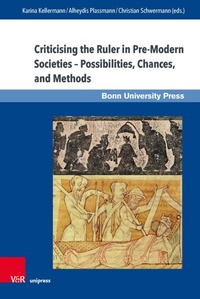
Criticising the Ruler in Pre-Modern Societies - Possibilities, Chances and Methods
Kritik am Herrscher in vormodernen Gesellschaften - Möglichkeiten, Chancen, Methoden
1st Edition
Published on 9. December 2019
458 pages
978-3-8470-1088-3 (ISBN)
Description

In vormodernen Monarchien beobachten wir Widerspruch und Widerstand gegen einzelne Herrscher, ihre politischen Entscheidungen und ihre Verwaltung, aber in der Regel keine direkten Angriffe auf die Ordnungsprinzipien und das politische System. Wenn Unzufriedenheit zu Aufständen und Revolten führten, blieb es normalerweise bei einem bloßen Austausch des Regenten. Subtilere Methoden der Herrscherkritik konnten sich mittels fester Usancen oder spezifischer Codes und Spielregeln innerhalb des legalen Rahmens Gehör verschaffen und zielten darauf ab, die Qualitäten des Regenten zu verbessern oder spezifische Modi der Amtsführung zu reformieren. Diese verschiedenen Formen und Praktiken von Herrscherkritik in vormodernen monarchischen Gesellschaften sind Gegenstand dieses Bandes. When looking at pre-modern monarchical societies, one does not expect to observe fundamental dissent directed at the social order as such or at the political system. As a rule, criticism was limited to individual monarchs, their performance and decisions. While discontent could lead to insurrection and rebellion, which normally only culminated in the ruler being replaced by another monarchical figurehead, the subtler methods of voicing criticism were applied within a framework of legality, of a set of customs or of a code of rules of the game and intended to improve the performance of the incumbent or reform his conduct at court. The various forms of verbal or staged censure of rulers in pre-modern monarchical societies are the subject of this volume.
Dr. Karina Kellermann ist apl. Professorin für Ältere Deutsche Philologie und lehrte bis zum Juli 2019 an der Universität Bonn. Sie ist Leiterin des Projekts »Publizistische Zeitklagen« des SFB 1167.
Dr. Karina Kellermann ist apl. Professorin für Ältere Deutsche Philologie und lehrte bis zum Juli 2019 an der Universität Bonn. Sie ist Leiterin des Projekts »Publizistische Zeitklagen« des SFB 1167.
More details
Other editions
Additional editions
Karina Kellermann | Alheydis Plassmann | Christian Schwermann
Criticising the Ruler in Pre-Modern Societies - Possibilities, Chances, and Methods
Kritik am Herrscher in vormodernen Gesellschaften - Möglichkeiten, Chancen, Methoden
Book
12/2019
1st Edition
Brill Deutschland
€85.00
Shipment within 7-9 days
Persons
Dr. Karina Kellermann ist apl. Professorin für Ältere Deutsche Philologie und lehrte bis zum Juli 2019 an der Universität Bonn. Sie ist Leiterin des Projekts »Publizistische Zeitklagen« des SFB 1167.
Content
- Intro
- Title Page
- Copyright
- Table of Contents
- Body
- Series Editors' Preface
- Karina Kellermann / Alheydis Plassmann / Christian Schwermann: Criticising the Ruler - Possibilities, Chances, and Methods. Introduction
- Sources and Manuscripts
- Bibliography
- Karina Kellermann / Alheydis Plassmann / Christian Schwermann: Kritik am Herrscher - Möglichkeiten, Chancen, Methoden. Einleitung
- Quellen und Handschriften
- Literatur
- Egon Flaig: Der römische Prinzipat. Monarchische Herrschaften typisieren - auf den Spuren von Foucault, Bourdieu und Max Weber
- 1. Ein interaktional geforderter Herrscher
- 2. Monarchien sortieren - Herrscherwechsel im Vergleich
- 3. Warum ist Foucault überhaupt nicht und Bourdieu kaum zu gebrauchen?
- 4. Weberianische Überlegungen zur Definition des Prinzipats
- 5. Modalitäten des Gehorsams und Akzeptanzmonarchie
- 6. Den Princeps kritisieren
- 7. Ritualisierte Kritik am römischen Kaiser
- Quellen
- Literatur
- Matthew Giancarlo: The Other British Constitution. Fürstenspiegel Texts, Popular Constitutionalism, and the Critique of Kingship in the Franco-British De regimine Tradition
- 1. Introduction: Mirroring the ruler
- 2. Criticism and constitution: 'De regimine principum', 'Secretum secretorum', 'Policraticus'
- 3. Mirrors of criticism: Gerald of Wales, the 'Song of Lewes', Vincent of Beauvais
- 4. Conclusion: mirrors of criticism
- Manuscripts
- Sources
- Bibliography
- Annette Gerok-Reiter: Variationen zwischen Herrscherkritik und -idealisierung in Veldekes 'Eneasroman'
- 1. Volkssprachiges Erzählen als Herrschaftsdiskurs
- 2. Herrschaft und Heilsgeschichte
- 3. Kritikfeld Kampfverhalten
- 4. Kritikfeld Minneverhalten
- 5. Zwischen Heilsgeschichte und Herrschaftskritik: Perspektiven
- Quellen
- Literatur
- Lisa Cordes: Megalomanie und hohle Bronze. Die Kolossalstatue als Vehikel von Herrscherkritik
- 1. Der Koloss als 'Kippfigur'
- 2. Der Koloss als Ausdruck von Macht und Göttlichkeit
- 3. Der Koloss des gestürzten Herrschers - Möglichkeiten negativer Umkodierung
- 3.1 Der Koloss als Witz
- 3.2 Der Koloss als Zeichen für Hybris und Verschwendungssucht
- 4. Der Koloss als Topos - die Herrscher der 'Historia Augusta'
- 5. Der hohle Koloss
- 6. Ein Berg als Koloss? - das Beispiel Alexanders
- 7. Fazit
- Quellen
- Literatur
- Gloria Chicote: The Rebellious Discourse of the Common People in the romancero castellano of the XV and XVI Centuries
- 1. The rebelliousness of the romances
- 2. The king's cruelty
- 3. The textual corpus
- 4. The bodies of politics
- Sources
- Bibliography
- Birgit Ulrike Münch: La grosse banquière und nòstre bon rei Enric. Formen bildimpliziter Kritik an der / dem Herrschenden um Maria de' Medici (1573-1642)
- 'Fluchtbilder' versus Verlobungsbild: Kritik und Rangordnung im Medici-Zyklus
- Kaltes Herz, verschmähte Mutterliebe und der beste Vater der Welt
- Der Tanz mit der Katze: sublime Kritik im höfischen Ballett
- Fazit
- Quellen
- Literatur
- Heiner Roetz: On Political Dissent in Warring States China
- Literature
- Sources in Classical Chinese
- Other Sources and Secondary Literature
- Matthew Strickland: Dreaming of Reform. Visions and Admonitions as Criticism of the Ruler in the Anglo-Norman and Angevin Realms
- The Limits of Dissent
- Warning Dreams and Royal Nightmares: William Rufus and Henry I
- Rebuking the Angevins, Dead and Alive
- Lincoln Cathedral Chapter: A Locus for Dissent?
- Conclusion: A Time of Protest
- Sources
- Bibliography
- Lena Oetzel: Debating, Petitioning, Legislating. Criticizing the Monarch in Elizabethan Parliaments
- 1. Introduction
- 2. Elizabethan Parliaments: development and key players
- 3. Forms of Parliamentary Criticism
- 3.1 Speeches and Debates: Techniques and Arguments of Criticism
- 3.2 Petitions: Direct Communication between Queen and Parliament
- 3.3 Legislation and Parliamentary Procedures
- 4. The Queen's Point of View
- 5. Parliamentary Criticism in Context
- 6. Conclusion: Criticizing the Monarch as Communication
- Sources
- Bibliography
- Martin Powers: Theories of Dissent and their Institutional Correlates in China
- Sources
- Literature
- Raji C. Steineck: Mythologischer Dissens. Über eine ungewohnte Form politischer Kritik in der japanischen Geschichte
- Einleitung: Kritische Mythologie - eine contradictio in adiecto?
- Mythos und Mythologie: eine terminologische Klärung
- Heldenmythos und Herrschaftskritik
- Mythos und politische Beratung
- Mythologische Kritik an herrschenden Einrichtungen
- Schluss: Mythos und Kritik
- Quellen
- Literatur
- Maureen Perrie: Holy Fools (iurodivye) as Critics of the Tsar in Early Modern Russia
- 1. Nikola of Pskov
- 2. St Basil (Vasilii the Blessed)
- 3. Iurodivye in the reign of Tsar Fedor Ivanovich
- 4. Elena
- 5. Old Believers
- Sources
- Bibliography
- Mohamad El-Merheb: "There is no just ruler at this time!" Political Censure in Pre-Modern Islamic Juristic Discourses
- 1. Introduction
- 1.1 Poetry
- 1.2 Advice literature
- 1.3 Shadow plays
- 1.4 The Censure of the Jurists
- 2. The Sermon at Friday Prayer
- 3. Criticism in Fatwa¯s
- 4. The Law of Rebellion
- "As far as I can tell, there is no just imam at this time!"
- Sources
- Bibliography
- Stephen Church: When does Advice become Criticism? Criticising John Lackland before Magna Carta
- Sources
- Bibliography
- Jan-Dirk Müller: Panegyrik und Didaxe als Herrscherkritik. Erasmus' von Rotterdam 'Iulius exclusus e coelis', 'Institutio principis Christiani' und 'Panegyricus' auf Philipp den Schönen
- Quellen
- Literatur
- Charles West: "And how, if you are a Christian, can you hate the emperor?" Reading a Seventh-Century Scandal in Carolingian Francia
- Manuscripts
- Sources
- Literature
- List of Figures
- Karina Kellermann / Alheydis Plassmann / Christian Schwermann: Criticising the Ruler - Possibilities, Chances, and Methods. Introduction
- Egon Flaig: Der römische Prinzipat. Monarchische Herrschaften typisieren - auf den Spuren von Foucault, Bourdieu und Max Weber
- Matthew Giancarlo: The Other British Constitution. Fürstenspiegel Texts, Popular Constitutionalism, and the Critique of Kingship in the Franco-British De regimine Tradition
- Birgit Ulrike Münch: La grosse banquière und nòstre bon rei Enric. Formen bildimpliziter Kritik an der / dem Herrschenden um Maria de' Medici (1573-1642)
- List of Contributors
- Index of Personal Names
- Index of Place Names
- Index of Terms Related to Criticism of Rulers
