

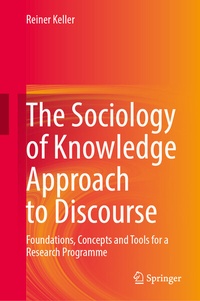
The Sociology of Knowledge Approach to Discourse
Description

In this updated version of a contemporary classic of discourse research, Reiner Keller develops the theoretical and methodological foundations of the Sociology of Knowledge Approach to Discourse (SKAD). Translated from the original German into English for the first time, this book brings together two previously unconnected domains of knowledge analysis in social science: the rich traditions of sociology of knowledge and symbolic interactionism on one hand and the works of discourse studies, especially in relation to Michel Foucault, on the other. It presents a critical discussion of key developments in sociology of knowledge, symbolic interactionist, and related interpretive approaches, explains the communicational turn of recent work in the field, and examines how traditions within sociology of knowledge shifted focus or converged over time. Following this, the book discusses the development of discourse theory and discourse analysis since the 1960s, including critical discourse analysis, hegemony analysis, or cultural studies approaches. Embarking from a profound reconstruction of Michel Foucault's work, the book then sets its own distinctive course by integrating major elements of Foucault's perspective with the sociology of knowledge. Along this path, Reiner Keller establishes the heuristics and methodology for a sociology of knowledge approach to discourse, providing a comprehensive research programme for the study of social relations of knowledge and politics of knowledge. Since its first publication in 2005, SKAD has informed a multitude of studies worldwide and across several academic disciplines. Today it can be considered as one of the major perspectives in discourse research in social science and beyond.
More details
Other editions
Additional editions
Person
Reiner Keller is Chair of Sociology at the University of Augsburg (Germany). He has made major contributions to the establishment of empirical discourse research in German social sciences since the late 1990s. Some of his main research interests include social science discourse research, sociology of knowledge and culture, sociological theory, interpretive methods, and analysis of discursive struggles in contemporary societies. His numerous publications include books such as Doing Discourse Research: An Introduction for Social Scientists; Michel Foucault; Das Interpretative Paradigma ("The Interpretive Paradigm"), Müll. Die gesellschaftliche Konstruktion des Wertvollen ("Waste. The Social Construction of the Valuable").
