

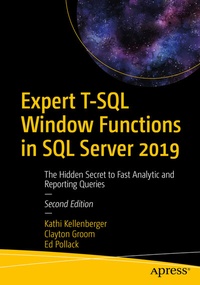
Expert T-SQL Window Functions in SQL Server 2019
The Hidden Secret to Fast Analytic and Reporting Queries
2nd Edition
Published on 21. October 2019
XVIII, 213 pages
978-1-4842-5197-3 (ISBN)
Description

Become an expert who can use window functions to solve T-SQL query problems. Replace slow cursors and self-joins with queries that are easy to write and perform better. This new edition provides expanded examples, including a chapter from the world of sports, and covers the latest performance enhancements through SQL Server 2019.
Window functions are useful in analytics and business intelligence reporting. They came into full blossom with SQL Server 2012, yet they are not as well known and used as often as they ought to be. This group of functions is one of the most notable developments in SQL, and this book shows how every developer and DBA can benefit from their expressive power in solving day-to-day business problems. Once you begin using window functions, such as ROW_NUMBER and LAG, you will discover many ways to use them. You will approach SQL Server queries in a different way, thinking about sets of data instead of individual rows. Your querieswill run faster, be easier to write, and easier to deconstruct, maintain, and enhance in the future.
Just knowing and using these functions is not enough. You also need to understand how to tune the queries. Expert T-SQL Window Functions in SQL Server clearly explains how to get the best performance. The book also covers the rare cases when older techniques are the best bet.
What You Will Learn
Who This Book Is For
Anyone who writes T-SQL queries, including database administrators, developers, business analysts, and data scientists. Before reading this book, you should understand how to join tables, write WHERE clauses, and build aggregate queries.
Window functions are useful in analytics and business intelligence reporting. They came into full blossom with SQL Server 2012, yet they are not as well known and used as often as they ought to be. This group of functions is one of the most notable developments in SQL, and this book shows how every developer and DBA can benefit from their expressive power in solving day-to-day business problems. Once you begin using window functions, such as ROW_NUMBER and LAG, you will discover many ways to use them. You will approach SQL Server queries in a different way, thinking about sets of data instead of individual rows. Your querieswill run faster, be easier to write, and easier to deconstruct, maintain, and enhance in the future.
Just knowing and using these functions is not enough. You also need to understand how to tune the queries. Expert T-SQL Window Functions in SQL Server clearly explains how to get the best performance. The book also covers the rare cases when older techniques are the best bet.
What You Will Learn
-
Solve complex query problems without cumbersome self-joins that run slowly and are difficult to read
-
Create sliding windows in a result set for computing such as running totals and moving averages
-
Return aggregate and detail data simultaneously from the same SELECT statement
-
Compute lag and lead and other values that access data from multiple rows in a result set
-
Understand the OVER clause syntax and how to control the window
-
Avoid framing errors that can lead to unexpected results
Who This Book Is For
Anyone who writes T-SQL queries, including database administrators, developers, business analysts, and data scientists. Before reading this book, you should understand how to join tables, write WHERE clauses, and build aggregate queries.
More details
Other editions
Additional editions
Kathi Kellenberger | Clayton Groom | Ed Pollack
Expert T-SQL Window Functions in SQL Server 2019
The Hidden Secret to Fast Analytic and Reporting Queries
Book
10/2019
2nd Edition
APress
€58.84
Shipment within 15-20 days
Persons
Kathi Kellenberger
is a data platform MVP and the editor of Simple-Talk at Redgate Software. She has worked with SQL Server for over 20 years. She is also co-leader of the PASS Women in Technology Virtual Group and an instructor at LaunchCode. In her spare time, Kathi enjoys spending time with family and friends, singing, and cycling.
Edward Pollack has over 20 years of experience in database and systems administration and architecture, developing a passion for performance optimization and making things go faster. He has spoken at many SQL Saturdays, 24 Hours of PASS, and PASS Summits, and has coordinated SQL Saturday Albany since its inception in 2014.
Clayton Groom is a data warehouse and analytics consultant at Clayton Groom, LLC. He has worked with SQL Server for 25 years. His expertise lies in designing and building data warehouse and analytic solutions on the Microsoft technology stack, including Power BI, SQL Server, Analysis Services, Reporting Services and Excel.
Edward Pollack has over 20 years of experience in database and systems administration and architecture, developing a passion for performance optimization and making things go faster. He has spoken at many SQL Saturdays, 24 Hours of PASS, and PASS Summits, and has coordinated SQL Saturday Albany since its inception in 2014.
Content
1. Looking through the Window.- 2. Discovering Ranking Functions.-3. Summarizing with Window Aggregates.- 4. Calculating Running and Moving Aggregates.- 5. Adding Frames to the Window.- 6. Taking a Peek at Another Row.- 7. Understanding Statistical Functions.- 8. Tuning for Better Performance.- 9. Hitting a Home Run with Gaps, Islands, and Streaks.- 10. Time Range Calculations.- 11. Time Trend Calculations.
