

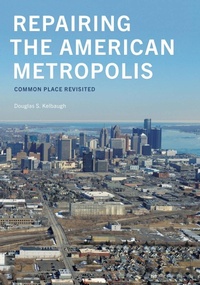
Repairing the American Metropolis
Description

Repairing the American Metropolis is based on Douglas Kelbaugh's Common Place: Toward Neighborhood and Regional Design, first published in 1997. It is more timely and significant than ever, with new text, charts, and images on architecture, sprawl, and New Urbanism, a movement that he helped pioneer. Theory and policies have been revised, refined, updated, and developed as compelling ways to plan and design the built environment.
This is an indispensable book for architects, urban designers and planners, landscape architects, architecture and urban planning students and scholars, government officials, developers, environmentalists, and citizens interested in understanding and shaping the American metropolis.
More details
Other editions
Additional editions
Person
Douglas Kelbaugh is professor of architecture and urban planning in Taubman College of Architecture and Urban Planning, and former principal in Kelbaugh, Calthorpe & Associates in Seattle and in Kelbaugh + Lee in Princeton, New Jersey. Among many other writings, he coauthored the national best seller The Pedestrian Pocket Book.
Content
Foreword
Acknowledgments
Introduction
1. Suburban Sprawl: Paved with Good Intentions
2. Critical Regionalism: An Architecture of Place
3. Typology: An Architecture of Limits
4. New Urbanism: Versus Everyday Urbanism and Post Urbanism
5. Public Policy: What We Should Do A.S.A.P.
Notes
Bibliography
Index
