

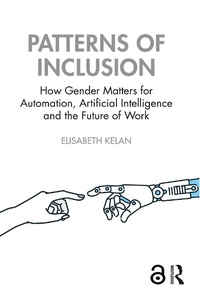
Patterns of Inclusion
How Gender Matters for Automation, Artificial Intelligence and the Future of Work
1st Edition
Published on 29. August 2024
184 pages
978-1-040-13011-7 (ISBN)
Description

Shortlisted for the 2025 Social Issues in Management (SIM) Outstanding Book Award from the Academy of Management.
It is widely presumed that digitalisation, automation and artificial intelligence (AI) shape the future of work; yet, gender is rarely considered in those debates. This ground-breaking book, written by a leading thinker on gender, inclusion and organisations, is based on in-depth research to show which patterns of gender and digitalisation emerge. By weaving these different patterns together, is it possible to understand the dynamic and complex ways gender and digitalisation intertwine in the work context?
The book highlights how futures of work are imagined between automation and augmentation: it shows which tasks are expected to be done by machines, and where humans are expected to have a competitive advantage. The book showcases how algorithmic bias is constructed as ultimately fixable, and analyses in/visibilities in AI production processes. Above all, the book shows how patterns relating to gender and inclusion are shaped and could be re-shaped.
This innovative book provides a stimulating and provocative read for those who are interested in how automation and AI shape the future of work in regard to gender and what this means for inclusion.
It is widely presumed that digitalisation, automation and artificial intelligence (AI) shape the future of work; yet, gender is rarely considered in those debates. This ground-breaking book, written by a leading thinker on gender, inclusion and organisations, is based on in-depth research to show which patterns of gender and digitalisation emerge. By weaving these different patterns together, is it possible to understand the dynamic and complex ways gender and digitalisation intertwine in the work context?
The book highlights how futures of work are imagined between automation and augmentation: it shows which tasks are expected to be done by machines, and where humans are expected to have a competitive advantage. The book showcases how algorithmic bias is constructed as ultimately fixable, and analyses in/visibilities in AI production processes. Above all, the book shows how patterns relating to gender and inclusion are shaped and could be re-shaped.
This innovative book provides a stimulating and provocative read for those who are interested in how automation and AI shape the future of work in regard to gender and what this means for inclusion.
Reviews / Votes
"A ground-breaking book that fills a critical gap by providing a much-needed thorough analysis through a gender lens of perspectives on the potential impacts of automation and AI on the future of work. It enables us to imagine more inclusive and equitable scenarios that better equip us to forge a fairer digital future for all."Ursula Wynhoven, Director and Representative to the United Nations, International Telecommunication Union
"An important work that provides unique, timely, and exceptional insights into the digitalisation of gender. Through rigorous research, Elisabeth Kelan illuminates the gendered values, decisions, and biases that shape digitalisation, automation, and artificial intelligence systems, and why they must be grounded in equity and inclusion."
Melissa Suzanne Fisher, New York University Institute for Public Knowledge and School of Professional Studies
More details
Edition
1. Auflage
Language
English
Place of publication
London
United Kingdom
Publishing group
Taylor & Francis Ltd
Target group
College/higher education
Professional and scholarly
ISBN-13
978-1-040-13011-7 (9781040130117)
Copyright in bibliographic data and cover images is held by Nielsen Book Services Limited or by the publishers or by their respective licensors: all rights reserved.
Schweitzer Classification
Other editions
Additional editions
Elisabeth Kelan
Patterns of Inclusion
How Gender Matters for Automation, Artificial Intelligence and the Future of Work
Book
08/2024
1st Edition
Routledge
€231.30
Shipment within 10-20 days
Elisabeth Kelan
Patterns of Inclusion
How Gender Matters for Automation, Artificial Intelligence and the Future of Work
Book
08/2024
1st Edition
Routledge
€56.80
Shipment within 10-20 days
Person
Elisabeth Kelan is Professor of Leadership and Organisation at Essex Business School, University of Essex, United Kingdom. Kelan is an expert on gender and digitalisation, women's leadership, men as change agents for gender equality, generations at work, and diversity and inclusion.
Content
1. Introduction: Human-Like 2. Imaging Futures between Automation and Augmentation 3. Uniquely Human and the Automatability of Socio-Emotional Skills 4. Algorithmic Bias as Ultimately Fixable 5. In/Visibility by Design 6. Conclusion: Unwritten Rules
