

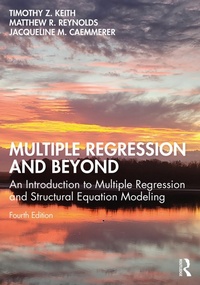
Multiple Regression and Beyond
An Introduction to Multiple Regression and Structural Equation Modeling
4th Edition
Published on 30. September 2025
712 pages
978-1-040-40160-6 (ISBN)
Description

Multiple Regression and Beyond provides a conceptually oriented introduction to multiple regression (MR) analysis and structural equation modeling (SEM), along with related analyses. By emphasizing the concepts and purposes of MR rather than the derivation and calculation of formulas, this book presents the material in a clearer and more accessible way. This approach not only covers essential coursework but also makes it more approachable for students, increasing the likelihood that they will conduct research using MR or SEM effectively and wisely.
This book covers both MR and SEM, explaining their relevance to each other. It also includes path analysis, confirmatory factor analysis, and latent growth modeling, incorporating real-world research examples throughout the chapters and end-of-chapter exercises. Figures and tables are used extensively to illustrate key concepts and techniques.
This new edition includes:
New sections on quantile regression, statistical suppression, contrast coding, and random intercept panel models
Support for the statistical program R and the R package lavaan in the text and on the website (www.tzkeith.com)
New examples and exercises
Updated instructor and student online resources (www.tzkeith.com)
This book covers both MR and SEM, explaining their relevance to each other. It also includes path analysis, confirmatory factor analysis, and latent growth modeling, incorporating real-world research examples throughout the chapters and end-of-chapter exercises. Figures and tables are used extensively to illustrate key concepts and techniques.
This new edition includes:
New sections on quantile regression, statistical suppression, contrast coding, and random intercept panel models
Support for the statistical program R and the R package lavaan in the text and on the website (www.tzkeith.com)
New examples and exercises
Updated instructor and student online resources (www.tzkeith.com)
More details
Edition
4th edition
Language
English
Place of publication
London
United Kingdom
Publishing group
Taylor & Francis Ltd
Target group
College/higher education
Illustrations
66 Tables, black and white; 430 Line drawings, black and white; 430 Illustrations, black and white
File size
19,84 MB
ISBN-13
978-1-040-40160-6 (9781040401606)
Copyright in bibliographic data and cover images is held by Nielsen Book Services Limited or by the publishers or by their respective licensors: all rights reserved.
Schweitzer Classification
Other editions
Additional editions
Timothy Z. Keith | Matthew Reynolds | Jacqueline Caemmerer
Multiple Regression and Beyond
An Introduction to Multiple Regression and Structural Equation Modeling
Book
09/2025
4th Edition
Routledge
€261.30
Shipment within 10-20 days
Timothy Z. Keith | Matthew Reynolds | Jacqueline Caemmerer
Multiple Regression and Beyond
An Introduction to Multiple Regression and Structural Equation Modeling
Book
09/2025
4th Edition
Routledge
€104.50
Shipment within 10-20 days
Persons
Timothy Z. Keith is Professor Emeritus at the University of Texas, Austin. Before retiring he was director of the graduate school psychology program (now school and clinical child psychology) in the Department of Educational Psychology. His research focused on the nature and measurement of intelligence, including the validity of tests of intelligence and the theories from which they are drawn.
Matthew R. Reynolds is Professor of Educational Psychology at the University of Kansas. His research focuses on the measurement and structure of human cognitive abilities and on sex differences in cognitive abilities and academic achievement.
Jacqueline M. Caemmerer is an Assistant Professor in the Department of Educational Psychology (school psychology graduate programs) at the University of Connecticut. Her research interests are in psychological assessment and validity issues. She is interested in better understanding what frequently used tests measure, their predictive validity, and developmental and cultural considerations of tests.
Matthew R. Reynolds is Professor of Educational Psychology at the University of Kansas. His research focuses on the measurement and structure of human cognitive abilities and on sex differences in cognitive abilities and academic achievement.
Jacqueline M. Caemmerer is an Assistant Professor in the Department of Educational Psychology (school psychology graduate programs) at the University of Connecticut. Her research interests are in psychological assessment and validity issues. She is interested in better understanding what frequently used tests measure, their predictive validity, and developmental and cultural considerations of tests.
Content
Preface
Notes for the Fourth Edition
Acknowledgments
Part I: Multiple Regression
Chapter 1: Simple bivariate regression
Chapter 2: Multiple regression: Introduction
Chapter 3: Multiple regression: More detail
Chapter 4: Three and more independent variables and related issues
Chapter 5: Three Types of multiple regression
Chapter 6: Analysis of categorical variables
Chapter 7: Regression with categorical and continuous variables
Chapter 8: Testing for interactions and curves with continuous variables
Chapter 9: Mediation, moderation, common cause, and suppression
Chapter 10: Multiple regression: Summary, assumptions, diagnostics, power, and problems
Chapter 11: Related methods: Quantile regression, logistic regression and multilevel modeling
Part II: Beyond Multiple Regression: Structural Equation Modeling
Chapter 12: Path modeling: Structural equation modeling with measured variables
Chapter 13: Path analysis: Assumptions and dangers
Chapter 14: Analyzing path models using SEM programs
Chapter 15: Error: The scourge of research
Chapter 16: Confirmatory factor analysis I
Chapter 17: Putting it all together: Introduction to latent variable SEM
Information Classification: General
Chapter 18: Latent variable models II: Single indicators, correlated errors, multigroup models, panel models, dangers & assumptions
Chapter 19: Latent means in SEM
Chapter 20: Confirmatory factor analysis II: Invariance and latent means
Chapter 21: Latent growth models
Chapter 22: Latent variable interactions and multilevel modeling in SEM
Chapter 23: Summary: Path analysis, CFA, SEM, mean structures, and latent growth models
Appendices
Appendix A: Data files and statistical program notes
Appendices B: Review of basic statistics concepts
Appendix C: Partial and semipartial correlation
Appendix D: Symbols used in this book
Appendix E: Useful formulae
Reference
Author index
Subject index
Notes for the Fourth Edition
Acknowledgments
Part I: Multiple Regression
Chapter 1: Simple bivariate regression
Chapter 2: Multiple regression: Introduction
Chapter 3: Multiple regression: More detail
Chapter 4: Three and more independent variables and related issues
Chapter 5: Three Types of multiple regression
Chapter 6: Analysis of categorical variables
Chapter 7: Regression with categorical and continuous variables
Chapter 8: Testing for interactions and curves with continuous variables
Chapter 9: Mediation, moderation, common cause, and suppression
Chapter 10: Multiple regression: Summary, assumptions, diagnostics, power, and problems
Chapter 11: Related methods: Quantile regression, logistic regression and multilevel modeling
Part II: Beyond Multiple Regression: Structural Equation Modeling
Chapter 12: Path modeling: Structural equation modeling with measured variables
Chapter 13: Path analysis: Assumptions and dangers
Chapter 14: Analyzing path models using SEM programs
Chapter 15: Error: The scourge of research
Chapter 16: Confirmatory factor analysis I
Chapter 17: Putting it all together: Introduction to latent variable SEM
Information Classification: General
Chapter 18: Latent variable models II: Single indicators, correlated errors, multigroup models, panel models, dangers & assumptions
Chapter 19: Latent means in SEM
Chapter 20: Confirmatory factor analysis II: Invariance and latent means
Chapter 21: Latent growth models
Chapter 22: Latent variable interactions and multilevel modeling in SEM
Chapter 23: Summary: Path analysis, CFA, SEM, mean structures, and latent growth models
Appendices
Appendix A: Data files and statistical program notes
Appendices B: Review of basic statistics concepts
Appendix C: Partial and semipartial correlation
Appendix D: Symbols used in this book
Appendix E: Useful formulae
Reference
Author index
Subject index
