

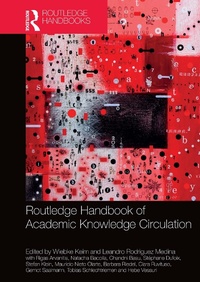
Routledge Handbook of Academic Knowledge Circulation
1st Edition
Published on 30. June 2023
626 pages
978-1-000-89732-6 (ISBN)
Description

Knowledge is a result of never-ending processes of circulation. This accessible volume is the first comprehensive multidisciplinary work to explore these processes through the perspective of scholars working outside of Anglo-American paradigms. Through a variety of literature reviews, examples of recent research and in-depth case studies, the chapters demonstrate that the analysis of knowledge circulation requires a series of ontological and epistemic commitments that impact its conceptualisation and methodologies.
Bringing diverse viewpoints from across the globe and from a range of disciplines, including anthropology, economics, history, political science, sociology and Science & Technology Studies (STS), this wide-ranging and thought-provoking collection offers a broad and cutting-edge overview of outstanding research on academic knowledge circulation. The book is structured in seven sections: (i) key concepts in studying the circulation of academic knowledge; (ii) spaces and actors of circulation; (iii) academic media and knowledge circulation; (iv) the political economy of academic knowledge circulation; (v) the geographies, geopolitics and historical legacies of the global circulation of academic knowledge; (vi) the relationships between academic and extra-academic knowledges; and (vii) methodological approaches to studying the circulation of academic knowledge.
This handbook will be essential reading for academics, researchers and postgraduate researchers in the humanities and social sciences interested in the circulation of knowledge.
Bringing diverse viewpoints from across the globe and from a range of disciplines, including anthropology, economics, history, political science, sociology and Science & Technology Studies (STS), this wide-ranging and thought-provoking collection offers a broad and cutting-edge overview of outstanding research on academic knowledge circulation. The book is structured in seven sections: (i) key concepts in studying the circulation of academic knowledge; (ii) spaces and actors of circulation; (iii) academic media and knowledge circulation; (iv) the political economy of academic knowledge circulation; (v) the geographies, geopolitics and historical legacies of the global circulation of academic knowledge; (vi) the relationships between academic and extra-academic knowledges; and (vii) methodological approaches to studying the circulation of academic knowledge.
This handbook will be essential reading for academics, researchers and postgraduate researchers in the humanities and social sciences interested in the circulation of knowledge.
More details
Series
Edition
1. Auflage
Language
English
Place of publication
London
United Kingdom
Publishing group
Taylor & Francis Ltd
Target group
College/higher education
Product notice
Reflowable
Illustrations
7 Tables, black and white; 20 Line drawings, black and white; 5 Halftones, black and white; 25 Illustrations, black and white
ISBN-13
978-1-000-89732-6 (9781000897326)
Copyright in bibliographic data and cover images is held by Nielsen Book Services Limited or by the publishers or by their respective licensors: all rights reserved.
Schweitzer Classification
Other editions
Additional editions
Wiebke Keim | Leandro Rodriguez Medina | Rigas Arvanitis
Routledge Handbook of Academic Knowledge Circulation
Book
11/2024
1st Edition
Routledge
€71.00
Shipment within 10-20 days
Wiebke Keim | Leandro Rodriguez Medina | Rigas Arvanitis
Routledge Handbook of Academic Knowledge Circulation
Book
06/2023
1st Edition
Routledge
€335.70
Shipment within 10-20 days
Persons
Wiebke Keim is CNRS researcher at the SAGE (Societes, Acteurs, Gouvernement en Europe) research centre at Strasbourg University, France. Her research interests include the sociology of knowledge and science, the history of sociology, the epistemology of the social sciences, critiques of Eurocentrism, fascisms and post-fascisms. She is the author of Vermessene Disziplin: Zum konterhegemonialen Potential afrikanischer und lateinamerikanischer Soziologien (2008) and Universally Comprehensible, Arrogantly Local: South African Labour Studies from the Apartheid Era into the New Millennium (2017), and co-author of Gauging and Engaging Deviance, 1600-2000 (2014), and of Scripting Defiance: Four Sociological Vignettes (2022).
Leandro Rodriguez Medina is Professor of Sociology at Universidad Autonoma Metropolitana-Azcapotzalco, Mexico. He is also a member of the National System of Researchers at Mexico's Council for Science and Technology and founding editor-in-chief of the Tapuya: Latin American Science, Technology, and Society journal. His research interests include Science & Technology Studies (STS), science and technology policies in Latin America, the international circulation of knowledge within the social sciences, and the relationship between cities and culture. He is author of Material Hermeneutics in Political Science (2013); Centers and Peripheries in Knowledge Production (Routledge, 2014), and The Circulation of European Knowledge: Niklas Luhmann in the Hispanic Americas and co-editor of La Teoria del Actor-Red desde America Latina (2022).
Rigas Arvanitis, Ceped, Universite Paris Cite-Institut de Recherche pour le Developpement (IRD), France
Natacha Bacolla, Consejo de Investigaciones Cientificas y Tecnicas, Universidad Nacional del Litoral - Universidad Nacional de Rosario, Argentina
Chandni Basu, Rabindra Bharati University Kolkata, India and Albert-Ludwigs-Universitaet-Freiburg, Germany
Stephane Dufoix, Universite Paris-Nanterre and senior member of the Institut universitaire de France, France
Stefan Klein, Departamento de Sociologia, Universidade de Brasilia (SOL/ICS), Brazil
Mauricio Nieto Olarte, Universidad de los Andes, Colombia,
Barbara Riedel, Albert-Ludwigs-Universitaet-Freiburg, Germany
Clara Ruvituso, Mecila/Ibero-Amerikanisches Institut, Germany
Gernot Saalmann, Albert-Ludwigs-Universitaet-Freiburg, Germany
Tobias Schlechtriemen, Albert-Ludwigs-Universitaet-Freiburg, Germany
Hebe Vessuri, Independent researcher
Leandro Rodriguez Medina is Professor of Sociology at Universidad Autonoma Metropolitana-Azcapotzalco, Mexico. He is also a member of the National System of Researchers at Mexico's Council for Science and Technology and founding editor-in-chief of the Tapuya: Latin American Science, Technology, and Society journal. His research interests include Science & Technology Studies (STS), science and technology policies in Latin America, the international circulation of knowledge within the social sciences, and the relationship between cities and culture. He is author of Material Hermeneutics in Political Science (2013); Centers and Peripheries in Knowledge Production (Routledge, 2014), and The Circulation of European Knowledge: Niklas Luhmann in the Hispanic Americas and co-editor of La Teoria del Actor-Red desde America Latina (2022).
Rigas Arvanitis, Ceped, Universite Paris Cite-Institut de Recherche pour le Developpement (IRD), France
Natacha Bacolla, Consejo de Investigaciones Cientificas y Tecnicas, Universidad Nacional del Litoral - Universidad Nacional de Rosario, Argentina
Chandni Basu, Rabindra Bharati University Kolkata, India and Albert-Ludwigs-Universitaet-Freiburg, Germany
Stephane Dufoix, Universite Paris-Nanterre and senior member of the Institut universitaire de France, France
Stefan Klein, Departamento de Sociologia, Universidade de Brasilia (SOL/ICS), Brazil
Mauricio Nieto Olarte, Universidad de los Andes, Colombia,
Barbara Riedel, Albert-Ludwigs-Universitaet-Freiburg, Germany
Clara Ruvituso, Mecila/Ibero-Amerikanisches Institut, Germany
Gernot Saalmann, Albert-Ludwigs-Universitaet-Freiburg, Germany
Tobias Schlechtriemen, Albert-Ludwigs-Universitaet-Freiburg, Germany
Hebe Vessuri, Independent researcher
Editor
Strasbourg University, France
Universidad Autonoma Metropolitana Azcapotzalco, Mexico
Ceped, Universite Paris Cite-Institut de Recherche pour le Developpement (IRD), France
Universidad Nacional del Litoral & Universidad Nacional de Rosario, Argentina
Rabindra Bharati University, India
Universite Paris-Nanterre, France
Universidade de Brasilia (SOL/ICS), Brazil
Universidad de los Andes, Colombia
Albert-Ludwigs-Universitaet-Freiburg, Germany
Mecila/Ibero-Amerikanisches Institut, Germany
Content
Towards a Collective Introduction Section I: Key concepts in studying the circulation of academic knowledge 1. Writing: on the Entanglements of Producing and Circulating Academic Knowledge 2. Studying the Circulation of Academic Knowledge as Reception 3. Translation of Knowledge 4. Academic Knowledge Circulation Enacting Reality 5. Consecration of Academic Knowledge in Circulation 6. Localisation of Circulating Academic Knowledge 7. Recontextualising Circulating Knowledge 8. The Circulation of Incorrect Information Section II: Spaces and actors of circulation 9. Theories and Practices of Knowledge Brokering 10. Highly Skilled Migration and Knowledge Circulation 11. Political Oppression, War and Emigration: Their Effects on the Circulation of Scholars 12. The Role of Religious Actors in the Circulation of Academic Knowledge 13. International Scientific Associations and Conferences as Agents in the Unequal Circulation of Knowledge 14. Expertise within International Organisations and Circulation of Knowledge Section III: Academic media and knowledge circulation 15. The Role of the Book and Publishing Markets in Knowledge Circulation 16. The role of Bibliographic Indices for Knowledge Circulation 17. The Role of Academic Journals in the Circulation of Academic Knowledge 18. The Circulation of Academic Knowledge in the Medium of School Programmes 19. Circulating Knowledge through Intermediary Objects in Scientific Cooperative Networks Section IV: The political economy of academic knowledge circulation 20. Knowledge Dependency and Circulation 21. Digital Object Identifier: Privatising Knowledge Circulation through Infrastructuring 22. Knowledge Machines: A Complex Web of History and Technology 23. Free Circulation of Academic and Artistic Knowledge in the Context of Cognitive Capitalism 24. Knowledge Circulation and Unequal Partnerships 25. The Changing Economics of Academic Publishing and the Discourse of "Predatory" Science 26. Knowledge Circulation and the Institutionalisation of Climate Science as a New Academic Field 27. Crossing Disciplines and the Role of Knowledge Circulation for the Emergence of New Interdisciplinary Fields Section V: The geographies, geopolitics and historical legacies of the global circulation of academic knowledge 28. Academic Knowledge, Translation and Geopolitics 29. The Construction of Academic Prestige and Its Role in Knowledge Circulation 30. Representation and the Transnational Circulation of Knowledge 31. Knowledge Circulation and the Gaze of Epistemic Others: towards an African Epistemology 32. Indigenisation: The Significance of the Debates for the Circulation of Academic Knowledge Section VI: The relationships between academic and extra-academic knowledge 33. Science and Society: Approaches for the Circulation of Knowledge beyond Academia 34. Newspapers and the Circulation of Academic Knowledge 35. Consultancy Praxis: Dynamics of Circulation between Academia and State Knowledge 36. Experts and Social Movements in the Circulation of Academic Knowledge 37. Addressing Inclusion and Sustainability in the Circulation of Knowledge beyond Academia Section VII: Methodological approaches to studying the circulation of academic knowledge 38. Ethnography and the Circulation of Knowledge 39. Biographic Methods and the Study of Academic Knowledge Circulation 40. Prosopography and the Study of Academic Knowledge Circulation 41. Actor-Network Theory and the Materiality for Researching Academic Knowledge Circulation 42. Field Theory and the Circulation of Academic Knowledge 43. Bibliometrics and the Study of Academic Knowledge Circulation 44. Using Digital Text-Based Approaches to Study Knowledge Circulation 45. Studying Metaphors and the Understanding of Knowledge Circulation
