
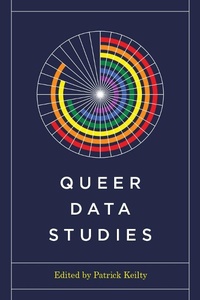
Queer Data Studies
Description
Alles über E-Books | Antworten auf Fragen rund um E-Books, Kopierschutz und Dateiformate finden Sie in unserem Info- & Hilfebereich.
Untangles how data shapes and is shaped by queer worlds
Data, perilous and powerful, is both a worldmaking and a dismantling force. The collection of data about queer lives and bodies, the consequences of data analysis for queer subjects, and considerations of privacy and consent often present ethical dilemmas even as queer data expands our understanding of who and what counts. The need for queer analyses and perspectives has taken on a new sense of urgency in light of hostile antiqueer policies by major technology companies, the security theater of airports, the disproportionate rates of policing queer people and people of color, digital surveillance in border security, and the proliferation of digital health records.
Gathering wide-ranging interdisciplinary conversations into one rich volume, Queer Data Studies challenges readers to rethink how the extraction, circulation, modeling, governance, and use of data affects queer subjects and, at the same time, to consider how the power of data might be harnessed in the service of queer ethics. Contributors take a capacious approach to data, drawing from a range of sources, including stories, sounds, medical data, police data, maps, and algorithmic modeling. This anthology engages intersectional, decolonial, feminist, queer, and trans research, advancing ongoing dialogues about data across the social sciences, humanities, and applied sciences.
All prices
More details
Other editions
Additional editions
Person
Patrick Keilty is associate professor in the Faculty of Information and the Cinema Studies Institute at the University of Toronto. He is coeditor of Feminist and Queer Information Studies Reader. Contributors: Ryan Conrad, Mathew Gagné, Gary Kafer, Harris Kornstein, Shaka McGlotten, Stephen Molldrem, Susanna Paasonen, Nikita Shepard, Jenny Sundén, Suisui Wang, and Lina ?igelyte
Content
Acknowledgments Introduction Patrick Keilty 1 Black Data Shaka McGlotten 2 "To Fight for an End to Intrusions into the Sex Lives of Americans" | Gay and Lesbian Resistance to Sexual Surveillance and Data Gathering, 1945?1972 Nikita Shepard 3 Machine Learning and the Queer Technics of Opacity Queer Data Studies 4 Objectionable Nipples | Puritan Data Politics and Sexual Agency in Social Media Queer Data Studies 5 HIV Data as Queer Data | Biomedical Sexualities, Treatmentas-Prevention, and the New Sex Hierarchy for People Living with HIV Stephen Molldrem 6 Generating Vulnerability | Male Sex Workers, Third-Party Platforms, and Data Security Ryan Conrad 7 Not Enough Meaningful Data? Lessons from Eastern Europe Lina Žigelytė 8 Reciprocating Sexy Information | Reflections on Studying the Data of Gay Sex in Beirut Mathew Gagné 9 Homobiles | Queering Data through Ephemerality and Intimacy Harris Kornstein 10 Situated Indications | Queer STS Experiments on Global Datafication Suisui Wang List of Contributors Index

System requirements
File format: ePUB
Copy protection: Adobe-DRM (Digital Rights Management)
System requirements:
- Computer (Windows; MacOS X; Linux): Install the free reader Adobe Digital Editions prior to download (see eBook Help).
- Tablet/smartphone (Android; iOS): Install the free app Adobe Digital Editions or the app PocketBook before downloading (see eBook Help).
- E-reader: Bookeen, Kobo, Pocketbook, Sony, Tolino and many more (not Kindle).
The file format ePub works well for novels and non-fiction books – i.e., „flowing” text without complex layout. On an e-reader or smartphone, line and page breaks automatically adjust to fit the small displays.
This eBook uses Adobe-DRM, a „hard” copy protection. If the necessary requirements are not met, unfortunately you will not be able to open the eBook. You will therefore need to prepare your reading hardware before downloading.
Please note: We strongly recommend that you authorise using your personal Adobe ID after installation of any reading software.
For more information, see our ebook Help page.
File format: PDF
Copy-Protection: Adobe-DRM (Digital Rights Management)
System requirements:
- Computer (Windows; MacOS X; Linux): Install the free reader Adobe Digital Editions prior to download (see eBook Help).
- Tablet/smartphone (Android; iOS): Install the free app Adobe Digital Editions or the app PocketBook before downloading (see eBook Help).
- E-reader: Bookeen, Kobo, Pocketbook, Sony, Tolino and many more (only limited: Kindle).
The file format PDF always displays a book page identically on any hardware. This makes PDF suitable for complex layouts such as those used in textbooks and reference books (images, tables, columns, footnotes). Unfortunately, on the small screens of e-readers or smartphones, PDFs are rather annoying, requiring too much scrolling.
This eBook uses Adobe-DRM, a „hard” copy protection. If the necessary requirements are not met, unfortunately you will not be able to open the eBook. You will therefore need to prepare your reading hardware before downloading.
Please note: We strongly recommend that you authorise using your personal Adobe ID after installation of any reading software.
For more information, see our eBook Help page.
File format: ePUB
Copy protection: without DRM (Digital Rights Management)
System requirements:
- Computer (Windows; MacOS X; Linux): Use a reader that can handle the file format ePUB, such as Adobe Digital Editions or FBReader – both free (see eBook Help).
- Tablet/Smartphone (Android; iOS): Install the free app Adobe Digital Editions or the app PocketBook (see eBook Help).
- E-reader: Bookeen, Kobo, Pocketbook, Sony, Tolino and many more (not Kindle).
The file format ePUB works well for novels and non-fiction books – i.e., 'flowing' text without complex layout. On an e-reader or smartphone, line and page breaks automatically adjust to fit the small displays.
This eBook does not use copy protection or Digital Rights Management
For more information, see our eBook Help page.
