

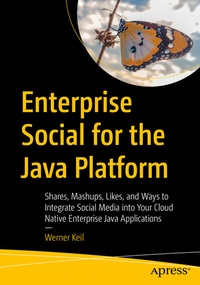
Enterprise Social for the Java Platform
Description

Learn everything you need to know about frameworks that help developers to integrate their solutions with social networks or APIs, from general purpose (Facebook, Twitter, Google, Mastodon) to specialized (LinkedIn, Xing, WhatsApp, YouTube, Instagram, Flickr, TikTok) to vertical (eToro, Fitbit, Strava). This book will teach you how to add social media features to web applications or services developed using Java, Jakarta EE, or generally running on a Java Virtual Machine (JVM).
Jam-packed with practical examples of social integration into enterprise applications, you'll learn how to address common requirements such as social login, identity federation, single sign-on via social accounts, OpenID Connect, and mashups. You'll also see how to leverage Java social frameworks like Facebook Business SDK, Twitter4J, Agorava, Keycloak, and Spring Security.
Enterprise Social for the Java Platform is an excellent companion to books covering Jakarta EE Security, Spring Security, portals, and related frameworks. Upon completing it, you'll be armed with the expertise you need to integrate your own Java enterprise applications with social media networks.
What You Will Learn- Harness the reach and power of social media platforms by integrating your enterprise Java applications with them
- Understand social media standards for different platforms
- Address common security issues
Who This Book Is For
Developers, architects, and managers of projects involving the use of APIs or Social Networks.More details
Other editions
Additional editions
Person
Werner Keil is a cloud architect, Eclipse RCP, and a microservice expert for a large bank. He helps Global 500 Enterprises across industries and leading IT vendors. He worked for over 30 years as an IT manager, PM, coach, and SW architect and consultant for the finance, mobile, media, transport, and public sectors. Werner develops enterprise systems using Java, Java/Jakarta EE, Oracle, IBM, Spring or Microsoft technologies, JavaScript, Node, Angular, and dynamic or functional languages. He is a Committer at Apache Foundation, and Eclipse Foundation, a Babel Language Champion, UOMo Project Lead, and active member of the Java Community Process in JSRs such as 321 (Trusted Java), 344 (JSF 2.2), 354 (Money, also Maintenance Lead), 358/364 (JCP.next), 362 (Portlet 3), 363 (Unit-API 1), 365 (CDI 2), 366 (Java EE 8), 375 (Java EE Security), 380 (Bean Validation 2), and 385 (Unit-API 2, also Spec Lead), and was the longest serving Individual Member of the Executive Committee for nine years in a row until 2017. Werner is currently the Community representative in the Jakarta EE Specification Committee. He was among the first five Jakarta EE Ambassadors when it was founded as Java EE Guardians, and is a member of its Leadership Council.
