

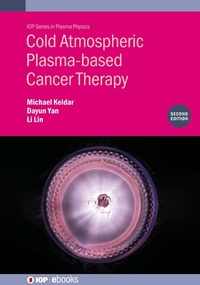
Cold Atmospheric Plasma-based Cancer Therapy (Second Edition)
Description

Recent progress in atmospheric plasmas has led to non-thermal or cold atmospheric plasma devices with ion temperatures close to room temperature. With the unique chemical and physical properties of cold atmospheric plasmas enabling its recent application in biomedicine, plasma medicine has established itself as a new scientific field, combining plasma physics, engineering, medicine, and bioengineering. Today, non-thermal or cold atmospheric plasmas (CAPs) can have tremendous applications in biomedical technology.
This book provides a comprehensive introduction to the fundamentals of the non-thermal plasmas and plasma devices used in plasma medicine. Several chapters are devoted to the analysis of the mechanisms of plasma interaction with cancer and normal cells, including a description of the mechanism of plasma selectivity. As a revised and significantly expanded second edition, this text includes a detailed description of non-invasive modality, new in vivo work and adaptive plasma written by experts in these areas. This reference text also provides an up-to-date description of the field, the primary challenges and future directions.
This book is designed for a broad audience, from students to engineers and scientists, who are interested in the emerging field of plasma medical application.
More details
Other editions
Additional editions

Persons
Michael Keidar is an A. James Clark Professor of Engineering. His research concerns plasma physics and engineering with application in plasma medicine, advanced spacecraft propulsion, and plasma-based nanotechnology. He received the 2017 Davidson award in plasma physics. In 2016, he received the AIAA Engineer of the Year award for his work on micropropulsion, which resulted in the successful launch of a nanosatellite with thrusters developed by his laboratory.
Dayun Yan is a postdoctoral researcher at George Washington University. His current research focuses on several core problems in plasma sources and plasma medicine. By August 2022, Dayun had published ~60 papers in peer-reviewed journals. He wrote the first edition of Cold Plasma Cancer Therapy. He was guest editor of three journals (Applied Sciences, Pharmaceutics, and Biomedicines) and peer-reviewer for 80+ journals.
Li Lin is a postdoctoral researcher at George Washington University. His research interests are low-temperature plasma physics and chemistry, plasma simulation, plasma and biomedical diagnostics, microwave technologies, and machine learning. Li is also an editorial board member of Scientific Reports, an editorial board member of Medical Science, a topic editor of Catalysts, a reviewer board member of Symmetry, and a member of IEEE and APS. Li has published over 40 journal article publications.
Content
1 Introduction to non-thermal plasma physics
2 Cold atmospheric plasma generators
3 Diagnostics and modeling of cold atmospheric plasmas
4 Chemically based cold atmospheric plasma treatment
5 Cold atmospheric plasma-activated solutions
6 Physics based cold atmospheric plasma therapy
7 Selective anti-cancer performance
8 Animal studies and immune responses
9 Clinical perspectives
10 Physics and technology of the adaptive plasma therapy
