

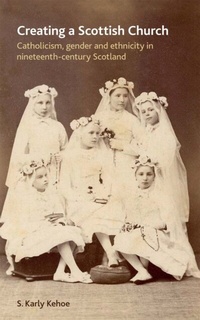
Creating a Scottish Church
Catholicism, Gender and Ethnicity in Nineteenth-Century Scotland
1st Edition
Published on 3. October 2017
224 pages
978-1-5261-3034-1 (ISBN)
Description

This book highlights how the Catholic population participated in the extension of citizenship in Scotland and considers Catholicism's transition from an underground and isolated church to a multi-faceted institution by taking a critical look at gender, ethnicity and class.
It prioritises the role of women in the transformation and modernization of Catholic culture and represents a radical departure from the traditional perception of the church as an institution on the fringes of Scotland's religious and civic landscape. It examines how Catholicism participated in constructions of national identity and civic society. Industrialisation, urbanisation, and Irish migration forced Catholics and non-Catholics to reappraise Catholicism's position in Scotland and in turn Scotland's position in England. Using previously unseen archival material from private church and convent collections, it reveals how the construction of a Catholic social welfare system and associational culture helped to secure a civil society and national identity that was distinctively Scottish. -- .
It prioritises the role of women in the transformation and modernization of Catholic culture and represents a radical departure from the traditional perception of the church as an institution on the fringes of Scotland's religious and civic landscape. It examines how Catholicism participated in constructions of national identity and civic society. Industrialisation, urbanisation, and Irish migration forced Catholics and non-Catholics to reappraise Catholicism's position in Scotland and in turn Scotland's position in England. Using previously unseen archival material from private church and convent collections, it reveals how the construction of a Catholic social welfare system and associational culture helped to secure a civil society and national identity that was distinctively Scottish. -- .
Reviews / Votes
Historians, teachers, and a wider community in Scotland and beyond will welcome this considerable contribution to our understanding of the complex creation of a scottish churchLesley Orr, University of Edinburgh, Scottish Literary Review,
Kehoe's study, meticulously researched and well-written, is of particular importance for two reasons. First, it addresses the general neglect of Catholicism in the historiography of religion in Scotland... Second, it combines exploration of gender, ethnicity and class, promoting understanding of both the essential role of women in the Catholic Church and of how the church was transformed into an institution visibly active in the public sphere that worked to secure and safeguard a distinctly Scottish national identity and civil society.
Tanja Bueltmann, Scottish Historical Review
This book is one of a burgeoning number of recent works on female religious in various orders and countries, but the detail and national scope of this study make it a very valuable addition to this field, and to the areas of Scottish nationalism and nineteenth-century British church history.
Rowan Strong, Journal of Ecclesiastical History
This commendable inquiry into the ways in which a religious minority retained a sense of its own distinctiveness while seeking to incorporate itself into civic society and the national narrative, charts new territory in the historiography and reminds the reader that debates about migration and its effects on a nation's religious and political landscape have a longstanding genealogy.
Alana Harris, Lincoln College, University of Oxford, Reviews in History
The focus on women religions and their impact on Catholic ideas, educational and social welfare and, ultimately, their role in the re-imagining of Scottish Catholic identity means that this book is essential reading for students, academics and for all those with an interest in Scottish Catholic history. This book will have an enormous influence on any subsequent thinking and research into nineteenth-century Catholicism.
Stephen McKinney, University of Glasgow, Expository Times
It has been easy in the past to ignore the efforts of Scottish Catholic women. Karly Kehoe's scrupulously researched and thoughtful book has now made this much more difficult. Kehoe's work in the private archives of religious institutes and the Scottish Catholic Archives has done a great service to historians of Scottish history. -- .
All prices
More details
Language
English
Place of publication
Manchester
United Kingdom
Edition type
Digital original
Illustrations
Illustrations, black & white
Illustrations, black & white
ISBN-13
978-1-5261-3034-1 (9781526130341)
Copyright in bibliographic data and cover images is held by Nielsen Book Services Limited or by the publishers or by their respective licensors: all rights reserved.
Schweitzer Classification
Other editions
Additional editions
S. Karly Kehoe
Creating a Scottish Church
Catholicism, Gender and Ethnicity in Nineteenth-Century Scotland
Book
02/2013
Manchester University Press
€26.40
Shipment within 15-20 days
Person
S. Karly Kehoe is Lecturer in History at Glasgow Caledonian University -- .
Content
List of figures and tables
Acknowledgements
Abbreviations
Introduction
1. Scotland's Catholic Church before Emancipation
2. Reinventing strategies: Coping with change
3. The recruitment of women religious
4. Constructing of a system of education
5. Consolidating Catholicity: Devotion, association and community
6. Conclusion
Bibliography
Index -- .
Acknowledgements
Abbreviations
Introduction
1. Scotland's Catholic Church before Emancipation
2. Reinventing strategies: Coping with change
3. The recruitment of women religious
4. Constructing of a system of education
5. Consolidating Catholicity: Devotion, association and community
6. Conclusion
Bibliography
Index -- .
