

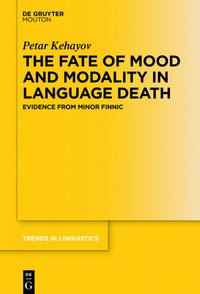
The Fate of Mood and Modality in Language Death
Evidence from Minor Finnic
1st Edition
Published on 24. July 2017
XIX, 385 pages
978-3-11-052408-6 (ISBN)
Description

Research into the "grammar of language death" is often biased toward formal processes (e.g. paradigmatic levelling ). In this study the author changes the perspective and shows that the relative susceptibility of linguistic elements to loss, change and innovation in language death circumstances can be dependent on meaning and thus organized along semantic notions rather than along structure.
More details
Other editions
Additional editions
E-Book
07/2017
1st Edition
De Gruyter Mouton
€149.95
Available for download
Book
07/2017
1st Edition
De Gruyter Mouton
€149.95
Shipment within 7-9 days
Person
Petar Kehayov , University of Regensburg, Germany.
Content
- Intro
- Acknowledgments
- Table of contents
- Transliteration and transcription conventions
- Abbreviations of languages, dialects and names of settlements (in Russian and in the respective Finnic variety)
- Abbreviations of linguistic notions
- List of figures. List of maps. List of tables
- 1. Introduction
- 2 Language death: current state of the research
- 3. Mood and modality: definitions, semantic values and their organization
- 4. Mood and modality meets language death
- 5. The languages studied
- 6. Methods of inquiry
- 7. Intensity of the language contact and the degree of contraction outside MM-domain
- 8. MM in the receding varieties
- 9. Toward a uniform account of the phenomena observed in the domain of MM
- 10. Conclusions
- Appendices: examples of elicited linguistic data
- Appendix I. Q5: materials from Eastern Seto
- Appendix II. Non-controlled elicitation: materials from Central Lude
- References
- Language index: Finnic varieties
- Subject index
